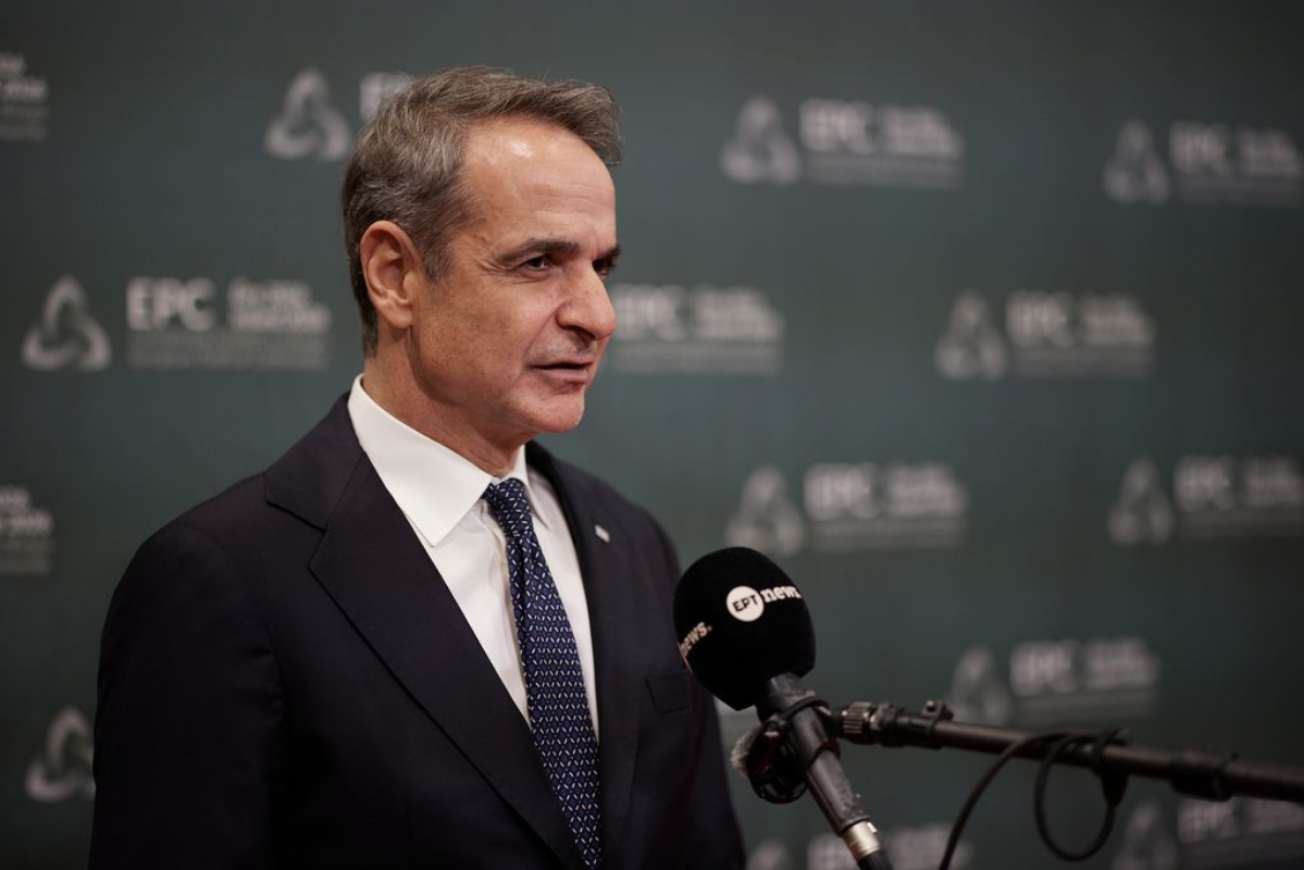
Europe cannot remain on the sidelines of negotiations that will determine its own security architecture. That was the central message delivered by Greek Prime Minister Kyriakos Mitsotakis in Dublin, as European leaders gathered for the ninth summit of the European Political Community.
Speaking ahead of the discussions, Mitsotakis outlined two priorities: ensuring meaningful European participation in negotiations over a future peace settlement in Ukraine and securing an international commitment to end attacks on commercial vessels.
His intervention reflects a broader geopolitical concern: who will shape Europe’s post-war security order, and how can international trade and energy supplies be protected from the consequences of ongoing conflicts?
For Greece, a country with one of the world’s most significant merchant fleets, the protection of international shipping is not simply a foreign policy issue. It is a matter of economic security and strategic interest.
“There Can Be No Long-Term Peace Agreement Without Europe”
Mitsotakis delivered a clear message on the diplomatic efforts to end the war in Ukraine.
While acknowledging recent progress in discussions, he warned that a sustainable peace settlement could not be negotiated without European involvement.
“There can be no discussion about a long-term peace agreement in Ukraine, nor indeed about Europe’s future security architecture, without Europe being at the negotiating table,” he said.
The statement addresses one of the central questions surrounding the diplomatic process: whether European governments and institutions will play a direct role in shaping an agreement that will profoundly affect their security.
Mitsotakis argued that European institutions should be represented, potentially alongside some of the continent’s most influential countries.
“My personal view has always been that the European institutions should be represented, possibly accompanied by some of the most important European countries,” he explained.
The proposal leaves open the precise composition of a European delegation but establishes a clear principle: Europe’s security cannot be determined without European participation.
For the European Union, the issue extends beyond diplomatic representation. It raises fundamental questions about strategic autonomy, collective defence and the continent’s ability to influence decisions affecting its future.


A Ceasefire Must Come First
The Greek prime minister also emphasized that an immediate priority should be securing a ceasefire in Ukraine.
“The first step should always be to focus on achieving a ceasefire,” Mitsotakis said.
His remarks distinguish between the immediate cessation of hostilities and the much more complex negotiations required to establish a lasting peace.
A ceasefire could create conditions for further diplomatic engagement, but a comprehensive agreement would need to address security guarantees, territorial disputes and the future relationship between Russia, Ukraine and the wider European security system.
Mitsotakis did not present a peace settlement as imminent or guaranteed.
Instead, he identified the cessation of hostilities as the essential starting point for a broader diplomatic process.
Greece Calls for a Global Truce on Attacks Against Merchant Ships
One of the most significant elements of Mitsotakis’s intervention was his proposal for a worldwide cessation of attacks against commercial shipping.
Speaking as the leader of a major maritime nation, he expressed particular concern about developments in the Black Sea.
“As the leader of a maritime country, I am particularly concerned about what is happening in the Black Sea,” he said.
He then referred to an appeal he had made to the United Nations Security Council.
“I have also called on the Security Council for a global truce, a global ceasefire when it comes to attacks against commercial vessels,” Mitsotakis stated.
The proposal goes beyond the immediate circumstances of the war in Ukraine.
It seeks to establish the protection of commercial shipping as a distinct international priority, regardless of the broader military and political disputes involved.
For Greece, the initiative carries particular importance.
Greek-owned shipping plays a major role in transporting energy, commodities and manufactured goods across international markets.
Attacks on merchant vessels can increase insurance premiums, disrupt shipping routes, delay deliveries and create additional costs throughout global supply chains.
These consequences extend far beyond the countries directly involved in military conflicts.
Athens is therefore seeking to place maritime security at the centre of international diplomatic discussions, arguing that the protection of commercial shipping should not have to wait for a comprehensive settlement of every conflict.
The Black Sea and the Middle East: Two Crises, Shared Economic Risks
Mitsotakis also drew attention to the conflict in the Middle East and its wider economic implications.
Although the summit was taking place in Ireland, he warned that developments elsewhere continued to shape Europe’s economic outlook.
“We should not forget that there is another conflict in the Middle East, which has created significant economic uncertainty,” he said.
The connection between the two regions lies in the vulnerability of global trade, energy markets and transportation networks.
In the Black Sea, the continuing war presents risks to maritime activity and commercial transportation.
In the Middle East, regional instability creates uncertainty surrounding energy supplies and critical shipping routes.
Both conflicts have the potential to affect prices, trade flows and economic confidence across Europe.
The Greek prime minister’s argument places these developments within a broader framework of European economic resilience.
Security, in this context, is not limited to military preparedness. It also concerns the uninterrupted movement of goods, reliable energy supplies and the capacity of European economies to withstand external shocks.
Energy Independence: Europe’s Strategic Challenge
Energy security formed another major component of Mitsotakis’s remarks.
The Greek prime minister argued that European countries share a common interest in reducing energy costs and strengthening their domestic capabilities.
“I believe European countries share a common concern about how we can reduce energy costs,” he said.
He linked this objective to the need to reduce dependencies that weaken both economic competitiveness and long-term security.
“How can we develop our own capabilities, reducing dependencies that undermine not only our competitiveness but also our future security?” he asked.
The argument reflects a wider European debate about energy independence and the strategic consequences of relying heavily on external suppliers.
Developing domestic clean energy production, diversifying supply sources and expanding infrastructure are increasingly viewed as essential components of economic security.
For Greece, these priorities intersect with investment in renewable energy, electricity interconnections and the country’s role in regional energy networks.
The central question is how Europe can reduce its exposure to international disruptions while maintaining affordable energy for businesses and households.

From Critical Minerals to Artificial Intelligence
Mitsotakis expanded the discussion beyond conventional energy security.
He identified critical raw materials, space capabilities and artificial intelligence as sectors in which Europe needs to strengthen its own technological and industrial capacity.
“These are all capabilities that Europe needs to develop within the European continent,” he said.
His remarks reflect the increasingly close relationship between technological development, economic competitiveness and geopolitical power.
Access to critical minerals is essential for advanced manufacturing and clean energy technologies.
Space infrastructure supports communications, navigation and security.
Artificial intelligence is becoming central to industrial productivity, scientific research and national capabilities.
Europe’s ability to develop these technologies will influence its position in the international economy and its capacity to respond independently to future crises.
Artificial Intelligence: Opportunities and Risks
The Greek prime minister also welcomed the decision to dedicate a separate European Council discussion to artificial intelligence.
He acknowledged the transformative potential of the technology while warning about the challenges associated with uncontrolled development.
“The opportunities offered by artificial intelligence are significant, but equally significant are the challenges and threats posed by its uncontrolled development,” he said.
The remarks highlight a growing policy dilemma for European governments.
They must encourage innovation and investment while ensuring that technological development remains subject to appropriate safeguards.
For the European Union, this involves balancing competitiveness, security and regulation at a time when other major economies are accelerating their investment in advanced AI systems.
Mitsotakis presented the issue as part of a wider strategic agenda rather than an isolated technological debate.
The Political Significance of the Dublin Intervention
The Greek prime minister’s intervention brought together three interconnected priorities: European participation in peace negotiations, international maritime security and greater economic and technological independence.
The common theme is Europe’s ability to protect its interests in an increasingly uncertain international environment.
For Greece, these issues carry particular significance.
The country is a member of the European Union and NATO, a major maritime power and an economy directly exposed to international energy and trade disruptions.
By linking the protection of merchant vessels with the future European security architecture, Mitsotakis sought to bring a distinctly Greek strategic concern into the wider European discussion.
His proposal for a global maritime truce also introduces a practical question into the diplomatic agenda: whether commercial shipping can be protected through international commitments even while broader conflicts remain unresolved.
The next test will be whether these proposals translate into concrete diplomatic initiatives and coordinated international action.
The message from Dublin was clear: Europe must participate in decisions about its own security, while Greece wants the protection of international shipping to become a central element of the diplomatic response to ongoing conflicts.
Source: pagenews.gr