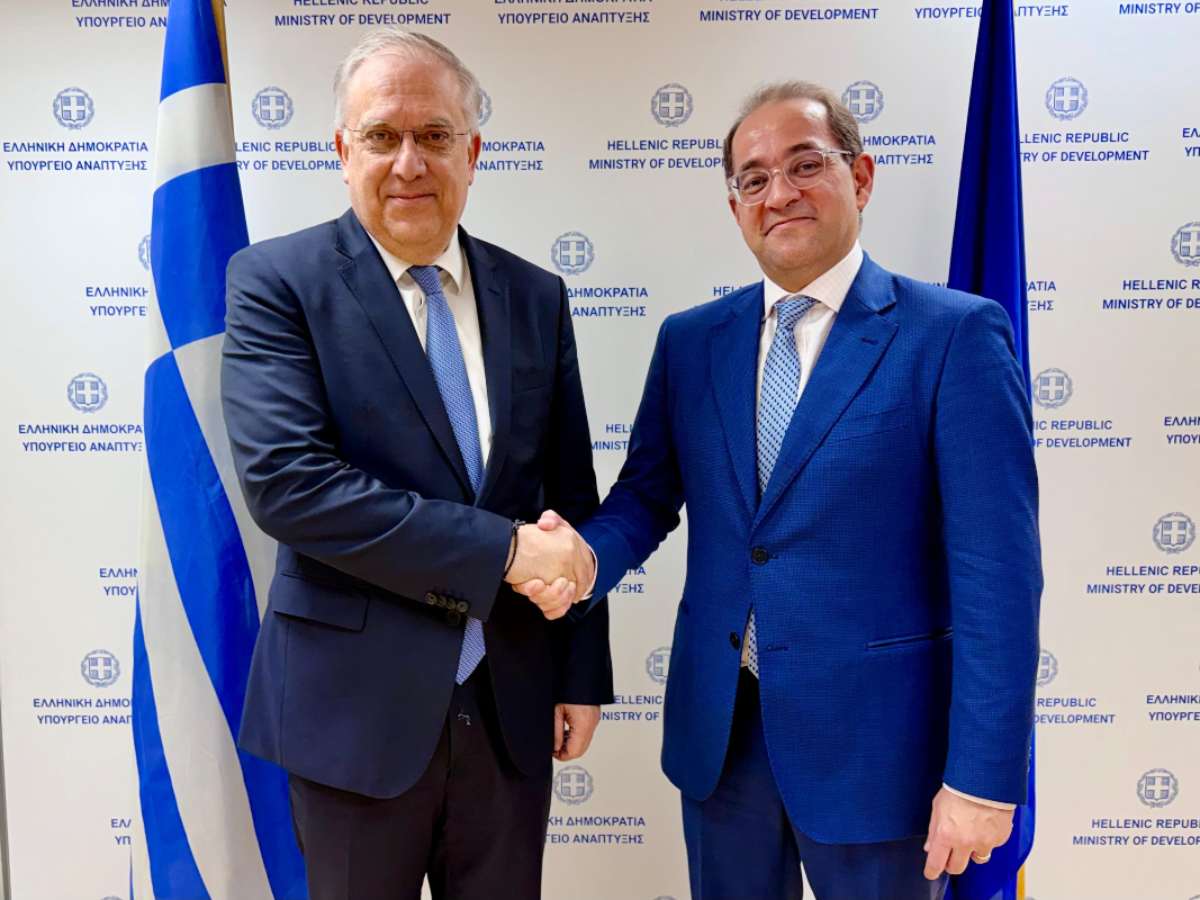
Greece and Egypt are moving to deepen their strategic partnership at a time when the Eastern Mediterranean is facing renewed geopolitical tensions, mounting energy security challenges and growing competition over regional investment.
On Friday, November 20, 2026, Greek Development Minister Takis Theodorikakos met Egyptian Finance Minister Ahmed Kouchouk in Athens to discuss expanding economic cooperation, accelerating investment and advancing major infrastructure projects.
The talks went well beyond conventional bilateral trade.
At the center of the meeting were three issues with potentially significant regional implications: the disputed Turkey–Libya maritime memorandum, the proposed 3 GW Greece–Egypt electricity interconnection known as GREGY, and efforts to strengthen industrial and investment ties between the two countries.
For Athens, the partnership with Cairo represents an opportunity to combine diplomatic cooperation with economic development and energy diversification.
For Egypt, closer ties with Greece offer another route into European markets and the possibility of participating in major cross-border energy and industrial projects.
Theodorikakos Rejects Turkey–Libya Maritime Deal
One of the most politically significant aspects of the meeting concerned the maritime memorandum signed between Turkey and Libya’s Tripoli-based government in 2019.
Theodorikakos welcomed Egypt’s clear position regarding the agreement, which Greece considers invalid and contrary to international law.
According to the Greek Ministry of Development, the minister described the memorandum as null and illegal, lacking any legal foundation.
The Greek government maintains that the agreement disregards maritime rights arising from Greek islands and conflicts with its interpretation of the international law of the sea.
The issue has remained a major source of tension between Athens and Ankara since 2019.
Egypt’s position is particularly important because Cairo is one of Greece’s principal strategic partners in the Eastern Mediterranean.
In August 2020, Greece and Egypt signed an agreement partially delimiting their exclusive economic zones, strengthening their bilateral framework for maritime cooperation.
That agreement also demonstrated the existence of competing approaches to maritime boundaries in the region.
Theodorikakos’s remarks therefore carried a clear diplomatic message: Athens regards its cooperation with Cairo as an important pillar of regional stability and the protection of maritime rights under international law.
The meeting did not, however, announce any new legal or operational measure against the Turkey–Libya memorandum.
International Law and Stability in the Eastern Mediterranean
Beyond the maritime dispute, Theodorikakos emphasized the shared commitment of Greece and Egypt to international law, regional security and peaceful cooperation.
The Eastern Mediterranean has become increasingly important to European energy security, international shipping and regional trade.
It is also an area where competing maritime claims and broader geopolitical tensions create uncertainty for long-term investment.
Greece and Egypt have sought to establish a framework of cooperation based on diplomatic engagement, economic ties and infrastructure development.
The two countries regard stability as essential to attracting capital and implementing major projects.
Their partnership covers more than energy.
It includes transport networks, industrial cooperation, commercial exchanges and opportunities for research and innovation.
The latest ministerial meeting reinforced the ambition to translate these strategic relationships into tangible economic results.


GREGY: The 3 GW Electricity Link That Could Reshape Regional Energy Flows
A central focus of the discussions was the proposed GREGY electricity interconnector, designed to connect Egypt and Greece through a submarine power cable.
The project has a planned capacity of 3 gigawatts, equivalent to 3,000 megawatts.
Its strategic objective is to enable electricity generated in Egypt to reach Greece and potentially other European markets through the interconnected European power system.
The project is particularly significant because of Egypt’s potential to expand renewable electricity generation, including solar and wind power.
For Greece, GREGY could contribute to three major policy objectives: strengthening energy security, diversifying electricity supply and reinforcing the country’s position as a regional energy hub.
Theodorikakos reiterated Greece’s full support for the project and stressed that intensive efforts are underway to advance its implementation.
The Egyptian finance minister also emphasized the interconnector’s importance, highlighting its potential benefits not only for Greece and Egypt but for Europe as a whole.
The project remains under development, and its realization depends on technical studies, regulatory approvals, financing arrangements and construction.
Nevertheless, its planned capacity illustrates the scale of the energy cooperation being pursued.
Greece as Egypt’s Electricity Gateway to Europe
The significance of GREGY extends beyond the direct connection between two national electricity systems.
If completed, the project could establish a new energy corridor linking North Africa with the European Union.
Greece would serve as an entry point for electricity imported from Egypt, potentially allowing supplies to reach additional European markets.
Such a development could strengthen the strategic importance of Greek electricity infrastructure.
It could also create new opportunities for industrial consumers, energy companies and cross-border electricity trading.
For Europe, diversification of energy sources remains a major priority.
Successive energy crises and geopolitical disruptions have reinforced the importance of developing alternative supply routes and strengthening interconnected infrastructure.
A Greece–Egypt electricity link could contribute to these objectives, provided that the project proves technically and commercially viable.
Its ultimate economic impact will depend on construction costs, electricity prices, generation capacity in Egypt and the ability of connected networks to accommodate additional power flows.
From Geopolitics to Business: A Broader Investment Partnership
The meeting also addressed opportunities for cooperation across several sectors of the real economy.
Theodorikakos and Kouchouk discussed expanding bilateral ties in productive investment, manufacturing, industry, trade, energy, transportation, logistics, research and innovation.
Egypt offers a large domestic market, an important geographic position and access to major international shipping routes.
Greece, meanwhile, is seeking to strengthen its role as an investment, production and logistics hub in southeastern Europe.
Closer cooperation could create opportunities for businesses operating in manufacturing, infrastructure development, transport and energy services.
The two ministers also highlighted the longstanding presence of Greek companies in Egypt.
Greek businesses have operated in the Egyptian economy for many years, establishing commercial relationships and experience that could support additional investment.
The objective is to build on those existing ties while encouraging new partnerships between companies and business organizations.
Theodorikakos Promotes Greece’s New Investment Framework
The Greek development minister presented the government’s initiatives aimed at attracting productive investment and strengthening industrial competitiveness.
According to the ministry’s statement, Theodorikakos highlighted Greece’s Development Law, efforts to simplify administrative procedures and measures designed to accelerate investment licensing.
These initiatives are intended to improve the business environment and facilitate projects capable of generating production, employment and export opportunities.
The minister also emphasized Greece’s interest in attracting more Egyptian investment.
This is an important dimension of the bilateral relationship.
Athens is not seeking only to expand the activities of Greek businesses in Egypt.
It also wants Egyptian companies and investors to explore opportunities within the Greek economy.
Potential areas of cooperation include manufacturing, transport infrastructure, energy and other productive sectors.
No specific new investment agreement or financial commitment was announced during the meeting.
Ahmed Kouchouk: Business Cooperation Must Drive the Partnership
Egyptian Finance Minister Ahmed Kouchouk welcomed the strong relationship between the two countries and expressed his government’s willingness to deepen economic cooperation.
According to the official Greek statement, he emphasized opportunities in investment, trade, manufacturing, research and innovation.
Kouchouk placed particular importance on the role of the private sector.
He highlighted the need for business organizations and companies in both countries to develop partnerships and identify opportunities for joint initiatives.
His remarks reflected an understanding that government-level cooperation must ultimately translate into commercial agreements and investment activity.
The Egyptian minister also underscored the significance of the GREGY electricity interconnector.
He presented the project as an initiative with implications extending beyond the two participating countries.
Its development could strengthen energy links between Egypt and the wider European market.
Industry, Logistics and Innovation: The Next Economic Frontier
The economic agenda discussed in Athens reflects the increasing importance of cross-border industrial and logistics networks.
For Greece, closer cooperation with Egypt could create opportunities to expand trade and develop new investment relationships.
For Egyptian businesses, Greece offers access to the European Union’s single market and transport infrastructure connecting southeastern Europe with other regions.
The two countries also see opportunities in research and innovation.
Collaboration between businesses, universities and research organizations could support the development of new technologies and industrial applications.
The challenge will be to translate these areas of interest into specific projects.
That will require coordination between government agencies, financial institutions, investors and private-sector organizations.
The ministerial meeting established political support for further cooperation, but the scale of future economic benefits will depend on implementation.
A Strategic Partnership With Wider European Implications
The Greece–Egypt relationship has developed into an important component of Eastern Mediterranean diplomacy.
The two countries share an interest in regional stability, international trade and energy infrastructure.
Their cooperation also has a European dimension.
Greece is an EU member state, while Egypt is a major regional partner whose economic and energy links with Europe are increasingly important.
Projects such as GREGY could reinforce those connections.
At the same time, closer industrial and investment ties could help diversify economic activity and expand commercial opportunities.
Theodorikakos’s meeting with Kouchouk demonstrated that Athens wants to place economic development at the center of its relationship with Cairo.
The goal is to move beyond diplomatic declarations toward investment projects, productive partnerships and infrastructure capable of delivering long-term benefits.
A Dual Message to Ankara and Brussels
The meeting delivered two distinct messages.
The first was geopolitical.
Greece reiterated its opposition to the Turkey–Libya maritime memorandum and welcomed Egypt’s position, reinforcing the importance Athens attaches to cooperation with Cairo over international law and regional stability.
The second was economic and strategic.
Through the proposed 3 GW GREGY electricity interconnector, Greece and Egypt are seeking to develop a new energy connection between North Africa and Europe.
The discussions on industry, trade, investment and logistics demonstrated that the partnership is intended to extend well beyond electricity infrastructure.
For Theodorikakos, stronger relations with Egypt are closely linked to Greece’s broader objectives of attracting investment, increasing industrial competitiveness and supporting productive growth.
The strategic significance of the Greece–Egypt partnership lies in its ability to combine diplomatic alignment with concrete economic opportunities.
The next challenge will be turning that political commitment into completed infrastructure, new investment agreements and measurable economic results.
Source: pagenews.gr