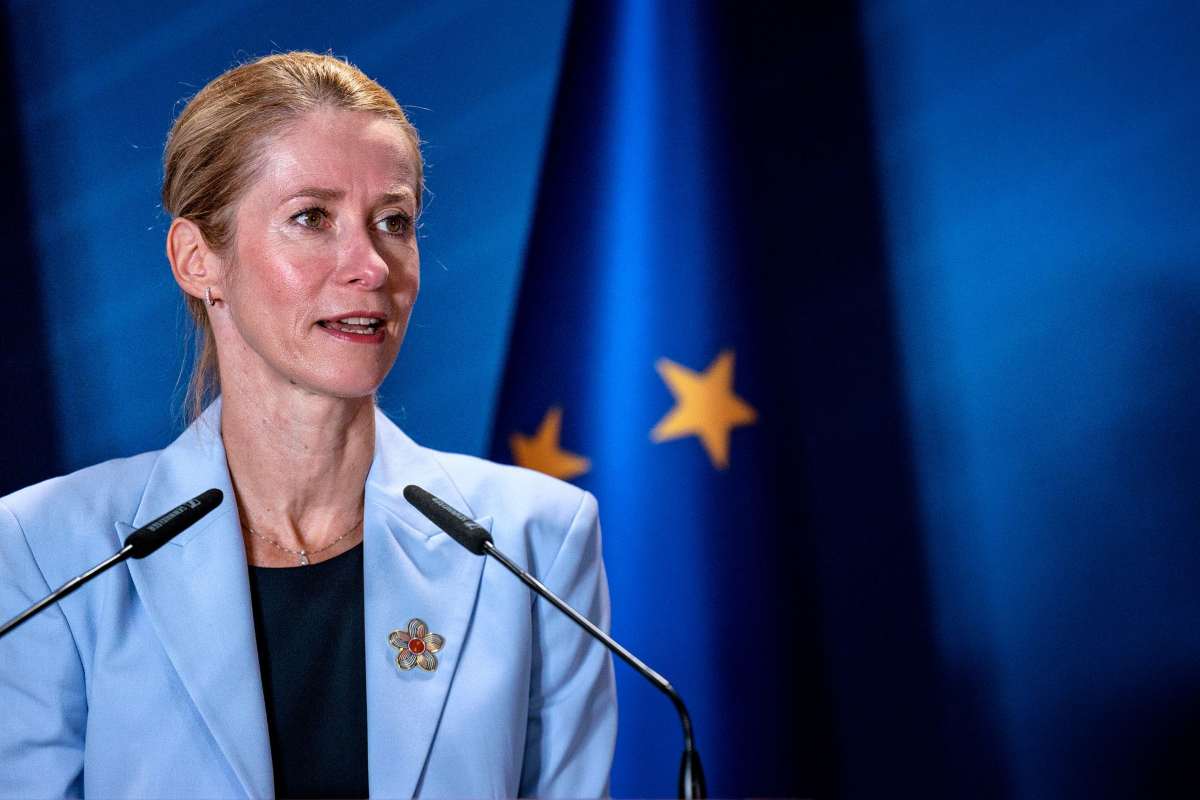
“While Putin was strolling down the red carpet in Shenzhen, Russian bombardments struck Kyiv, damaging several European and non-European embassies.”
With this pointed statement, Kaja Kallas, the European Union’s foreign policy chief, condemned Russia’s latest attack on the Ukrainian capital as Vladimir Putin attended a trilateral summit with US President Donald Trump and Chinese President Xi Jinping.
The contrast was striking.
In China, red carpets, diplomatic handshakes and discussions about a new international order.
In Kyiv, explosions, damaged buildings, a reported civilian death and destruction reaching the diplomatic missions of two European Union member states.
Brussels responded by announcing that it would summon Russia’s diplomatic representative to deliver a formal protest.
The question now confronting the EU is whether diplomatic condemnation is enough when Russian strikes are damaging the embassies of its own member states.


Kallas Condemns Moscow: “Diplomatic Premises Are Protected Under International Law”
The EU’s High Representative for Foreign Affairs and Security Policy used unusually forceful language to denounce the attack.
“Diplomatic premises are protected under international law. Russia’s disregard for it is demonstrated every day,” Kallas said, according to the statement reported following the strikes.
She also pledged that the European Union would continue increasing its support for Ukraine and pressure on Moscow.
However, the announcement was not accompanied by specific new sanctions or other immediate punitive measures.
Summoning a diplomatic representative is an established instrument of international diplomacy. It communicates official condemnation but does not, by itself, impose additional economic or political costs.
The incident therefore raises a question that has repeatedly confronted European leaders throughout the war: what follows the condemnation when Russia continues its military operations despite successive rounds of sanctions and diplomatic protests?
Diplomatic missions enjoy special protection under the Vienna Convention on Diplomatic Relations.
Damage to an embassy is a serious incident requiring investigation, although the fact that a diplomatic building was hit does not automatically establish that it was deliberately targeted.
Austria: Embassy Damaged, Vehicles Hit – Chancellor Calls Strikes “Absolutely Unacceptable”
The Austrian embassy in Kyiv suffered material damage during the Russian attack.
Vehicles in the surrounding area were also damaged.
Austrian Chancellor Christian Stocker said he was shocked by the incident, describing the strikes as “absolutely unacceptable.”
He expressed relief that no members of the Austrian diplomatic mission had been injured.
The incident carries particular significance for Vienna.
Austria maintains a policy of military neutrality while participating in the European Union’s common response to Russia’s invasion of Ukraine.
The damage to its diplomatic premises demonstrates how the consequences of Russian attacks extend beyond Ukrainian government facilities and military infrastructure.
Foreign diplomatic missions operating in the capital also face the risks created by the continuing bombardment.
Netherlands: Projectile Lands Behind Embassy – Russian Ambassador Summoned
The Dutch embassy was also damaged during the strikes.
Dutch Foreign Minister Tom Berendsen said a projectile landed behind the diplomatic mission, causing material damage.
No embassy personnel were reported injured.
Dutch authorities launched an investigation into the precise circumstances of the incident.
The Hague subsequently summoned the Russian ambassador to register its formal protest.
The Netherlands has been among the European countries providing substantial political and military support to Ukraine.
Damage to its diplomatic mission adds another source of tension to relations with Moscow.
For both Austria and the Netherlands, the immediate priority is establishing what happened and ensuring the safety of their diplomatic personnel.
One Person Killed as Historic Cathedral Suffers Damage
The attack also caused civilian casualties and damage elsewhere in Kyiv.
According to reports from the Ukrainian capital, at least one person was killed, while a historic cathedral sustained damage.
The strikes form part of Russia’s continuing campaign of aerial attacks against Ukraine, which has repeatedly affected residential neighbourhoods, energy infrastructure and other civilian facilities.
Ukrainian authorities have consistently accused Moscow of carrying out attacks that endanger civilians and damage protected infrastructure.
Russia generally maintains that its military operations target facilities connected to Ukraine’s war effort.
Whether an individual strike violates international humanitarian law depends on the circumstances, including the nature of the target, the precautions taken and compliance with the principles of distinction and proportionality.
The damage to diplomatic buildings adds another dimension to the investigation.


Putin in Shenzhen: Handshakes With Trump and Xi as Kyiv Comes Under Fire
While the destruction unfolded in Kyiv, Vladimir Putin was attending a high-profile trilateral summit in China alongside Donald Trump and Xi Jinping.
The meeting attracted international attention because of its potential implications for relations between the three major powers.
Trump appeared highly satisfied with the talks, reportedly rating the summit “12 out of 10” and describing the relationships established as “fantastic.”
Yet the summit ended without an announced agreement to bring the war in Ukraine to an end.
The continuation of Russian strikes during the diplomatic gathering exposed the gap between the international negotiations and the military reality on the ground.
Putin’s presence at the table of the world’s major powers did not coincide with a suspension of Russian attacks on Ukraine.
That was precisely the contradiction Kallas chose to highlight.
Her criticism connected the diplomatic reception given to the Russian president with the bombardment taking place in the Ukrainian capital.
For European governments, the simultaneous developments raised questions about whether high-level engagement with Moscow could produce meaningful progress towards ending the conflict.
Merz Warns Against a New Yalta: Europe Must Not Be Excluded
The Shenzhen summit also intensified concerns in European capitals about the continent’s role in future negotiations.
In Berlin, where the so-called Coalition of the Willing convened, German Chancellor Friedrich Merz warned against a diplomatic settlement resembling the 1945 Yalta conference.
The concern is that major powers could attempt to determine Europe’s security arrangements without meaningful participation from European governments and Ukraine itself.
For Berlin, a sustainable peace settlement cannot depend exclusively on understandings reached between Washington, Moscow and Beijing.
European leaders want a direct role in shaping security guarantees and the terms of any future agreement.
The damage to Austrian and Dutch diplomatic missions in Kyiv gave added urgency to those concerns.
The war’s consequences are not confined to Ukraine’s territory or its armed forces.
They affect the security interests, diplomatic operations and political responsibilities of European Union member states.
Brussels Protests – But What Comes Next?
Kallas’s condemnation leaves little doubt about the European Union’s official position.
Brussels considers Russia responsible for the continuing aggression against Ukraine and has pledged to maintain pressure on Moscow.
The EU already operates an extensive sanctions regime targeting Russia, while its member states have provided financial, humanitarian and military assistance to Kyiv.
However, adopting additional restrictive measures generally requires agreement among member states.
A diplomatic protest can be delivered quickly, but its practical consequences depend on whether it is followed by further decisions.
The damage to the Austrian and Dutch embassies also creates an immediate security issue.
European governments must assess whether additional protective arrangements are needed for their diplomatic missions in Kyiv.
The question is therefore not simply whether Brussels condemns the latest attack.
It is whether the incident will lead to new diplomatic, economic or security measures beyond the formal summoning of Russia’s representative.


The Red Carpet Did Not Stop the Bombs
The images from Shenzhen and Kyiv presented two sharply different realities.
In China, the leaders of three major powers discussed international relations and the prospects for diplomatic cooperation.
In Ukraine, civilians faced another day of Russian attacks.
Kaja Kallas condemned the strikes and accused Moscow of disregarding international law.
Austria and the Netherlands protested the damage to their diplomatic missions.
The European Union announced that it would summon Russia’s diplomatic representative.
Yet the broader question remains unresolved.
When Russian bombardments damage European embassies, will Brussels respond with another diplomatic protest, or will the incident produce additional measures?
For now, the latest developments underline a central contradiction of the war.
High-level diplomacy continues, but so do the hostilities.
Putin walked the red carpet in China. Kyiv was left counting the damage from Russian bombs.
Source: pagenews.gr