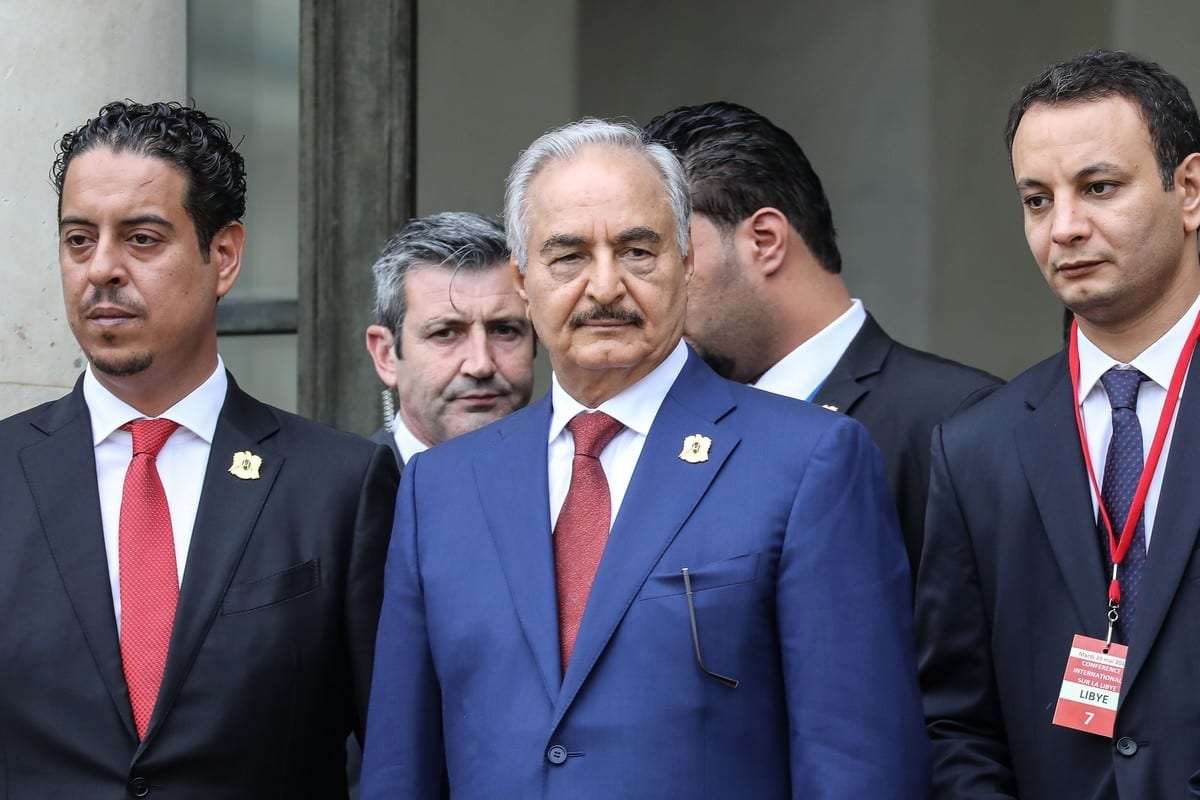
Six years ago, Turkey played a decisive military role in defeating Khalifa Haftar’s offensive against Tripoli. Today, eastern Libya’s military commander is in Ankara at the invitation of Turkish President Recep Tayyip Erdogan.
Haftar’s arrival on Tuesday, November 24, confirmed to Reuters by a source within his military command, marks a significant turning point in relations between Turkey and eastern Libya.
The visit comes just two weeks before Erdogan is scheduled to travel to Libya for the first time in 15 years, as Washington intensifies efforts to reunify the country’s rival administrations.
For Greece, the rapprochement raises important questions about the future of the Turkish-Libyan maritime agreement and the balance of power in the Eastern Mediterranean.


From Battlefield Enemies to Negotiating Partners
During the 2019–2020 Libyan conflict, Turkey and Haftar stood on opposing sides.
Ankara’s military intervention in support of the Tripoli-based government played a decisive role in repelling Haftar’s offensive against the Libyan capital.
It was during this period, in November 2019, that Turkey signed its controversial maritime delimitation agreement with Tripoli, triggering strong objections from Greece and Egypt.
Relations between Ankara and eastern Libya, however, have steadily improved in recent years.
Turkish officials have made increasingly frequent visits to Benghazi, Haftar’s de facto capital, while Turkish companies have expanded their investments in construction, infrastructure and other sectors across eastern Libya.
Erdogan’s invitation to Haftar represents another significant step in the rapprochement between the former adversaries.
Erdogan Is No Longer Betting Exclusively on Tripoli
Turkey’s evolving approach comes at a particularly sensitive moment for Libya’s political future.
Ankara maintains its longstanding relationship with the Tripoli-based administration while simultaneously cultivating ties with eastern Libya, reducing its dependence on a single political faction.
On December 8–9, Erdogan is scheduled to attend the fourth Turkey-Africa Partnership Summit in Tripoli, marking his first visit to Libya in 15 years.
According to Al-Monitor, the Turkish president is also expected to meet representatives of Libya’s rival administrations on the sidelines of the summit.
The sequence of diplomatic engagements — Haftar in Ankara, followed by Erdogan in Tripoli — illustrates Turkey’s efforts to maintain influence across Libya’s political divide.


Washington’s Reunification Plan Faces Resistance
Turkey’s diplomatic outreach coincides with a US-backed initiative to overcome Libya’s longstanding institutional fragmentation.
The proposed arrangement could see representatives of eastern Libya secure senior government positions in Tripoli, a prospect that has encountered resistance from powerful western Libyan factions.
According to Al-Monitor, Washington has warned that it could take measures against those obstructing the reunification process.
The negotiations extend beyond the distribution of political offices. Control over state institutions, oil revenues, security structures and public expenditure remains central to Libya’s competing power networks.
Turkey’s engagement with both administrations could help preserve its economic and diplomatic interests regardless of the eventual political settlement.
The Big Question for Athens: What Happens to the Maritime Deal?
For Greece, Erdogan’s rapprochement with Haftar carries particular geopolitical significance.
The 2019 Turkish-Libyan maritime memorandum was originally associated with Ankara’s relationship with the Tripoli-based government. Turkey’s expanding engagement with eastern Libya introduces an additional dimension to the dispute.
Reports by Agenzia Nova and IntelliNews indicated that eastern Libya’s parliament approved the maritime agreement on October 20, 2026, a development that, if confirmed, would represent a significant political shift.
Such approval, however, would not in itself establish the agreement’s international legal validity.
Athens maintains that the memorandum violates international maritime law and disregards the maritime entitlements of Greek islands, including Crete.
Ankara rejects that interpretation and continues to defend its maritime claims and energy cooperation with Libya.
Egypt’s recent intervention at the United Nations challenging the Turkish-Libyan agreement has added further diplomatic pressure to the dispute.
There is currently no confirmed information that Haftar’s visit to Ankara has produced a new agreement concerning maritime boundaries.


Oil, Reconstruction and the Eastern Mediterranean
Beyond diplomacy, Turkey’s expanding presence in eastern Libya has a substantial economic dimension.
Reconstruction projects, infrastructure contracts, construction investments and potential energy partnerships offer significant opportunities for Turkish businesses.
Closer economic relations with Benghazi could allow Ankara to consolidate its commercial presence irrespective of the outcome of Libya’s reunification negotiations.
Libya’s substantial oil reserves and strategic position along the southern Mediterranean coast also make the country central to broader regional competition over energy resources, maritime boundaries and commercial routes.
Two Rival Administrations, One Expanding Turkish Strategy
Haftar’s visit to Ankara and Erdogan’s forthcoming trip to Tripoli highlight the extent to which Turkey’s Libya policy has evolved since 2019.
Having once intervened militarily on behalf of one side, Ankara is now building political and economic relationships with both.
For Washington, the immediate challenge is overcoming resistance to political reunification.
For Turkey, the opportunity lies in preserving its influence across a potentially reconfigured Libyan political landscape.
For Greece, the central question is whether closer Turkish ties with eastern Libya will translate into broader Libyan political support for Ankara’s maritime claims.
The meetings in Ankara and Tripoli could provide important indications of how these competing interests will shape the next chapter of Eastern Mediterranean geopolitics.
Source: pagenews.gr