Turkey Sells Gulf Security Under NATO’s Shield — The Mecca Pact’s Strategic Gamble
 ΧΡΟΝΟΣ ΑΝΑΓΝΩΣΗΣ 5 '
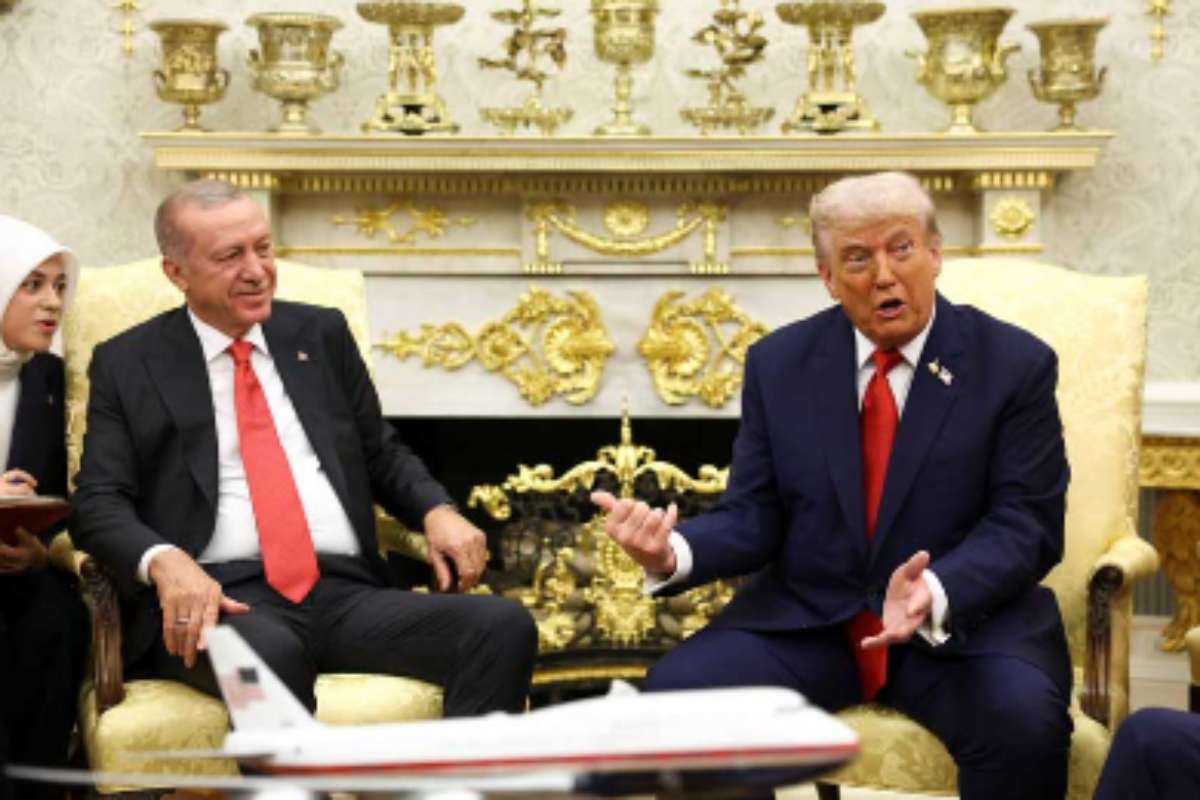
Πηγή Φωτογραφίας: U.S. President Donald Trump speaks during a meeting with Turkey's President Recep Tayyip Erdogan in the Oval Office at the White House in Washington, D.C., U.S., September 25, 2025. REUTERS/Kevin Lamarque



Turkey relies on NATO’s missile defences while assuming new security commitments towards Saudi Arabia and Pakistan. That combination lies at the heart of its strategy: remaining an essential Western ally while preserving freedom of action in the Middle East.
On Thursday, November 5, Turkey’s parliament completed ratification of the Mecca Joint Defence Agreement, approving it by 279 votes to 119, according to the Associated Press.
Signed on August 7, the agreement treats an attack against one member as an attack against all three. Translating that commitment into military action, however, still depends on political decisions and national procedures.
NATO protection underpins Turkish autonomy
In March, NATO air-defence assets intercepted missiles launched from Iran towards Turkey. The alliance described the first interception as a practical demonstration of its ability to protect its members.
Subsequent Turkish Defence Ministry announcements confirmed the continuing importance of allied missile-defence coverage.
Those incidents reveal an important limit to Turkish strategic autonomy: Ankara can broaden its partnerships while continuing to derive critical security benefits from the West.
The geopolitical interpretation is that this protection facilitates Turkey’s regional ambitions. Ankara is adding new roles to the position it already holds within the alliance.
From a bilateral partnership to a three-country pact
The Mecca agreement expands the mutual-defence framework established by Saudi Arabia and Pakistan in September 2025.
The Iran war and the exposure of Gulf states to attacks intensified the search for additional security partners. For Riyadh, Turkish participation offers more options in equipment, training and military cooperation.
Ankara has maintained that the arrangement neither replaces existing alliances nor targets a particular country. Political and military coordination mechanisms have also been announced.
The result is another layer of cooperation in a region where even close American partnerships cannot guarantee that Washington will act on every local priority.
Riyadh wants more security options
The Arab Center Washington DC describes Saudi Arabia’s approach as diversification without replacing its American relationship.
US technology, support and security cooperation remain central to the kingdom. The agreement with Ankara and Islamabad broadens Saudi options without providing a ready substitute for Washington.
This also explains why the initiative can be compatible with American demands for partners to assume greater regional responsibilities.
The potential difference lies in expectations. Washington may see burden-sharing; Turkey seeks influence, access and opportunities to negotiate the terms of its contribution.
Defence industry offers a substantial prize
The mutual-defence clause dominates the headlines. Joint exercises, intelligence sharing, technical support and co-production may prove more consequential in practice.
For Turkey, the Saudi market offers capital and demand for defence technology. For Riyadh, cooperation can support efforts to develop domestic production capabilities.
Pakistan contributes military experience and its own established relationship with Saudi Arabia.
These connections can outlast a political declaration. They create continuing requirements for maintenance, training, supplies and coordination.
The commitments have limits
Ratification prompted questions in Turkey’s parliament about possible involvement in regional conflicts.
Lawmakers sought clarification on the implications of Saudi Arabia’s confrontation with the Houthis and tensions between Pakistan and India.
According to Turkish Minute’s reporting, the form and scale of assistance would be determined through consultations and assessments of each country’s capabilities. Sending Turkish forces into combat requires separate parliamentary authorisation.
The agreement should therefore not be interpreted as automatically bringing Turkey into every conflict involving its partners. Equally, nuclear-armed Pakistan’s participation does not, by itself, establish an automatic nuclear guarantee for the other members.
Becoming indispensable
The arrangement’s strategic value for Ankara lies in becoming useful to several centres of power simultaneously.
Other middle powers can pursue comparable networks of partnerships. Turkey’s combination of NATO membership, geography, military capabilities and defence production is harder to replicate.
The decisive test will come when a real crisis requires the three governments to agree on what assistance they will provide—and at what cost.
For now, Ankara seeks to increase the value of its commitments while retaining control over their activation. As Fuat Oktay, chairman of the Turkish parliament’s Foreign Affairs Committee, put it, Turkey:
“Will not be drawn into an uncontrolled process against its will.”
Source: pagenews.gr
Διαβάστε όλες τις τελευταίες Ειδήσεις από την Ελλάδα και τον Κόσμο