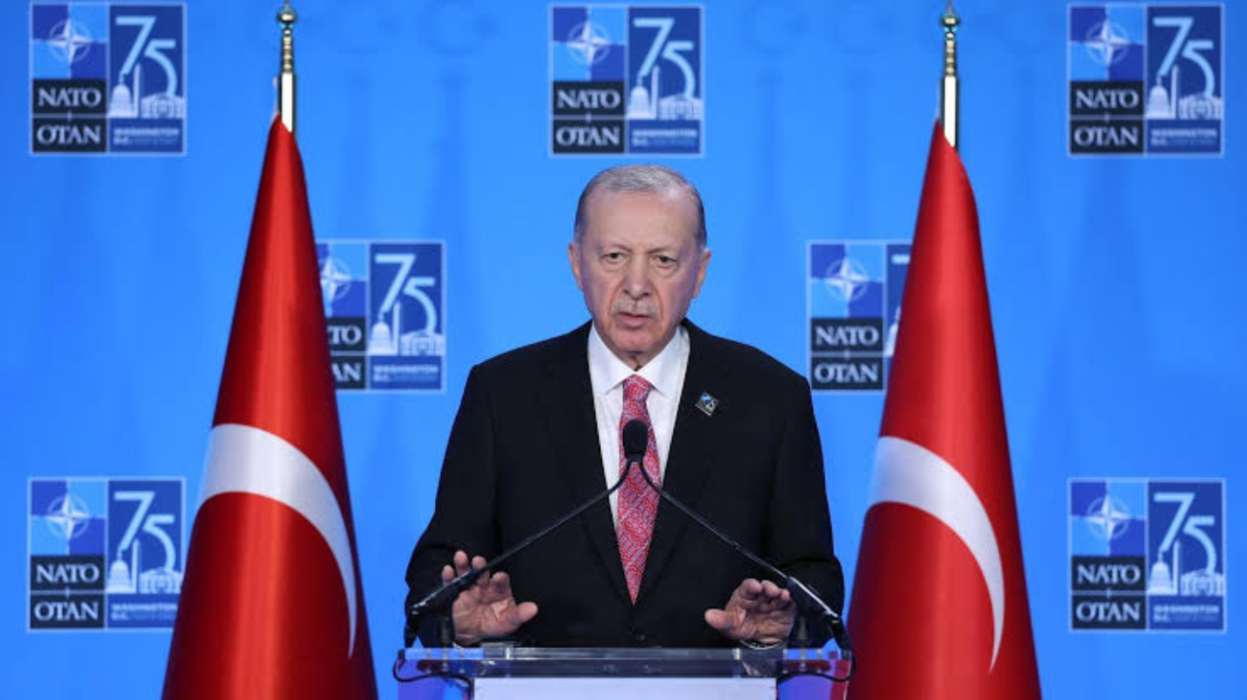
Just days before Turkey welcomes NATO leaders, President Recep Tayyip Erdoğan’s government has come under renewed scrutiny following a fresh wave of security operations and restrictions on political activity.
Turkish authorities have carried out hundreds of arrests in what officials describe as counterterrorism operations while tightening security measures and limiting public demonstrations ahead of the summit. The government maintains that the operations are aimed exclusively at combating terrorist organizations. Opposition parties and human rights groups, however, argue that the measures risk extending beyond legitimate security concerns to include political opponents and civil society actors.
Turkey’s Strategic Shield Within NATO
According to European policy analysts, hosting the NATO summit strengthens Erdoğan’s diplomatic leverage at a critical geopolitical moment.
Turkey remains one of the Alliance’s most indispensable members. It controls access to the Black Sea through the Turkish Straits, possesses NATO’s second-largest military, plays a pivotal role in the Middle East and the Black Sea region, and continues to serve as a key partner on migration management and regional diplomacy.
This strategic importance makes it increasingly difficult for both Brussels and Washington to publicly confront Ankara over democratic backsliding while seeking to preserve Alliance unity in the face of growing security challenges from Russia and instability across the Middle East.
Europe’s Enduring Dilemma
The latest developments revive one of the European Union’s most persistent foreign policy challenges.
On one hand, EU institutions have repeatedly expressed concerns over judicial independence, media freedom, political pluralism, and the broader state of democracy in Turkey.
On the other, Ankara has become increasingly indispensable for:
- NATO’s collective defense;
- Black Sea security;
- migration management;
- European energy security;
- and stability across the Eastern Mediterranean.
This dual reality has produced a familiar paradox in EU policy: sustained criticism of Turkey’s domestic governance alongside continued strategic cooperation.


The Optics Ahead of the Summit
Reports that several independent Turkish media organizations faced difficulties obtaining accreditation to cover the NATO summit have further fueled concerns over press freedom.
Journalist associations argue that excluding independent media from high-profile international events risks undermining the democratic image Turkey seeks to project as host of one of the world’s most important security gatherings.
For many European diplomats, the timing is particularly sensitive. NATO continues to define itself as an alliance founded on democratic values, yet one of its key members is once again facing questions over civil liberties at home.
Erdoğan’s Geopolitical Calculation
Political observers argue that Erdoğan is seeking to capitalize on Turkey’s growing geopolitical relevance.
Russia’s war in Ukraine, instability in the Middle East, competition over Eastern Mediterranean energy routes, and renewed attention to European defense have significantly increased Turkey’s strategic value to Western partners.
This stronger geopolitical position provides Ankara with greater room to maneuver against European criticism without fundamentally jeopardizing its central role within NATO.
More Than a Turkish Debate
The controversy extends beyond Turkey itself.
For the European Union, it represents another test of whether its geopolitical ambitions can remain compatible with its commitment to democratic norms and the rule of law.
As security concerns increasingly dominate the European agenda, Brussels faces mounting pressure to balance strategic pragmatism with the values that underpin the Union’s foreign policy.
The Bigger Picture
The NATO summit will officially focus on defense spending, deterrence against Russia, and strengthening Allied capabilities.
Yet beneath the security agenda lies a broader political question: can Western institutions continue separating geopolitical necessity from democratic accountability?
For now, Turkey appears well positioned to leverage its strategic importance. Whether Europe chooses to place greater emphasis on democratic standards—or continues prioritizing geopolitical stability—may shape EU–Turkey relations well beyond this year’s NATO summit.
Source: pagenews.gr