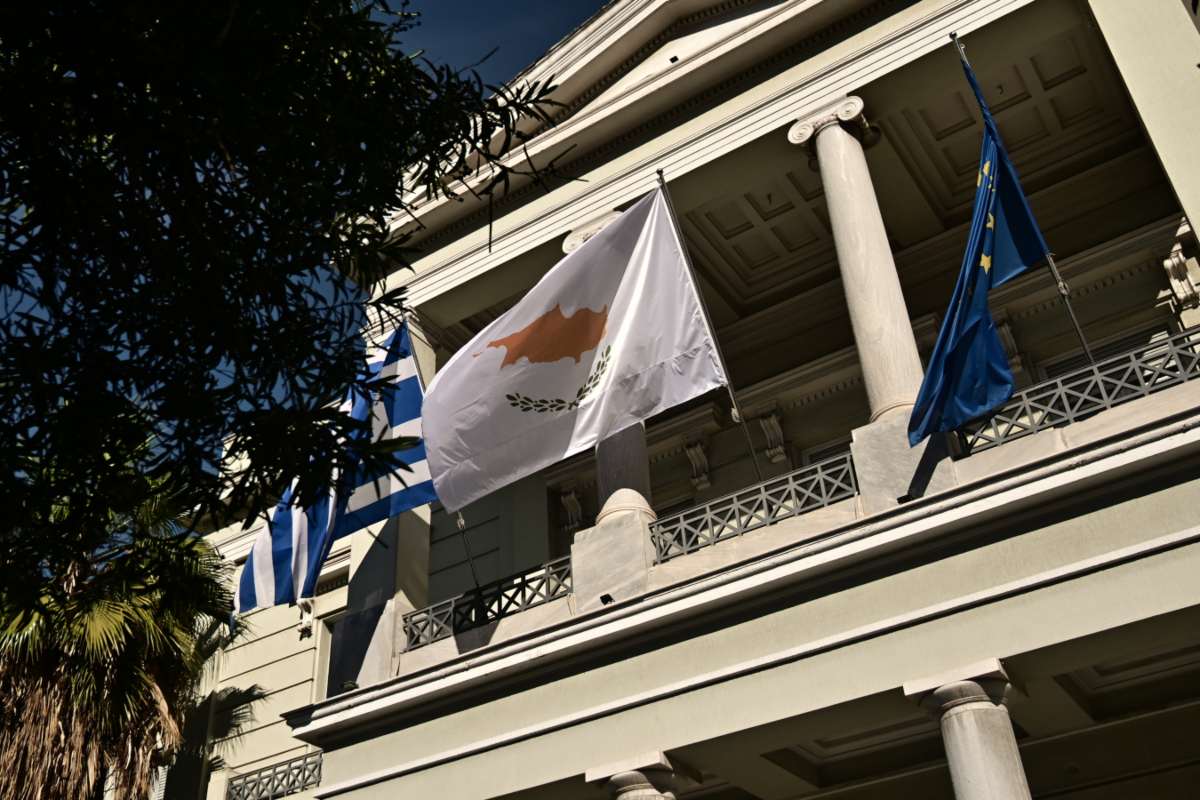
Cyprus Remains One of Europe’s Last Unresolved Geopolitical Conflicts
More than half a century after the Turkish military intervention of July 20, 1974, the Cyprus issue continues to occupy a central place in Greece’s foreign policy.
Marking the 52nd anniversary of the invasion, Greece’s Ministry of Foreign Affairs issued a strongly worded statement emphasizing that Cyprus is not merely a historical dispute but an ongoing international issue involving the occupation of the territory of a sovereign member state of both the European Union and the United Nations.
“The Cyprus issue remains, to this day, an international matter of the illegal invasion and occupation of the territory of a member state of the European Union and the United Nations,” the Ministry stated, reaffirming Athens’ long-standing diplomatic position.
The message underscores Greece’s broader effort to keep Cyprus high on the international agenda at a time when global attention is increasingly focused on conflicts in Ukraine and the Middle East.
Remembering the Past While Defining Future Policy
The statement begins by paying tribute to those who defended Cyprus during the events of 1974.
“Greece bows in memory of those who fell and expresses its respect and gratitude to all those who courageously and selflessly defended the island,” the Ministry declared.
It also recalls the lasting humanitarian consequences of the invasion, including the displacement of thousands of Cypriots, the continuing tragedy of the missing persons and the suffering of those who remained trapped in occupied areas.
For Athens, these unresolved humanitarian issues remain a powerful reminder that the Cyprus question extends far beyond diplomacy and continues to carry profound historical and human dimensions.


A Message to the International Community
Beyond its commemorative significance, the statement carries a broader diplomatic message.
Greece seeks to remind its international partners that the division of Cyprus should not be viewed as a “frozen conflict” but as an ongoing violation of the United Nations Charter, international law and the sovereignty of a European Union member state.
At a time when European governments consistently emphasize respect for territorial integrity and international legality, Athens argues that Cyprus represents an equally important test of the international community’s commitment to those same principles.
By framing the issue in these terms, Greece aims to reinforce the argument that Cyprus is not solely a Greek-Turkish dispute but a matter concerning the credibility of the international rules-based order.
No Change in the Agreed Framework
The Ministry of Foreign Affairs also reaffirmed Greece’s unwavering commitment to the internationally agreed framework for resolving the Cyprus question.
“In full coordination with the Republic of Cyprus, Greece remains committed to achieving a comprehensive, mutually acceptable settlement based on a bi-zonal, bi-communal federation, with political equality between Greek Cypriots and Turkish Cypriots, a single international legal personality, one sovereignty and one citizenship,” the statement said.
This position directly rejects Turkey’s continued advocacy of a two-state solution, a proposal that remains unacceptable to Greece, the Republic of Cyprus, the European Union and the United Nations.
Athens continues to argue that any sustainable settlement must remain fully consistent with UN Security Council resolutions, the EU acquis and the fundamental principles of European law.


Supporting the United Nations Initiative
The Greek government also expressed support for the ongoing diplomatic efforts led by UN Secretary-General António Guterres, emphasizing its readiness to contribute constructively to renewed negotiations.
“Greece remains ready and will continue to contribute constructively to the next steps in the ongoing efforts of the UN Secretary-General aimed at restarting negotiations within the agreed framework under United Nations auspices,” the Ministry stated.
This reflects Athens’ long-standing preference for multilateral diplomacy and internationally mediated negotiations rather than unilateral initiatives capable of altering the established parameters of the peace process.
Cyprus in the New Eastern Mediterranean Security Architecture
The Cyprus issue has acquired renewed strategic significance as the Eastern Mediterranean emerges as one of Europe’s most sensitive geopolitical regions.
Energy corridors, maritime security, regional defense cooperation and increasing competition among global and regional powers have transformed the island’s importance well beyond the traditional framework of Greek-Turkish relations.
Against this backdrop, Greece argues that resolving the Cyprus problem has become increasingly relevant not only for regional stability but also for the broader security architecture of the European Union.
Athens continues to present Cyprus as a cornerstone of stability in the Eastern Mediterranean, linking its future directly to Europe’s security interests and the defense of international law.
Cyprus as a Test of International Credibility
The conclusion of the Ministry’s statement encapsulates Greece’s enduring strategic objective.
“Resolving the Cyprus issue, reunifying the island and ending the occupation of the territory of a European Union member state remain among Greece’s highest foreign policy priorities.”
Beyond commemorating a historic tragedy, the statement serves as a broader geopolitical message directed both at Turkey and at Greece’s international partners. As Europe confronts an increasingly volatile security environment, Athens argues that Cyprus cannot be treated as an unresolved issue of the past. Instead, it remains a defining test of the international community’s willingness to uphold the principles of sovereignty, territorial integrity and the peaceful resolution of disputes.
For Greece, the future of Cyprus is therefore not only a national priority but also a measure of the credibility of the international legal order itself.
Source: pagenews.gr