Cyprus Arms Its EEZ: €150 Million Israeli Warship Deal Sends Strategic Message to Ankara
 ΧΡΟΝΟΣ ΑΝΑΓΝΩΣΗΣ 13 '
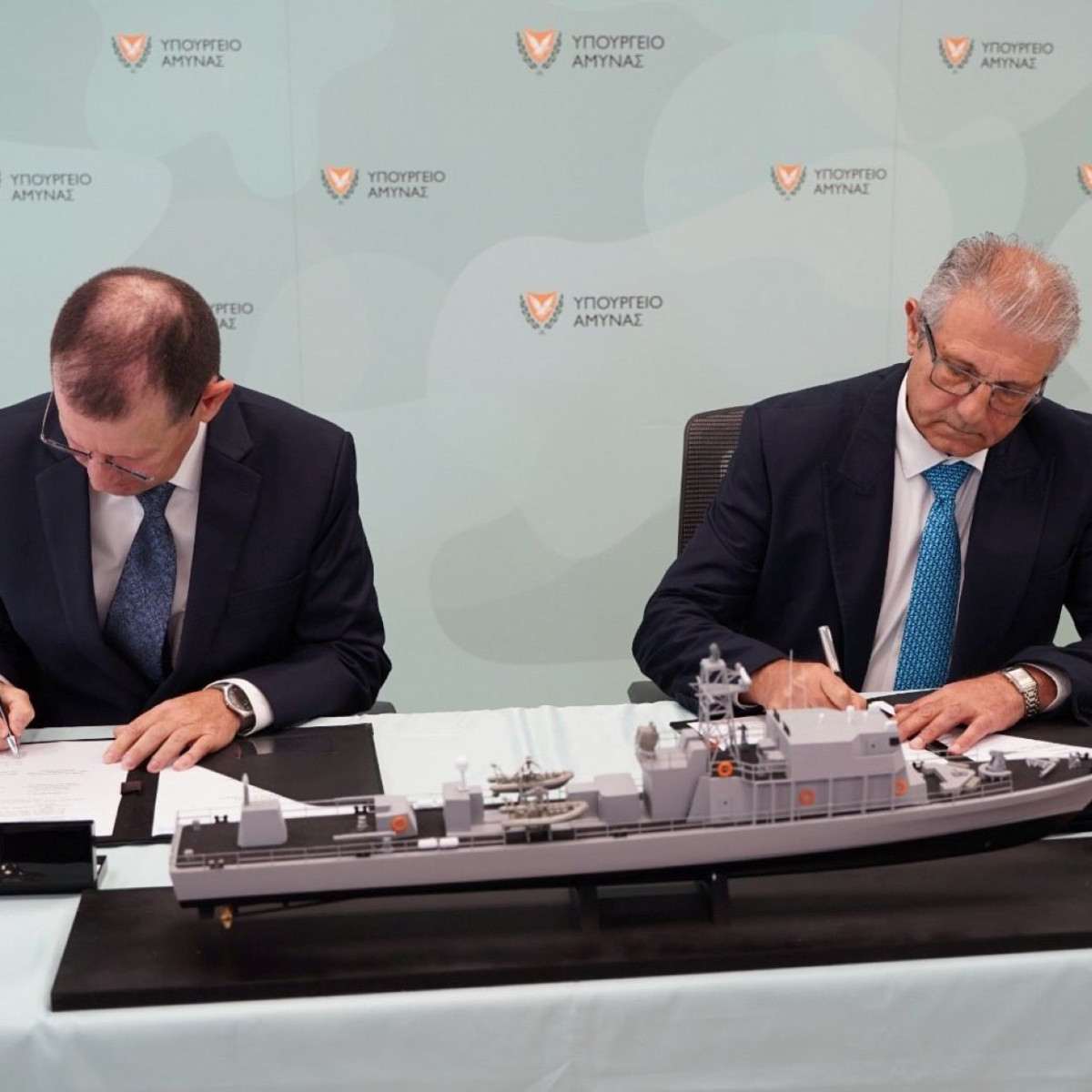
Πηγή Φωτογραφίας: AP Photo//Cyprus Arms Its EEZ: €150 Million Israeli Warship Deal Sends Strategic Message to Ankara



Cyprus is taking another significant step towards strengthening its maritime security, deepening its strategic defence relationship with Israel through the acquisition of a second offshore patrol vessel (OPV).
The agreement, signed on October 26, 2026, involves the construction and delivery of a new vessel by Israel Shipyards, equipped with advanced naval systems supplied by Rafael Advanced Defense Systems.
The deal also provides for the modernisation of the Republic of Cyprus Navy’s existing Israeli-built patrol vessel, P61 Archiploiarchos Andreas Ioannides.
According to reports in the Israeli and Cypriot media, the overall procurement package is valued at approximately €150 million, although the precise contract value has not been confirmed in the official defence ministry announcement.
The acquisition comes at a strategically important moment.
Cyprus is preparing to advance the development of offshore natural gas resources, while the Eastern Mediterranean remains an arena of competing maritime claims, energy ambitions and shifting regional alliances.
For Nicosia, the investment is about more than purchasing another naval platform.
It reflects a broader effort to protect its maritime interests, reinforce its ability to monitor offshore infrastructure and establish a more credible security presence across its exclusive economic zone.
A new chapter in Cyprus–Israel defence cooperation
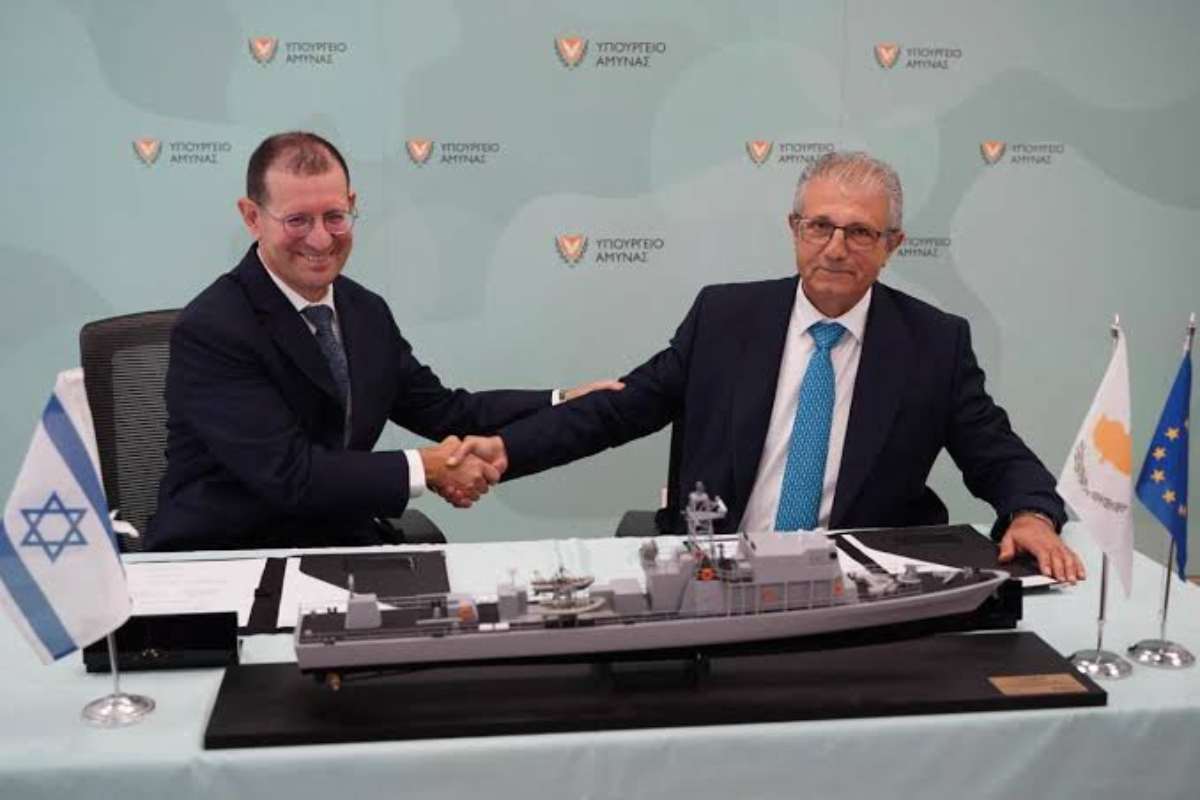
The agreement was signed in Cyprus by senior representatives of the two countries’ defence establishments.
Israel was represented by Amir Baram, director-general of the Israeli Ministry of Defense, while Cyprus was represented by Stelios Kountouris, deputy permanent secretary of the Ministry of Defence.
Representatives of Israel’s International Defense Cooperation Directorate, known as SIBAT, as well as Israel Shipyards and Rafael, also participated.
The Cypriot Ministry of Defence described the agreement as another important step towards strengthening the operational capabilities of its Naval Command.
According to the official announcement, the new vessel and the upgraded P61 will support a broader range of maritime missions, including patrol operations, surveillance, search and rescue.
These capabilities are particularly important for a small island state whose maritime interests extend far beyond its coastline.
With two offshore patrol vessels, Cyprus would be better positioned to maintain a more sustained presence at sea, rotate ships between operational duties and maintenance, and respond to incidents in strategically sensitive areas.
The procurement does not transform Cyprus into a major naval power.
It does, however, strengthen capabilities that are directly relevant to maritime security and the protection of offshore economic activity.
The Cronos gas field changes the strategic equation
The timing of the agreement is closely connected to Cyprus’s evolving energy ambitions.
At the centre of those ambitions is the Cronos gas discovery, located in Block 6 of the Cypriot exclusive economic zone.
The field is being developed by the Eni–TotalEnergies consortium, with plans to bring Cypriot natural gas into regional energy markets.
The development of offshore gas resources introduces additional security requirements.
Exploration vessels, subsea infrastructure, production facilities and future gas transportation routes all require a stable operating environment.
For international energy companies, the security of offshore operations is an important consideration in investment decisions.
For Cyprus, the ability to monitor maritime activity around energy installations is increasingly becoming a component of its national economic strategy.
Offshore patrol vessels can contribute to surveillance, identification of suspicious activity, maritime law enforcement and emergency response.
However, protecting extensive underwater infrastructure also requires intelligence-sharing, aerial surveillance, specialist technology and international cooperation.
The new Israeli-built vessel should therefore be understood as one element of a wider maritime security architecture rather than a complete solution to every potential threat.
The Great Sea Interconnector adds another dimension
The naval procurement also takes place against the backdrop of the Great Sea Interconnector (GSI), the proposed electricity connection between Greece and Cyprus.
The project is intended to connect Cyprus to the European electricity system, reducing the island’s energy isolation and creating new opportunities for cross-border electricity trading.
Its strategic importance extends beyond energy prices.
Submarine electricity cables are critical infrastructure, and their construction and operation depend on a predictable maritime environment.
The ability to monitor activity in surrounding waters is therefore relevant to the broader security conditions required for such projects.
Nevertheless, there is an important distinction.
The Cyprus–Israel naval agreement has not been officially announced as a dedicated security arrangement for the Great Sea Interconnector.
Any direct connection between the procurement and the cable project remains a geopolitical assessment rather than a confirmed contractual purpose.
What is clear is that Cyprus is investing simultaneously in offshore energy development, regional connectivity and maritime security capabilities.
Together, these priorities are reshaping the island’s strategic role in the Eastern Mediterranean.
Modernising the Andreas Ioannides
The existing P61 Archiploiarchos Andreas Ioannides entered service in 2018.
Built by Israel Shipyards, the vessel is based on a design related to the Sa’ar 4.5 family.
It measures approximately 62 metres in length, has a displacement of around 430 tonnes and can reportedly reach speeds of up to 32 knots.
Its operational characteristics make it suitable for extended maritime patrols, surveillance and security missions.
The new agreement provides for the modernisation of the vessel’s systems by Rafael.
The precise technical specifications of the upgrade have not been publicly disclosed.
Nevertheless, operating two vessels built by the same shipyard could offer advantages in maintenance, training, logistical support and equipment compatibility.
For a relatively small naval force, such efficiencies can be particularly valuable.
The operational effectiveness of a fleet depends not only on the capabilities of individual vessels but also on their availability, reliability and the ability to sustain deployments over time.
The new Sa’ar 62: More than a conventional patrol vessel?
The second Cypriot OPV is expected to be based on Israel Shipyards’ Sa’ar 62 design.
The platform is intended for offshore patrol, maritime surveillance and security operations, with equipment configurations adapted to customer requirements.
A model displayed during the signing ceremony attracted attention among defence analysts because of the weapons systems apparently represented on the vessel.
Some assessments suggest that the configuration could include Spike NLOS precision-guided missiles and Rafael’s C-Dome naval air-defence system.
If confirmed, these capabilities would provide the vessel with a broader operational role than that of a conventional patrol ship.
Spike NLOS missiles could offer the ability to engage selected targets at considerable distances, while C-Dome is designed to counter aerial threats.
However, neither Cyprus nor Israel has officially confirmed the final weapons configuration of the new vessel.
The systems identified in photographs of the model should therefore be treated as possible equipment options, not as confirmed elements of the contract.
That distinction matters because the operational significance of the procurement will depend heavily on the final configuration delivered to the Cypriot Navy.
Delivery expected in 2028
According to reporting by Kathimerini Cyprus, the new patrol vessel is expected to be delivered in 2028.
The delivery schedule could be accelerated because part of the vessel’s construction is reportedly already complete.
If the timetable is maintained, Cyprus would be able to expand its offshore patrol capabilities within approximately two years.
The relatively short delivery period would be advantageous at a time when international defence manufacturers are facing significant demand and lengthy production schedules.
Nevertheless, the introduction of a new vessel will also require investment in crew training, maintenance facilities and operational support.
These factors will determine how quickly the platform becomes fully operational.
A strategic signal to Turkey
The agreement carries a clear regional significance.
Turkey continues to dispute aspects of the Republic of Cyprus’s maritime claims and energy exploration activities in the Eastern Mediterranean.
Ankara also argues that Turkish Cypriots should have a share in the island’s offshore energy resources.
Nicosia, meanwhile, maintains that its exploration and development activities are consistent with international law and its maritime delimitation agreements.
Against this background, the acquisition of a second OPV strengthens Cyprus’s ability to maintain a visible presence in waters of strategic interest.
The significance is not limited to military deterrence.
A stronger maritime surveillance capability can also improve situational awareness, support civilian authorities and help manage incidents before they escalate.
The agreement does not fundamentally alter the military balance between Cyprus and Turkey.
Turkey retains a substantially larger naval force and a wider range of military capabilities.
But the procurement could improve Cyprus’s ability to monitor maritime activity and respond to developments around its offshore interests.
The message to Ankara is therefore one of growing operational resilience rather than an immediate transformation of regional military power.
Israel becomes a central defence partner
The acquisition reinforces Israel’s position as a major defence supplier to Cyprus.
The relationship between the two countries has expanded significantly over the past decade, encompassing military equipment, security cooperation and shared interests in regional energy development.
For Israel, the contract provides another opportunity to deepen defence-industrial relationships in the Eastern Mediterranean.
For Cyprus, it offers access to established naval technology and the possibility of maintaining greater compatibility across its small patrol fleet.
Rafael’s involvement is also significant.
The Israeli company is a major developer of precision-guided weapons, air-defence systems and advanced military electronics.
Its participation could strengthen the long-term technical relationship between the two defence establishments.
At the same time, Cyprus continues to maintain defence relationships with European and other international partners.
The Israeli agreement should therefore be viewed as part of a diversified procurement strategy rather than an exclusive strategic alignment.
The European dimension: SAFE and defence investment
Cyprus is also seeking to strengthen its defence capabilities through European initiatives.
The European Union’s Security Action for Europe (SAFE) instrument provides financing opportunities for eligible defence procurement and investment projects.
Cyprus has been allocated access to approximately €1.18 billion under the framework, subject to the programme’s requirements and procedures.
Such instruments could significantly influence the country’s longer-term defence planning.
However, there is no official confirmation that the new Israeli OPV contract will be financed through SAFE.
The programme also includes eligibility rules governing procurement and the participation of suppliers from countries outside the European Union.
It would therefore be incorrect to assume that the Israeli contract automatically qualifies for European financing.
The broader significance is that Cyprus is pursuing military modernisation through a combination of national procurement decisions and European defence initiatives.
Greece and the emerging Eastern Mediterranean security network
The procurement also has implications for Greece.
Athens and Nicosia share an interest in maritime stability, the security of regional energy infrastructure and the development of cross-border connectivity.
The Great Sea Interconnector is particularly important in this respect.
The expansion of Cyprus’s maritime surveillance capabilities could contribute to a more stable environment for economic activity in the region.
Meanwhile, defence cooperation between Cyprus and Israel adds another dimension to the broader relationship among Greece, Cyprus and Israel.
Their trilateral cooperation has developed around energy, infrastructure, diplomacy and security.
It does not constitute a formal mutual-defence alliance with automatic military obligations.
Nevertheless, it provides a framework for coordination among countries with overlapping strategic interests.
As the Eastern Mediterranean becomes increasingly important for energy transportation and regional connectivity, such relationships are likely to attract greater attention.
From gas discoveries to maritime security
The Cyprus–Israel agreement reflects a wider shift in the strategic priorities of the Eastern Mediterranean.
For years, discussions about the region focused heavily on gas discoveries, exploration licences and competing maritime claims.
Those issues remain important.
But attention is increasingly turning towards the infrastructure required to commercialise energy resources and the security capabilities needed to support that infrastructure.
The development of the Cronos field, the proposed Greece–Cyprus electricity connection and the expansion of Cypriot naval capabilities are distinct projects.
Yet together they illustrate the same strategic reality: economic development in the Eastern Mediterranean is becoming more closely connected to maritime security.
For Cyprus, the challenge is to ensure that its defence capabilities evolve alongside its expanding economic interests.
The new offshore patrol vessel will not resolve regional disputes or eliminate threats to critical infrastructure.
It will, however, provide an additional platform for surveillance, patrol operations and maritime security.
The acquisition of a second Israeli-built OPV is therefore more than a defence procurement decision. It represents an investment in Cyprus’s ability to protect its maritime interests, support its emerging energy sector and strengthen its position within the changing geopolitical and geo-economic architecture of the Eastern Mediterranean.
As the island’s offshore resources become more economically significant, their security is becoming an increasingly central element of Nicosia’s national strategy.
Πηγή: pagenews.gr
Διαβάστε όλες τις τελευταίες Ειδήσεις από την Ελλάδα και τον Κόσμο