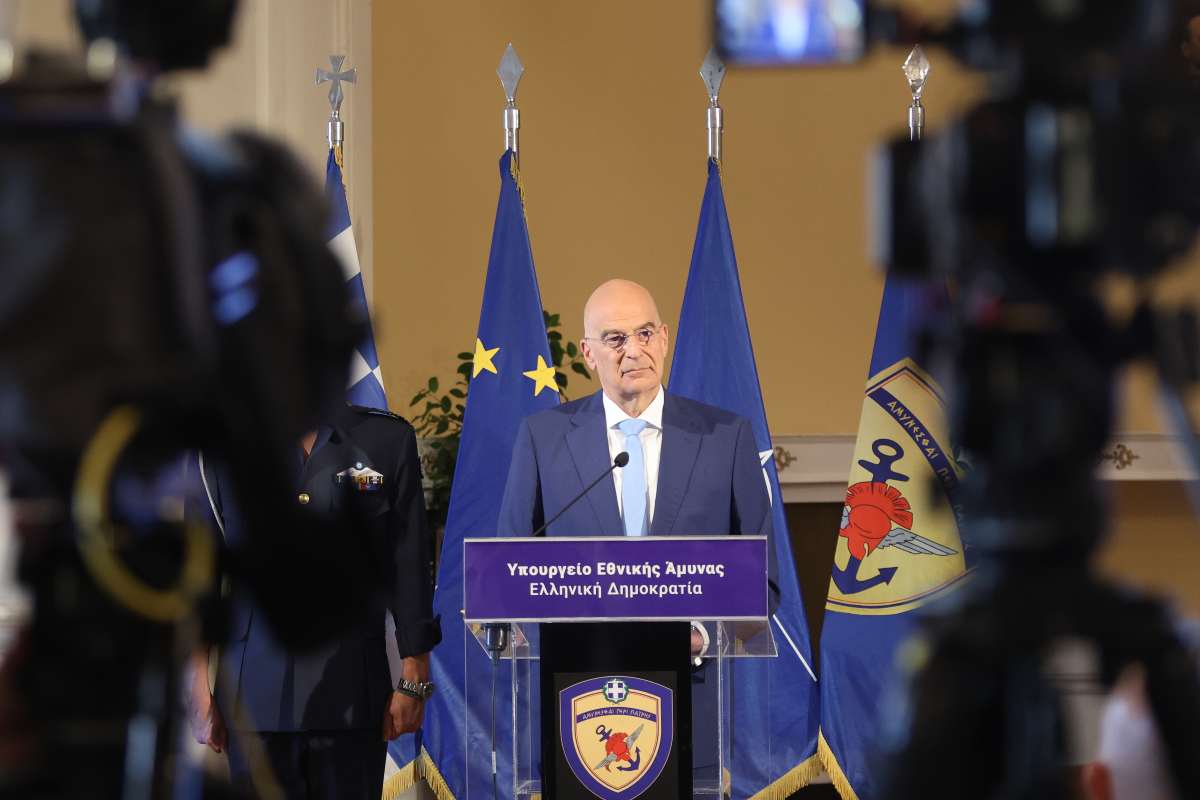
Greece is entering a new phase of defense modernization after the Government Council for National Security (KYSEA) approved the first major package of the country’s “Agenda 2030” defense reform plan. The initiative aims to transform the Hellenic Armed Forces into a modern, network-centric military capable of responding to the challenges of contemporary warfare.
Presenting the government’s new defense strategy, Minister of National Defence Nikos Dendias emphasized that the objective is to build an integrated command-and-control system capable of collecting, processing, and exploiting data from every operational domain while providing rapid responses to emerging threats.
“Achilles’ Shield” Takes Center Stage
The flagship project of the new procurement package is “Achilles’ Shield”, a multi-layered air, missile, and counter-drone defense architecture designed to protect Greece against a broad spectrum of aerial threats.
According to Dendias, the system represents a holistic command-and-control network that will integrate multiple sensors and weapons into a single operational framework. He also highlighted the significant participation of the Greek defense industry, with domestic industrial involvement estimated at €700 million.
The 10 Approved Defense Programs
1. Development of the “Achilles’ Shield” integrated air defense, ballistic missile defense, and counter-drone system.
2. Procurement of non-kinetic counter-unmanned surface vessel systems, designed to neutralize unmanned maritime threats without conventional firepower.
3. Acquisition of the HERON 1 Unmanned Aerial System (UAS) to strengthen intelligence, surveillance, and reconnaissance capabilities.
4. Deployment of Synthetic Aperture Radar (SAR) microsatellites, providing near real-time satellite imagery under exclusive national control.
5. Acquisition of ten additional Class II Unmanned Aerial Vehicles (UAVs) to expand reconnaissance and surveillance operations.
6. Introduction of night-vision devices as a standard component of the modern combat soldier’s equipment.
7. Acquisition of three Embraer C-390 Millennium tactical transport aircraft through a government-to-government agreement between Greece and Portugal. The first aircraft is expected to be delivered in 2027, with the fleet also capable of performing air-to-air refueling missions.
8. Procurement of ten underwater special operations vehicles, with eight to be built at the Skaramangas Shipyardsin Greece and two in the United Kingdom.
9. Comprehensive upgrade of the four MEKO-class frigates, including advanced anti-submarine warfare systems and modern electronic capabilities.
10. Procurement of AGM-114 Hellfire laser-guided missiles to enhance the strike capabilities of the AH-64 Apache attack helicopter fleet.


Investing in Human Capital
Beyond military equipment, the Ministry of National Defence is also investing in the next generation of military leadership through graduate education programs in the United States focused on Artificial Intelligence, autonomous systems, and advanced defense technologies.
The initiative aims to establish a highly specialized corps of officers capable of supporting the digital transformation of the Hellenic Armed Forces.

The Next Phase of “Agenda 2030”
Dendias stressed that the programs approved by KYSEA represent only the first phase of the broader modernization effort. He announced that a second phase of the new Force Structure, together with the 2027–2037 long-term defense procurement plan, will be presented in September.
The government’s strategic vision is to transform Greece’s Armed Forces into a fully network-enabled military, where real-time intelligence, artificial intelligence, and the seamless integration of weapons systems will serve as decisive force multipliers in an increasingly complex geopolitical environment.
Source: pagenews.gr