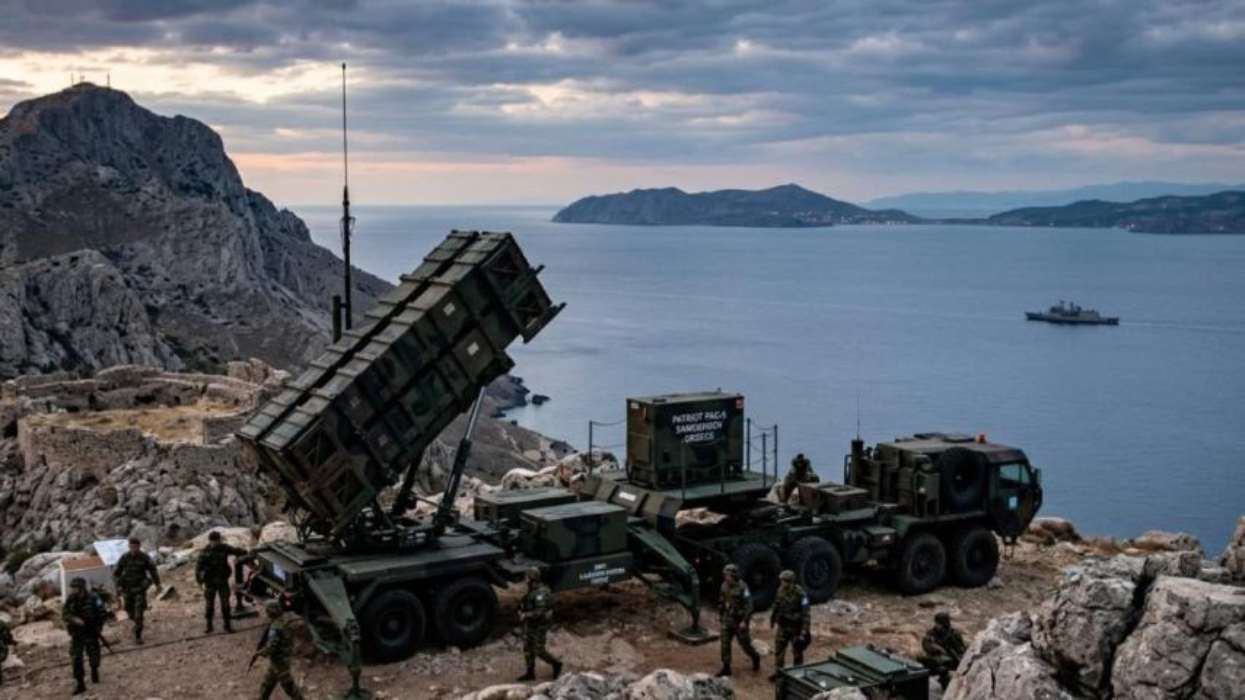
Greece is preparing to construct a new multi-layered air-defence, anti-ballistic and anti-drone shield that is expected to become fully operational within 35 months of the formal signing of the contract.
The programme, known as “Achilles’ Shield,” is not simply the acquisition of new missile systems. It is a far broader defence architecture combining advanced radars, interceptors, electronic-warfare capabilities, secure communications and a unified command network.
Its strategic objective is to provide continuous protection for the country’s critical infrastructure, military formations, islands and sensitive border regions, while enabling the Armed Forces to detect, assess and respond to multiple threats in real time.
Full operational deployment within 35 months
The 35-month timetable does not mean that all new systems will arrive simultaneously at the end of that period.
Rather, the aim is for the entire shield to be fully integrated, tested and operational by then.
This distinction is crucial. Before the new equipment can be deployed, the Armed Forces must complete a series of demanding infrastructure projects in Evros, the eastern Aegean islands and mainland Greece.
Existing military sites will have to be upgraded, while new facilities may also need to be constructed. Secure energy systems, protected communication networks and hardened operational centres must be ready before the missile batteries, radars and electronic-warfare assets are connected.
The systems will also require autonomous electricity supplies, independent of the national power grid, so that they can continue operating even during attacks against energy infrastructure, cyber operations or major disruptions.
The new architecture will therefore be judged not by the arrival of individual weapons, but by whether all components can function together as a single, resilient defence network.


The Greek-controlled “nervous system”
The most important element of the programme is not necessarily the missiles themselves.
It is the new Command and Control system, which will act as the digital nervous system of the entire shield.
Greek military planners reportedly insisted that the country must not be dependent on the supplier state for the operation of such a critical national-defence capability.
Without access to the source code and without national control over the central command architecture, Greece could find itself strategically dependent on a foreign manufacturer for upgrades, maintenance, target identification and even critical wartime functions.
For that reason, the command-and-control system is being developed with strong Greek participation and is intended to be operated under full national control.
The objective is clear: the system must not merely be used by the Greek Armed Forces. It must also carry a strong “Made in Greece” technological signature.


What C5ISR-T means
The new command architecture has been described as a C5ISR-T system.
The five “Cs” stand for:
- Command
- Control
- Compute
- Communications
- Cyber
ISR refers to:
- Intelligence
- Surveillance
- Reconnaissance
The final “T” stands for:
- Targeting
In operational terms, the system will collect information from multiple sensors, process it in real time, classify threats and identify the most suitable weapon for interception.
It will connect ground-based radars, aircraft sensors, naval systems, unmanned aerial vehicles and existing air-defence batteries into a single digital operational picture.
This means that a threat detected by one sensor could immediately be transmitted across the network and engaged by another platform located far away.


Connecting Israeli, American and existing Greek systems
The new shield is expected to connect a wide range of systems within one unified structure.
These may include the Israeli Spyder, Barak MX and David’s Sling systems, advanced AESA radars such as the ELM-2084, as well as Greece’s existing and upgraded Patriot and HAWK batteries.
Aircraft-mounted radars, the sensors of new-generation frigates and NATO-compatible surveillance assets will also contribute to the common operational picture.
This integrated approach represents a major change from the traditional model, in which different systems often operated independently or with limited interoperability.
The new doctrine requires every radar, interceptor and command centre to operate as part of a single network.
Designed for saturation attacks and drone warfare
Recent conflicts in Ukraine and the Middle East have demonstrated the growing importance of drones, loitering munitions, ballistic missiles and cruise missiles.
Modern attacks are increasingly designed to overwhelm air defences through saturation: large numbers of cheap drones may be launched alongside more sophisticated missiles, forcing defenders to respond to several threats at once.
“Achilles’ Shield” is being designed precisely for this environment.
Its sensors will need to distinguish between low-cost drones, aircraft, cruise missiles and ballistic threats. The command system will then determine whether the target should be engaged through electronic warfare, anti-drone technology or a hard-kill interceptor.
This is particularly important because using an expensive missile against every low-cost drone would be economically and operationally unsustainable.
The effectiveness of the shield will therefore depend not only on interception capability, but also on intelligent management of available weapons.
€700 million returning to the Greek economy
A major part of the negotiations concerned Greek industrial participation.
According to the programme’s planning, more than €700 million is expected to return to the Greek economy through industrial cooperation, production work, integration, maintenance and technical support.
The Greek side reportedly rejected a vague commitment to involve domestic companies and insisted instead on clearly defined work packages for Greek engineers, technicians and defence manufacturers.
This was treated as a strategic condition rather than a secondary economic benefit.
The objective is not simply to purchase foreign systems, but to transfer know-how, create skilled jobs and establish a domestic technological base capable of supporting the programme throughout its operational life.
From customer to co-producer
The most ambitious element of the industrial plan concerns the possible production of air-defence missiles or missile components in Greece.
Should this prospect materialise, it could lead to the creation of a production line on European territory serving both Greek requirements and potential export customers.
Such a development would fundamentally change Greece’s position in the defence market.
Instead of remaining almost exclusively a customer of foreign suppliers, the country could become a co-producer and exporter of advanced air-defence technology.
A Greek production line could potentially serve European countries seeking to strengthen their air defences, as well as selected markets in the Middle East.
It could also provide Greece with greater security of supply during periods of crisis, when global demand for missiles and spare parts rises sharply.
A difficult negotiation with Israel
The industrial agreement was reportedly one of the most difficult parts of the negotiations with the Israeli side.
Initially, Israeli negotiators are said to have preferred only a general reference to Greek industrial participation.
Athens, however, demanded specific obligations, defined responsibilities and measurable industrial work for Greek companies.
For the Greek Ministry of National Defence and the General Directorate for Defence Investments and Armaments, this was regarded as a non-negotiable issue.
The final objective is for Greek participation to exceed the minimum level initially set for the programme.
That participation is expected to extend beyond basic assembly and include software, integration, maintenance, technical support and potentially advanced production.
Protection of Evros, the islands and strategic infrastructure
The deployment plan places particular emphasis on Evros, the eastern Aegean and key locations in mainland Greece.
This reflects the need to protect military bases, airfields, ports, energy infrastructure, command centres and population centres from a wide range of threats.
The new architecture will also strengthen the protection of islands that have limited strategic depth and require rapid reaction times.
By linking radars and interceptors across different regions, the system is intended to provide wider coverage and reduce the risk of isolated defence zones.
The result will be a layered shield capable of responding at different distances and altitudes, depending on the type of threat.
Electronic warfare becomes central
A defining feature of the programme is the integration of hard-kill systems with what has been described as the “invisible” dimension of electronic warfare.
Not every threat will necessarily be destroyed by a missile.
Some drones or guided weapons may be jammed, misdirected or disabled electronically. Communications may be disrupted, navigation systems interfered with and hostile sensors deceived.
This combination of kinetic and non-kinetic capabilities is essential in modern warfare.
It also makes secure communications, cyber defence and protected data networks just as important as the launchers and interceptors themselves.
Part of a wider military transformation
“Achilles’ Shield” forms part of the broader transformation of the Greek Armed Forces and the country’s long-term defence planning.
The programme is aligned with the effort to modernise command structures, expand the use of unmanned systems, improve interoperability and strengthen the domestic defence industry.
It also reflects a shift toward network-centric warfare, in which information, sensors and digital connectivity are as important as conventional firepower.
For Greece, the programme is intended to create a defence system capable of adapting to rapidly changing threats rather than relying on isolated legacy platforms.
A strategic turning point
If the 35-month timetable is respected, “Achilles’ Shield” will represent one of the most important defence projects undertaken by Greece in decades.
Its success, however, will not be measured only by the number of missiles purchased or radars installed.
The decisive questions will be whether the systems are genuinely integrated, whether Greece retains full operational control, whether the infrastructure is resilient and whether domestic industry acquires meaningful technological capabilities.
The €700 million in Greek industrial participation could therefore prove as strategically important as the weapons themselves.
A successful programme would strengthen national deterrence, reduce foreign dependence and create a new defence-production ecosystem inside Greece.
For the first time, the country is attempting to build not simply an air-defence arsenal, but a unified national shield designed for the missile, drone and cyber battlefields of the coming decades.
Source: pagenews.gr