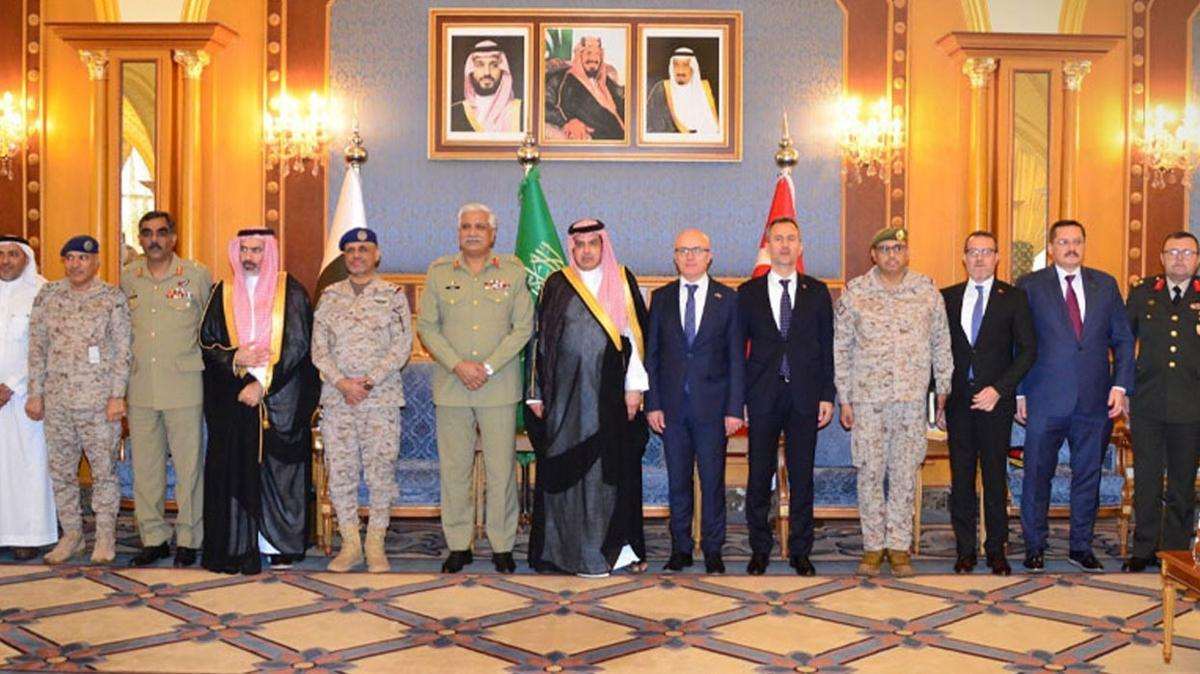
Saudi Arabia, Türkiye and Pakistan’s newly signed Mecca Joint Defense Agreement is already reshaping the strategic debate across the Middle East and Eastern Mediterranean. Signed on August 7, the pact establishes the principle that an attack against one of the three countries will be regarded as an attack against all.
For Greece, however, the agreement raises an uncomfortable but unavoidable question:
What happens if Athens and Ankara become involved in a serious military confrontation?
Would Saudi Arabia automatically side with Türkiye?
Would Pakistan provide military assistance to Ankara?
And could the new agreement indirectly alter the balance of power in the Aegean and Eastern Mediterranean?
The answer is considerably more complicated than the phrase “Islamic NATO” suggests.
What the collective-defense clause actually means
The core principle of the Mecca pact resembles collective-defense arrangements elsewhere: aggression against one member is treated as aggression against all three.
But available reporting indicates that the agreement does not publicly specify automatic troop deployments or predetermined military responses. It strengthens deterrence, defense coordination and military cooperation, while its signatories insist that its character is defensive.
That distinction matters enormously for Greece.
If Türkiye initiated hostilities against Greece, there is no publicly established provision saying Saudi Arabia and Pakistan would automatically be required to enter the conflict on Ankara’s side.
The much more difficult scenario would arise if Türkiye claimed that it had been attacked first.
In a fast-moving Aegean confrontation involving aircraft, warships or missiles, determining which country initiated hostilities could become politically decisive.


Would Saudi Arabia really fight Greece?
That appears highly unlikely in anything short of an extraordinary escalation.
Riyadh has developed important strategic relations with both Ankara and Athens. Saudi Arabia therefore has little interest in turning a Greek-Turkish confrontation into a Saudi-Greek one.
The most probable Saudi response to a limited Greek-Turkish military crisis would consequently be rapid diplomatic intervention, pressure for de-escalation and an attempt to mediate between the two sides.
The Kingdom would face a particularly uncomfortable dilemma because Greece has not merely maintained diplomatic relations with Saudi Arabia.
Athens has contributed directly to Saudi security.
Greece deployed a Patriot air-defense battery and Greek military personnel to Saudi Arabia to help protect critical infrastructure.
That history would carry substantial political weight if Riyadh were ever asked to support Türkiye against Greece.
Pakistan is the more complicated variable
Pakistan’s strategic relationship with Türkiye is exceptionally close.
The two countries cooperate extensively on defense, training and military technology, while Pakistan already had a mutual-defense relationship with Saudi Arabia before the trilateral arrangement emerged.
Islamabad could therefore be expected to lean politically more strongly toward Ankara than Riyadh might in a Greek-Turkish confrontation.
Yet even here, political support or military assistance does not automatically mean Pakistani forces entering a war against Greece.
Assistance could instead involve intelligence, logistics, equipment, ammunition, diplomatic backing or defensive deployments.


The nuclear question
Pakistan’s participation inevitably introduces another issue: nuclear deterrence.
Pakistan is a nuclear-armed state, and its defense relationship with Saudi Arabia has long generated speculation about whether Riyadh could ultimately benefit from some form of Pakistani nuclear umbrella.
But the new trilateral pact should not automatically be interpreted as extending Pakistani nuclear deterrence to Türkiye.
No publicly available provision establishes NATO-style nuclear sharing or an automatic Pakistani nuclear guarantee for Ankara.
That distinction is crucial.
Türkiye nevertheless gains strategic depth
Even without automatic Saudi or Pakistani military intervention, Ankara has gained something strategically significant.
Türkiye now sits inside a framework connecting:
Saudi financial and geopolitical weight, Pakistan’s large military and nuclear status, and Türkiye’s NATO-integrated armed forces and rapidly expanding defense industry.
The consequences for Greece may therefore emerge less through an actual war and more through defense-industrial cooperation, financing, technology transfers, intelligence coordination and access to larger military supply chains.
That is arguably the more important long-term development for Athens.
The NATO paradox
There is another extraordinary complication: both Greece and Türkiye belong to NATO.
The Atlantic Alliance was designed to defend its members against external aggression — not to manage a war between two allies.
A major Greek-Turkish confrontation would therefore almost certainly trigger enormous pressure from Washington, Brussels and other NATO capitals to stop hostilities before they expanded.
The Mecca pact adds another layer to an already complicated deterrence equation.
Washington is watching
As of August 8, there has been no major public White House response specifically defining Washington’s position toward the new trilateral pact.
That silence should not automatically be interpreted as either approval or opposition.
Saudi Arabia remains an important American security partner, Türkiye remains a NATO ally, and Pakistan retains significant strategic importance.
Washington’s attitude could change dramatically, however, if the arrangement evolved from a defensive regional framework into an explicitly anti-Western military bloc — or acquired a formal nuclear dimension.
And Israel?
Israel has another reason to watch developments carefully.
The agreement brings together Saudi Arabia, nuclear-armed Pakistan and an increasingly assertive Türkiye at a time when Ankara’s regional ambitions and its relationship with Israel are already major strategic issues.
Recent reporting has highlighted Israeli concern over Türkiye’s expanding regional role, although the agreement’s architects portray it as defensive rather than as an alliance directed against Israel.
For Greece and Cyprus, that potentially increases the strategic importance of their security relationship with Israel in the Eastern Mediterranean.
The Saudi dilemma: Türkiye is an ally, but Greece helped defend the Kingdom
This is perhaps the most interesting contradiction created by the Mecca pact.
Greece has committed military assets to Saudi security.
Saudi Arabia has now entered a collective-defense framework with Türkiye.
If Athens and Ankara ever crossed the threshold from political confrontation to military conflict, Riyadh could find itself caught between a new treaty partner and an established strategic partner that previously helped protect Saudi territory.
That is precisely why Saudi neutrality and mediation would probably be Riyadh’s preferred course — unless Türkiye were unmistakably the victim of a major Greek attack.
Should Athens be worried?
Yes — but not because Saudi fighter jets are suddenly likely to appear over the Aegean.
The deeper issue is that Türkiye is building strategic networks beyond NATO.
Those networks could eventually provide Ankara with greater defense-industrial capacity, financing, military technology, intelligence cooperation and diplomatic leverage.
The Greek response therefore should not be to treat Saudi Arabia as a lost partner.
Quite the opposite.
Athens has every reason to deepen its relationship with Riyadh, precisely so that Saudi Arabia’s strategic interests with Greece become too important to sacrifice during any future Greek-Turkish crisis.
The Mecca Agreement does not automatically place Saudi Arabia on Türkiye’s side against Greece.
But it does introduce a new variable into the Aegean security equation.
And for Athens, the objective should be clear:
If Riyadh is ever forced to choose between Ankara and Athens, Greek diplomacy should have ensured long before that moment that Saudi Arabia has every possible reason not to choose at all.
Source: pagenews.gr