Dendias: ‘We Had More Colonels Than Sergeants’ – Greece Builds the Army of 2030
 ΧΡΟΝΟΣ ΑΝΑΓΝΩΣΗΣ 9 '

Πηγή Φωτογραφίας: eurokinissi/Dendias: ‘We Had More Colonels Than Sergeants’ – Greece Builds the Army of 2030



“We had more colonels than sergeants. We had more majors than non-commissioned officers.”
With this unusually blunt description, Greek Defence Minister Nikos Dendias highlighted what he sees as one of the fundamental structural problems that accumulated over decades inside Greece’s Armed Forces.
But behind the striking remark lies a much bigger story.
Athens is attempting to move away from the traditional model of a large, bureaucratically heavy military built around numerous formations, bases and senior officers, towards a force increasingly driven by intelligence, drones, sensors, advanced technology and rapid decision-making.
The transformation forms part of Greece’s ambitious “Agenda 2030” defence reform – and reflects lessons emerging from Ukraine, the Middle East and the rapidly changing military balance in the eastern Mediterranean.
“The Armed Forces Are No Longer Just a Collection of Weapons”
Dendias has made the philosophy behind the reforms clear.
Modern Armed Forces, he argues, can no longer be understood simply as collections of fighter aircraft, warships, tanks and traditional formations such as divisions, brigades, regiments and battalions.
They are increasingly systems for acquiring, processing and exploiting information.
The modern battlefield is observed by thousands of sensors. Information is transmitted, analysed and converted into operational decisions.
The objective is simple but decisive: see the enemy first, understand what is happening faster and act before the opponent can respond.
That is the philosophy Greece wants to embed across its Armed Forces.
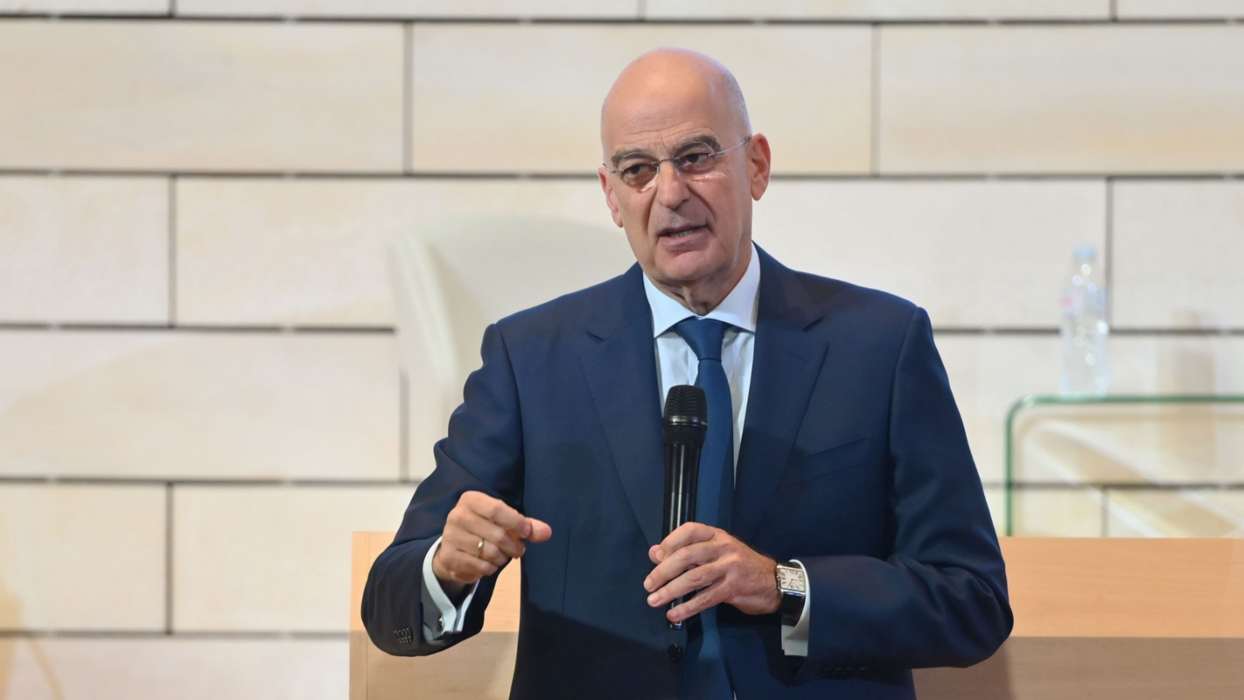
More Colonels Than Sergeants
The defence minister has been sharply critical of the military structure Greece inherited.
“We had endless divisions, endless regiments, endless battalions, endless military camps,” Dendias said.
Alongside those structures came a disproportionate number of senior officers.
Dendias has previously revealed that the number of colonels was more than three times the number of authorised positions, while Greece had more brigadier generals than the United States Army despite the enormous difference in size between the two forces.
For the Defence Ministry, this became a symbol of a top-heavy system that needed fundamental reform.
The response includes consolidation of units and military bases, reductions in unnecessary command structures and a shift towards smaller, more agile and technologically capable formations.
The objective is not simply a smaller military.
It is a more combat-effective military.
Greek Conscripts Are Learning to Fly Drones
Perhaps the clearest symbol of the transformation can be found in basic military training.
According to Dendias, Greece is moving towards training every new conscript in the use of Category I FPV drones.
The decision reflects one of the most important lessons of modern warfare.
Ukraine and conflicts across the Middle East have demonstrated that inexpensive unmanned systems can locate, track and sometimes destroy military equipment worth millions.
Small FPV drones have evolved from specialised equipment into a basic battlefield tool.
Athens wants that knowledge spread throughout the force rather than concentrated in a small number of specialist units.
The soldier of 2030, in other words, may need to be as comfortable operating a drone as handling a rifle.
Greece Wants to Build Its Own Drones
The transformation goes beyond training.
Dendias has announced plans for a third and larger Armed Forces drone production facility at Malakasa, while a training centre in Tripoli is being developed for operators of larger Category II and III UAVs.
The strategic objective is significant.
Greece does not want merely to purchase unmanned systems from foreign suppliers.
Athens wants domestic production capacity, technical expertise and the ability to continuously modify and improve its systems.
That capability becomes particularly important during a prolonged crisis or conflict, when foreign supply chains may become constrained.
‘Centaur’: Greece’s Counter-Drone Weapon Tested in Combat Conditions
One of the most important examples of the new approach is Greece’s “Centaur” counter-UAV system.
According to Dendias, the programme began not with a request to purchase a specific weapon but with an operational question:
How can Greece defend itself against swarms of hostile drones?
The answer was developed by Greece’s defence industry.
A prototype was subsequently deployed in the Red Sea, where Greek officials say the system demonstrated its effectiveness against drones launched by the Houthis.
Centaur is now intended to become an important counter-drone capability aboard Greek frigates.
There is another strategically important element: Greece controls the source code.
That allows the system to be modified and upgraded as threats evolve, reducing dependence on a foreign supplier.
From Rafale and F-35 to the ‘Achilles Shield’
None of this means Greece is abandoning major weapons platforms.
Quite the opposite.
Athens has acquired Rafale fighters, is upgrading much of its F-16 fleet to the advanced Viper configuration and is preparing to introduce the fifth-generation F-35 into the Hellenic Air Force.
At the same time, Greece is developing the multilayered “Achilles Shield”, designed to counter a spectrum of threats ranging from aircraft and drones to cruise and ballistic missiles.
The emerging doctrine therefore is not about choosing cheap drones instead of sophisticated fighter jets.
It is about connecting different weapons, sensors and command systems into a single network capable of detecting, evaluating and responding to threats in real time.
That represents a fundamental shift in how military power is organised.
Lessons From Ukraine and the Middle East
Greece’s reforms are taking place against a dramatically changing global security environment.
The wars of recent years have overturned many assumptions that shaped Western militaries after the Cold War.
Drones, electronic warfare, artificial intelligence, satellite intelligence, long-range missiles and relatively inexpensive unmanned systems have transformed the battlefield into an enormous competition over detection, data and speed.
Expensive platforms remain essential.
But a tank, ship or fighter aircraft that cannot operate effectively within a modern information network can become dangerously exposed.
The side that detects its opponent first – and converts that information into effective firepower fastest – can gain a decisive advantage.
That is the military environment Greece is preparing for.
Turkey Is the Strategic Reality in the Background
There is also an unavoidable geopolitical dimension.
Greece’s defence transformation is taking place alongside the continuing rise of Turkish military power.
Turkey has built one of the world’s most prominent drone industries, developed increasingly sophisticated missile systems, expanded its naval construction programme and invested heavily in domestic defence production.
Ankara’s ambition for greater strategic autonomy has fundamentally altered the military environment of the Aegean and eastern Mediterranean.
For Athens, matching Turkey platform for platform and soldier for soldier is neither necessarily possible nor strategically optimal.
Greece is instead seeking to maximise its advantages through technology, interoperability, high-end weapons, intelligence and superior information processing.
The objective is deterrence: ensuring that any adversary contemplating military action faces unacceptable risk and cost.
Greece’s Defence Industry Returns to the Equation
Another important component of Agenda 2030 is the effort to rebuild Greece’s domestic defence-industrial capabilities.
For years, much of the country’s defence expenditure flowed towards foreign weapons systems with limited participation by Greek companies.
The new approach seeks greater domestic involvement in research, development and production.
Drones and counter-drone technology are particularly important because they evolve extraordinarily quickly.
A system considered advanced today may require software or hardware modifications within months as electronic warfare techniques change.
Domestic technological control therefore becomes more than an economic policy.
It becomes part of national military resilience.
From a ‘Big Army’ to a Smart Army
This is ultimately the deeper meaning behind Dendias’s remark about Greece once having more colonels than sergeants.
Athens is not simply attempting to reduce the number of officers or close military bases.
It is trying to change its understanding of what military power means.
In the wars of the 20th century, power was often measured primarily in numbers: divisions, tanks, aircraft, ships and soldiers.
Those numbers still matter.
But they are no longer enough.
What matters increasingly is who has the better sensors. Who controls the electromagnetic spectrum. Who can deploy and defeat drones. Who can connect aircraft, warships and ground forces into a common operational picture.
And above all, who can turn information into a decision – and a decision into action – faster than the opponent.
That is the wager behind Greece’s Agenda 2030.
And Dendias’s striking admission that the country once had more colonels than sergeants may ultimately provide the clearest description of the military Greece is determined to leave behind.
Διαβάστε όλες τις τελευταίες Ειδήσεις από την Ελλάδα και τον Κόσμο