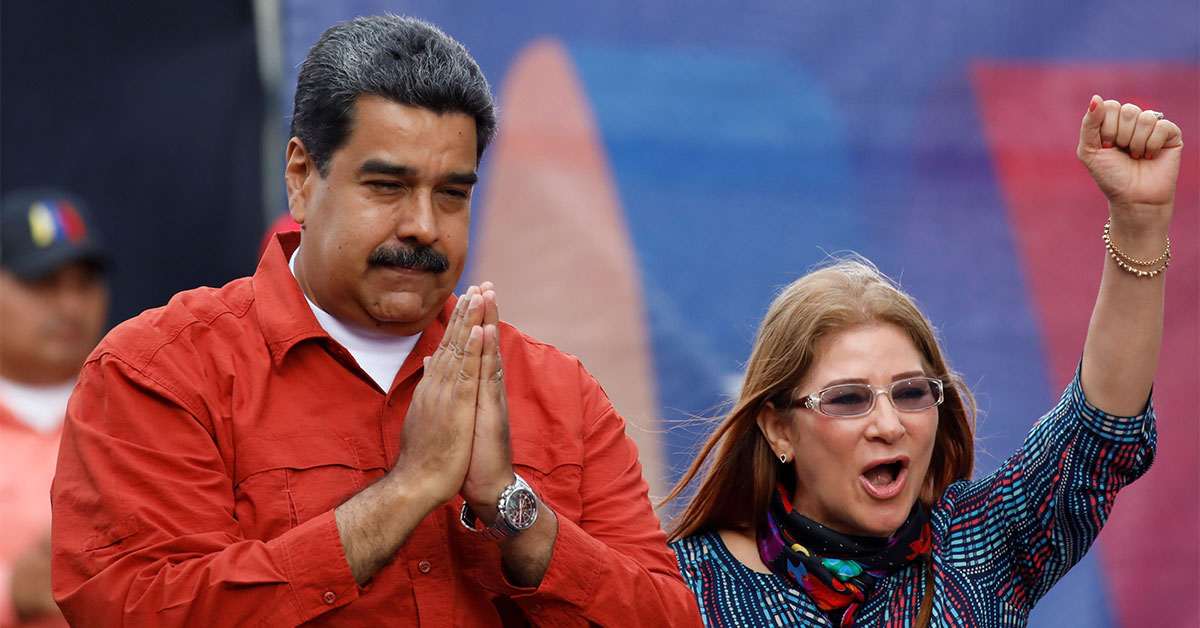
Once, he was the undisputed ruler of Venezuela. Today, the political system he left behind increasingly appears to be behaving as though Nicolás Maduro no longer exists.
The clearest sign has emerged from recent negotiations between the government and opposition in Caracas.
Across five rounds of talks, the government of interim president Delcy Rodríguez did not even raise the release of Maduro and his wife, Cilia Flores, who remain in US custody following the American operation of January 3.
“Maduro and Flores simply don’t exist at the negotiating table,” an opposition figure involved in the talks told the Financial Times.
Then came the phrase that encapsulates Venezuela’s extraordinary new reality:
“They have been erased from history.”


From “We Will Not Rest” to Silence
The transformation is striking.
Immediately after Maduro’s capture and transfer to the United States in January, Rodríguez denounced the American operation as a “vulgar attack”.
Her brother, Jorge Rodríguez, president of Venezuela’s National Assembly, declared that the government would not rest until Maduro and Flores were released.
Seven months later, their freedom was not even on the agenda of negotiations over the country’s political future.
The change is visible beyond the negotiating room.
According to the FT, posters demanding Maduro’s release are being taken down, while murals celebrating the former president have begun to disappear.
A man whose image once dominated Venezuela’s political landscape is gradually being removed from public view.
Rodríguez Got Washington’s Message
Behind the silence lies a ruthless calculation of political survival.
Delcy Rodríguez, who served as Maduro’s vice-president before his removal, has achieved something that would have seemed almost unimaginable at the beginning of the year: she has preserved much of the Chavista state apparatus while simultaneously developing a working relationship with Washington.
Her government has moved towards greater economic openness, including giving US companies increased access to Venezuela’s enormous energy resources.
At the same time, Rodríguez has replaced senior military figures with officials more closely aligned with the new leadership, strengthening her position within the security establishment.
The strategy increasingly appears straightforward:
save the system, even if that means sacrificing the man who once embodied it.


Venezuela Discusses Its Future – Without Maduro
The recent government-opposition talks offer perhaps the strongest evidence that Venezuela has already entered a post-Maduro era.
The two sides have agreed to pursue reforms of the judicial system and seek the recovery of Venezuelan international reserves held at the Bank of England.
At the centre of the dispute are more than 30 tonnes of Venezuelan gold, worth roughly $4bn, with discussions under way over how the assets could eventually be used to address the country’s economic and social crisis.
Potential changes to Venezuela’s Supreme Court are even more politically significant.
The judiciary was a critical pillar of power during the Maduro era. Reforming it would therefore touch one of the institutions most closely associated with the previous political order.
But the fundamental question remains unanswered:
Will this process ultimately produce genuinely free elections, or is Chavismo simply learning how to survive under new management?
Political Prisoners Released
The government has also announced the release of 131 political prisoners, presenting the move as part of a broader process of national reconciliation.
Human rights organisations have reported different verified totals, meaning the government’s figure should be treated cautiously.
Even so, the releases are another indication of how quickly Venezuela’s political environment is changing.
Washington wants stability, economic recovery and a credible political transition.
Rodríguez, meanwhile, needs to demonstrate that her government can deliver all three without allowing the Venezuelan state to collapse.


Maduro Waits for His Trial
While Caracas discusses Venezuela’s future, Maduro faces an entirely different reality.
He and Cilia Flores remain in US custody following their capture by American forces in January.
A federal court in New York has scheduled their trial to begin on June 1, 2027. Both have pleaded not guilty to the charges against them.
Maduro’s lawyers are expected to challenge both the indictment and the legality of his capture, including through arguments related to head-of-state immunity.
His defence has characterised the US operation as unlawful, while the Trump administration has presented it as a law-enforcement action.
Those questions will ultimately be decided in an American courtroom.
Politically, however, something else is already becoming clear:
Caracas no longer appears willing to make Maduro’s fate a central condition for Venezuela’s future.
Chavismo Tries to Survive Without Chávez’s Heir
This is where the geopolitical significance becomes much greater.
Maduro ruled Venezuela as the political heir to Hugo Chávez. For years, the state, ruling party, military and security establishment were deeply intertwined with his personal survival.
Now Chavismo is attempting something radically different:
surviving without Maduro.
Rodríguez is not dismantling the entire system she inherited.
Instead, she appears to be reshaping it just enough to establish a relationship with Washington, attract foreign investment and position herself for whatever political settlement comes next.
That may explain why Maduro’s fate has shifted from being a national cause to becoming a political liability.
Even Maduro’s Old Power Brokers Are Adapting
The transformation extends beyond Rodríguez.
Diosdado Cabello, one of the most powerful figures in the Chavista establishment, has also had to adjust to the new political reality.
The survival instincts of Venezuela’s political elite are becoming increasingly apparent.
For those who once surrounded Maduro, the central question is no longer necessarily how to bring their former leader home.
It is how to preserve their own influence in a country where Washington suddenly holds enormous leverage over the political and economic future.
That creates an extraordinary reversal.
The United States spent years trying to isolate the Maduro government. Now figures who served at the heart of that system are seeking ways to work with Washington in a Venezuela without Maduro himself.
Oil, Washington and the Bigger Deal
For the United States, the stakes extend far beyond the fate of one former president.
Venezuela possesses the world’s largest proven oil reserves.
Stabilising the country and bringing more Venezuelan production back into global markets therefore carries enormous geoeconomic significance.
Greater access for American energy companies could reshape Venezuela’s economic relationships after years in which sanctions and political isolation pushed Caracas towards countries including China, Russia and Iran.
For Rodríguez, co-operation with Washington offers something equally valuable: time, economic breathing room and international space to consolidate the new order.
Maduro increasingly appears to sit outside that equation.
And that may explain the silence surrounding his name better than anything else.
Washington Has Turned Venezuela’s Power Equation Upside Down
The geopolitical consequences could reach far beyond Caracas.
For years, Venezuela was one of Washington’s most persistent adversaries in Latin America and cultivated close relationships with Russia, China, Cuba and Iran.
A Venezuelan government prepared to work pragmatically with the United States would therefore represent a significant strategic shift in the Western Hemisphere.
Oil is central to that calculation, but it is not the only factor.
Migration, organised crime, regional security and the influence of Washington’s global rivals all make Venezuela strategically important to the Trump administration.
Rodríguez appears to understand the opportunity.
Rather than tying the survival of her government to Maduro’s return, she is attempting to demonstrate that Caracas can offer Washington something more useful: stability and access without the former president.
From the Presidential Palace to a US Jail – and Then Oblivion?
The story has an almost cinematic reversal.
At the beginning of 2026, Nicolás Maduro stood at the centre of virtually every political calculation involving Venezuela.
Today, he sits in US custody awaiting a trial scheduled for 2027, while former allies in Caracas negotiate with the opposition and Washington over the country’s future without demanding his return.
It remains unclear whether the Rodríguez government will become a bridge towards genuine democratic transition or merely a new version of an old system determined to survive.
The coming negotiations over elections, the judiciary, political prisoners and Venezuela’s frozen assets will help provide the answer.
For Maduro himself, however, the message coming from Caracas is already much colder.
The man who once demanded absolute loyalty from an entire political system is now watching that same system make perhaps its most consequential discovery:
it may no longer need him.