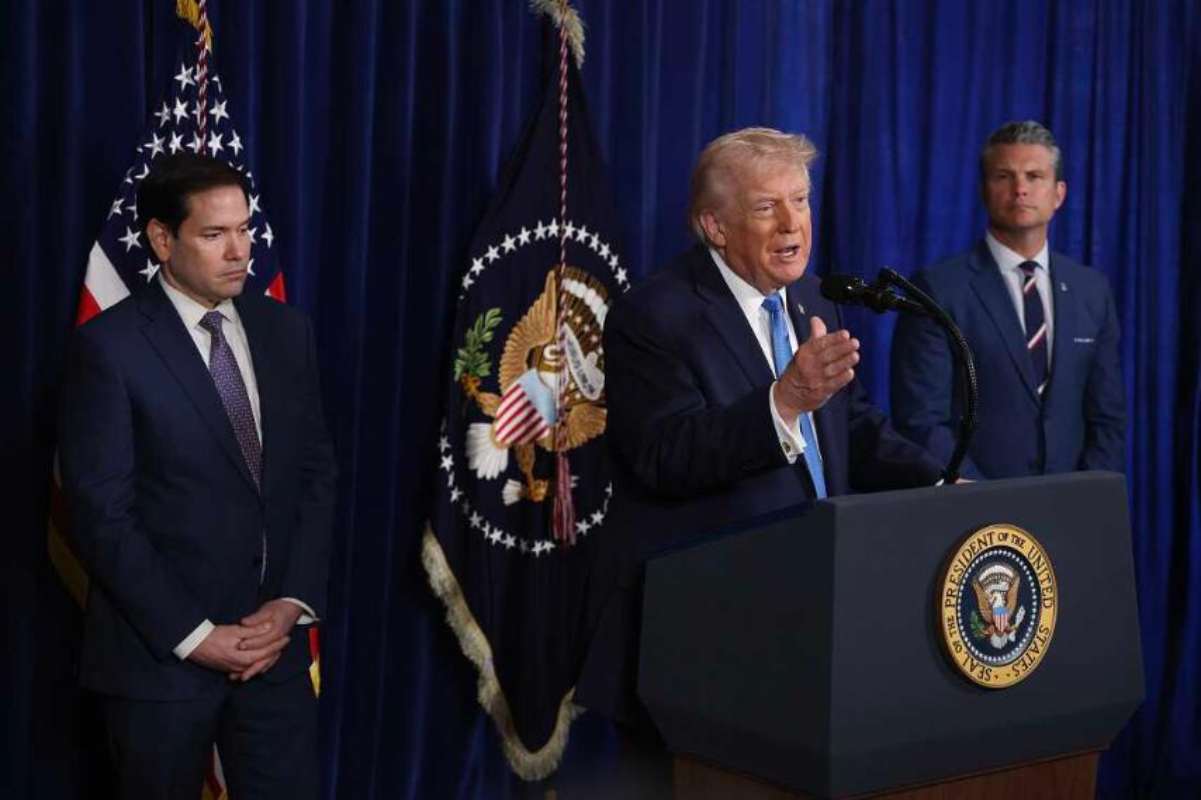
Donald Trump is attempting to rewrite the global energy equation through two moves unfolding thousands of miles apart but serving the same strategic objective: expanding U.S. control over future oil supplies while reducing Iran’s ability to convert its own energy resources into economic and geopolitical power.
The first move is unfolding in Venezuela.
Trump announced on August 28 an extraordinary agreement that could give the United States majority control over a structure linked to more than 65 billion barrels of Venezuela’s proven oil reserves.
The second is directed at Iran.
At the same time, Washington is escalating its financial campaign against Tehran, targeting the banking networks that allow Iranian oil revenues to enter the international financial system.
Taken together, the two moves reveal a broader American strategy.
The United States is not simply trying to control more barrels.
It is trying to control the infrastructure that determines whether those barrels can actually reach the global economy.
Washington Locks In 65 Billion Barrels
Trump presented the Venezuela agreement in characteristically dramatic terms.
“The United States of America has just entered into an Agreement with the Country of Venezuela on, THE BIGGEST OIL DEAL IN WORLD HISTORY!” the U.S. president wrote on Truth Social.
According to U.S. officials, the arrangement gives Washington majority control through a partnership involving private business over more than 65 billion barrels of proven Venezuelan reserves.
The fields involved are concentrated primarily in the Orinoco Belt and Lake Maracaibo regions.
The Venezuelan government says the agreement covers the development of 17 strategic oil fields.
Secretary of State Marco Rubio called the agreement “a huge win for both the American and Venezuelan people,” arguing that it could attract nearly $100 billion in private investment, generate thousands of jobs and contribute to the reconstruction of Venezuela’s battered energy industry.
Venezuela’s interim President Delcy Rodríguez has embraced the agreement as well.
“These investments will contribute not only to the recovery and modernization of our industry, but also to our country’s economic growth, the energy security of our hemisphere, and greater balance in international markets,” Rodríguez said.
Caracas estimates that the arrangement could ultimately generate approximately $209 billion in tax revenues.
But there is an important distinction.
The 65 billion barrels are underground.
They are not immediately available to American consumers.
Venezuela currently produces around 1.25 million barrels of crude per day, despite holding the world’s largest proven oil reserves.
Years of underinvestment, sanctions and deteriorating infrastructure mean that dramatically increasing production will require billions of dollars and extensive reconstruction of wells, pipelines, terminals, power infrastructure and heavy-oil upgrading facilities.
The legal and financial structure of the agreement also remains partly unclear.
That means Trump has not secured an immediate replacement for disrupted Gulf oil.
He has secured something potentially more valuable strategically: long-term access.


Why Venezuela Matters to America
Venezuela’s oil has another characteristic that makes it particularly important to Washington.
Much of it is heavy crude.
A significant part of the U.S. refining system along the Gulf Coast was historically designed to process precisely these heavier grades.
That creates an unusually strong industrial fit between Venezuelan resources and American refining capacity.
The geopolitical calculation therefore extends far beyond Venezuela itself.
With Middle Eastern energy flows exposed to military disruption, Washington is attempting to build an alternative supply architecture in the Western Hemisphere.
The Venezuela agreement effectively creates a potential strategic reservoir much closer to American refineries and less exposed to the Strait of Hormuz.
Trump himself claims the transaction will more than double American oil reserves and eventually reduce gasoline prices.
But any significant impact on prices will take time.
The immediate prize is not cheap gasoline.
It is strategic optionality.
Hormuz Is Moving Oil Again — But the Crisis Is Not Over
The second half of the equation lies thousands of miles away.
Oil exports from the Persian Gulf have partially recovered after the severe disruption caused by the war with Iran.
Available estimates suggest Gulf crude and petroleum-product exports have climbed back toward 15–16 million barrels per day, roughly two-thirds of pre-war levels.
That recovery matters because it challenges the idea that Tehran exercises complete operational control over the Strait of Hormuz.
Iran retains significant military capabilities to disrupt shipping.
But disruption is not the same thing as total control.
The real balance of power can be seen in tanker movements, insurance availability and actual cargo deliveries.
And another problem remains.
Crude oil is only part of the global energy system.
LNG, diesel and aviation fuel are considerably more complicated.
Liquefied natural gas depends on specialized vessels, dedicated liquefaction and regasification terminals and carefully coordinated infrastructure.
That means crude flows can recover while natural gas and refined-product markets remain severely constrained.
The result is a fragmented energy recovery.
Oil may move.
Other critical fuels may not.
Trump Goes After Iran’s Dollars
This is where Washington’s second move becomes particularly important.
The Trump administration is no longer concentrating exclusively on preventing Iranian oil from leaving Iranian ports.
It is targeting the financial infrastructure that allows Tehran to receive and move the proceeds.
On August 28, the U.S. Treasury’s Financial Crimes Enforcement Network proposed cutting Banque Misr’s UAE operations off from correspondent banking relationships with U.S. financial institutions.
Treasury estimates that between January 2024 and June 2026, Banque Misr UAE processed approximately $1.8 billion for 103 companies potentially connected to Iranian shadow-banking networks.
Treasury Secretary Scott Bessent delivered an unmistakable warning.
“We also warned that Iran’s enablers cannot continue to enjoy access to the U.S. dollar and the global financial system.”
According to Treasury, the UAE operation represented a critical node through which Iran could maintain access to dollars despite extensive U.S. sanctions.
The American action remains a proposed rule rather than a final prohibition.
But its geopolitical signal is already powerful.
Banks dealing with Iranian-linked networks now have to calculate not simply whether an individual transaction violates sanctions, but whether maintaining those relationships could jeopardize their own access to the American financial system.
That creates a chilling effect extending far beyond one bank.
Tehran Faces a Two-Front Energy Squeeze
Iran therefore confronts two interconnected pressures.
The first is physical.
Its ability to export crude has been sharply constrained by the military confrontation and U.S. pressure on its maritime infrastructure.
The second is financial.
Even when Iranian barrels find buyers, converting those sales into usable international liquidity becomes increasingly difficult if intermediary banks fear losing access to dollars.
This distinction is crucial.
Oil sitting underground is not geopolitical power.
Oil loaded onto a tanker is not necessarily geopolitical power either.
The transaction becomes strategically valuable only when the cargo can be insured, transported, delivered and paid for.
Washington is increasingly targeting every stage of that chain.
Panama Emerges as the Second Choke Point
The global energy map is becoming even more complicated because pressure is building at another strategic maritime passage: the Panama Canal.
Reduced rainfall has forced the Panama Canal Authority to prepare additional operating restrictions, including changes affecting Neopanamax vessels.
The consequences are already visible in the market for transit slots.
Competition for priority passage has pushed individual auction prices into the millions of dollars.
That matters because Hormuz and Panama perform different but complementary functions in global energy logistics.
Hormuz determines how easily huge quantities of Middle Eastern energy can leave the Persian Gulf.
Panama influences how efficiently certain cargoes can be redistributed between Atlantic and Pacific markets.
Pressure at both points reduces traders’ flexibility.
Suddenly, possessing the commodity is no longer enough.
The vessel, the route and the transit slot become strategic assets themselves.
Ukraine Targets Russia’s Energy Machine
A similar logic is emerging in the war between Russia and Ukraine.
Kyiv has increasingly targeted Russian refineries and energy infrastructure with long-range drones.
The objective is not simply physical destruction.
It is to reduce Moscow’s ability to convert crude oil into higher-value fuels and to increase the economic cost of sustaining the war.
President Volodymyr Zelensky has described such operations as “long-range sanctions.”
The phrase captures the changing nature of economic warfare.
Traditional sanctions attack financial access.
Drones attack physical production capacity.
Both seek the same outcome: reducing the adversary’s ability to turn natural resources into usable economic and military power.
The pressure on Russian refining capacity is particularly important at a moment when supplies of diesel and other refined products from the Middle East are already exposed to disruption.
The New Weapon Is Control of the Flow
This is the deeper connection between Venezuela, Iran, Hormuz, Panama and Russia.
The global struggle is gradually moving away from a simple competition over who owns the largest reserves.
The strategic question is becoming who controls the flow.
A country may possess hundreds of billions of barrels underground.
But those reserves lose much of their geopolitical value if there are no functioning wells, pipelines or refineries.
A producer may have oil ready for export.
But it becomes less valuable if tankers cannot sail safely through strategic waterways.
A cargo may reach its buyer.
But the transaction still fails if banks cannot clear the payment in dollars.
Energy power therefore increasingly rests on an entire ecosystem:
production, refining, tankers, insurance, ports, maritime choke points, banking networks and currencies.
Analysis: Trump Is Buying Freedom of Action
This is what makes Trump’s Venezuela move potentially much bigger than another oil agreement.
Washington is buying strategic time.
The 65 billion barrels cannot replace disrupted Persian Gulf supplies tomorrow morning.
They cannot instantly refill the Strategic Petroleum Reserve.
And they cannot immediately bring American gasoline prices down.
But over the longer term, they could provide the United States with a massive additional source of heavy crude located inside the Western Hemisphere and far from the military vulnerabilities of Hormuz.
At exactly the same time, Washington is attempting to make Iran’s own reserves progressively harder to monetize.
That is the strategic symmetry behind Trump’s two moves.
Venezuela expands America’s future energy options.
Financial pressure reduces Iran’s.
And the wider battle unfolding across Hormuz, Panama and Russian refining infrastructure demonstrates why this matters.
In the emerging geopolitical energy order, the winner may not be the country with the most oil.
It may be the power capable of controlling the entire journey from the oil field to the refinery, from the tanker to the maritime passage — and ultimately from the cargo invoice to the dollar that settles it.
That is the game Washington is now trying to dominate.
Source: pagenews.gr