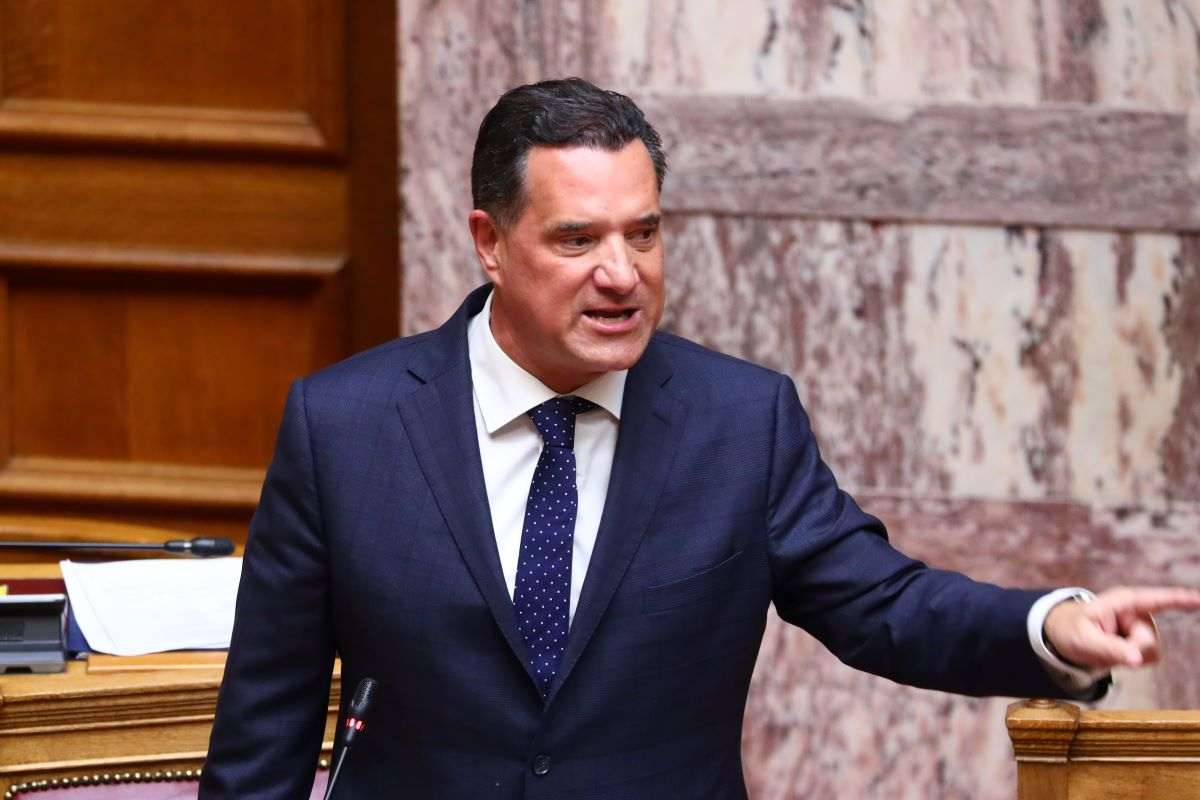
From the floor of the Greek Parliament to the headlines of the Turkish press, Adonis Georgiadis has found himself at the centre of a wider geopolitical confrontation over Greece’s deepening strategic relationship with Israel.
Turkey’s Sabah launched a sharply worded attack on the Greek Health Minister after remarks in which he defended Athens’ defence partnership with Israel and argued that it strengthens Greece’s ability to protect itself against potential threats.
Georgiadis himself highlighted the Turkish report in a post on X.
Sabah’s headline was unmistakably aggressive:
“Greek minister targets Ankara with arrogant remarks: The alliance with Israel protects us against Turkey!”
The Turkish newspaper went even further, describing Georgiadis’ intervention as a “scandalous provocation.”
Yet behind the inflammatory language lies a much bigger story.
This is not fundamentally about one Greek minister.
It is about Turkey’s growing concern over the changing military and strategic balance in the Eastern Mediterranean.
What Georgiadis actually said
The remarks that triggered the Turkish reaction were made in Parliament during a confrontation with a Communist Party of Greece (KKE) MP.
Georgiadis defended the approximately €3 billion Achilles Shield programme and congratulated Prime Minister Kyriakos Mitsotakis and Defence Minister Nikos Dendias on Greece’s expanding defence cooperation with Israel.
His central argument was straightforward:
“I consider the alliance with Israel important because it safeguards the freedom of the Greek state against any Turkish threat or any other threat.”
That distinction matters.
Georgiadis did not advocate military action against Turkey.
He described the Greek-Israeli partnership as an instrument of deterrence and national defence.
Sabah, however, framed the statement as an attack on Ankara.
And that difference between what Athens says and how Ankara presents it is increasingly becoming part of the Greek-Turkish geopolitical contest.


“We are here for the Greek people”
The parliamentary exchange became even sharper when the discussion turned to protests against Israel and the KKE’s criticism of Greece’s strategic relationship with Jerusalem.
Georgiadis made clear that, from his perspective, foreign and defence policy must be judged through the prism of Greek national interests.
“We will maintain this strategic alliance. We will serve it because we serve the interests of the Greek people.”
He then added:
“We do not serve the Soviet people, the communists, the proletariat or the Palestinian people. We are here for the Greek people.”
That language was inevitably controversial domestically.
But it also explains why Georgiadis’ intervention attracted attention in Turkey: he explicitly placed the Greek-Israeli relationship within the framework of Greece’s national security interests.
Achilles Shield is the real story
The real source of strategic concern is not Georgiadis’ rhetoric.
It is the Achilles Shield itself.
Greece and Israel signed an approximately €3 billion agreement to develop a multilayered air and missile defence architecture, representing the largest defence export agreement in the history of Israeli-Greek relations.
The system is designed to provide protection against ballistic missiles, aircraft, UAVs and other aerial threats.
Its architecture includes David’s Sling, BARAK MX and SPYDER systems, multi-mission radars and a new national command-and-control network.
A supplementary €26 million agreement covers Drone Dome counter-UAV capabilities.
This is therefore far more than another procurement programme.
It represents a significant restructuring of Greek air defence.
Why Ankara is watching the radars as much as the missiles
The strategic implications extend beyond interception.
Modern air defence depends on sensors, radar coverage, early warning, data fusion and command-and-control networks.
A more sophisticated Greek detection architecture can improve Athens’ situational awareness across the Aegean and parts of the Eastern Mediterranean.
For Turkey, that matters.
The Achilles Shield potentially increases the cost and complexity of any future military pressure against Greece by improving the country’s ability to detect, track and respond to airborne threats.
That is why the Turkish reaction should not be read simply as irritation over a ministerial statement.
The broader issue is deterrence.
Athens says deterrence — Ankara says “anti-Turkish front”
This is where the two narratives increasingly collide.
Athens argues that Greece is strengthening its defensive capabilities while building strategic relationships with countries such as France, the United States and Israel.
Turkey increasingly portrays those same developments as elements of an emerging regional alignment directed against Ankara.
Sabah’s coverage of Georgiadis illustrates that process almost perfectly.
Greece acquires a defensive architecture.
A Greek minister says it protects the country from potential threats.
And the Turkish headline becomes:
“Greek minister targets Ankara.”
That transformation is not merely media sensationalism.
It fits into a broader battle over which side is presented internationally as the destabilising actor.
From Filis’ warning to the Sabah headline
The episode is particularly striking in light of the warning recently made by international relations expert Konstantinos Filis.
Filis argued that Turkey’s fundamental positions toward Greece have not changed, but that Ankara is adapting the narrative surrounding them.
According to his assessment, Turkey increasingly seeks to portray itself as the defensive and stabilising actor while presenting Greece as a country that militarises islands, builds regional alliances and alters the regional balance.
The Sabah article provides a revealing example of precisely that mechanism.
A Greek defensive programme becomes evidence of an “anti-Turkish” policy.
A statement about deterrence becomes a “provocation.”
And cooperation with Israel becomes an alliance supposedly aimed directly at Turkey.
Israel is moving to the centre of the Greek-Turkish equation
There is another major change underway.
Israel is becoming increasingly prominent in Turkey’s interpretation of Greek foreign policy.
Athens sees Israel as an important strategic partner in defence, technology, intelligence, energy and regional security.
Ankara, by contrast, increasingly appears to view the Greece-Israel relationship through the lens of its own rivalry with Jerusalem.
That creates a potentially more complicated triangle:
Greece – Turkey – Israel.
The Achilles Shield makes that triangle more tangible because Israeli technology is becoming embedded in one of the most critical components of Greece’s defence architecture.
This does not mean that Greece has surrendered its strategic autonomy to Israel.
But it does mean that Greek-Israeli defence cooperation has reached a substantially deeper level.
Sabah even mobilises Greek criticism against the deal
Another revealing element of the Turkish article is its extensive use of criticism originating inside Greece.
Sabah cites Greek media commentary questioning the €3 billion price tag, the potential long-term technological dependence on Israeli systems and whether an increasingly close relationship with Israel could constrain Athens’ foreign-policy flexibility in the future.
Those are legitimate questions in Greece’s domestic political debate.
But Sabah deploys them for a different purpose: to demonstrate that the Achilles Shield is allegedly controversial even inside Greece.
This is a familiar feature of international information competition.
Arguments produced for domestic democratic debate are extracted and repackaged abroad to reinforce a completely different geopolitical narrative.
Georgiadis’ strongest argument: alliances are about national interests
Behind the combative language, Georgiadis’ core argument is rooted in a traditional principle of international politics.
States do not build defence partnerships because they agree on every issue.
They build them where strategic interests converge.
From this perspective, Greece does not have to endorse every decision of the Israeli government to conclude that cooperation with Israel in air defence, counter-drone technology, intelligence and military innovation can strengthen Greek national security.
That is why the most revealing sentence in Georgiadis’ intervention was perhaps the simplest:
“We are here for the Greek people.”
For the minister, the criterion is whether the partnership increases Greece’s ability to protect its territory and population.
The Turkish attack may reveal what has really changed
Sabah’s personal attack on Georgiadis could easily be dismissed as another provocative headline in the Turkish media.
But that would miss the larger strategic development.
Greece is acquiring a new multilayered air-defence architecture.
Its military relationship with Israel is deepening.
Its counter-drone and ballistic-missile capabilities are expanding.
And its wider network of defence relationships — from Israel to France and the United States — is increasing the country’s deterrence options.
None of that makes confrontation with Turkey inevitable.
The purpose of credible deterrence is precisely the opposite: to increase the cost of aggression and therefore reduce the incentive to attempt it.
That is why the reaction to Georgiadis matters.
The most important message coming from the Turkish coverage is not the insult directed at the Greek minister.
It is the strategic anxiety behind it.
If Ankara is paying this much attention to what Georgiadis said about the Achilles Shield, it is because the debate is no longer only about rhetoric. It is about a Greece that is building capabilities designed to make any future pressure against it considerably harder — and more expensive.
Source: pagenews.gr