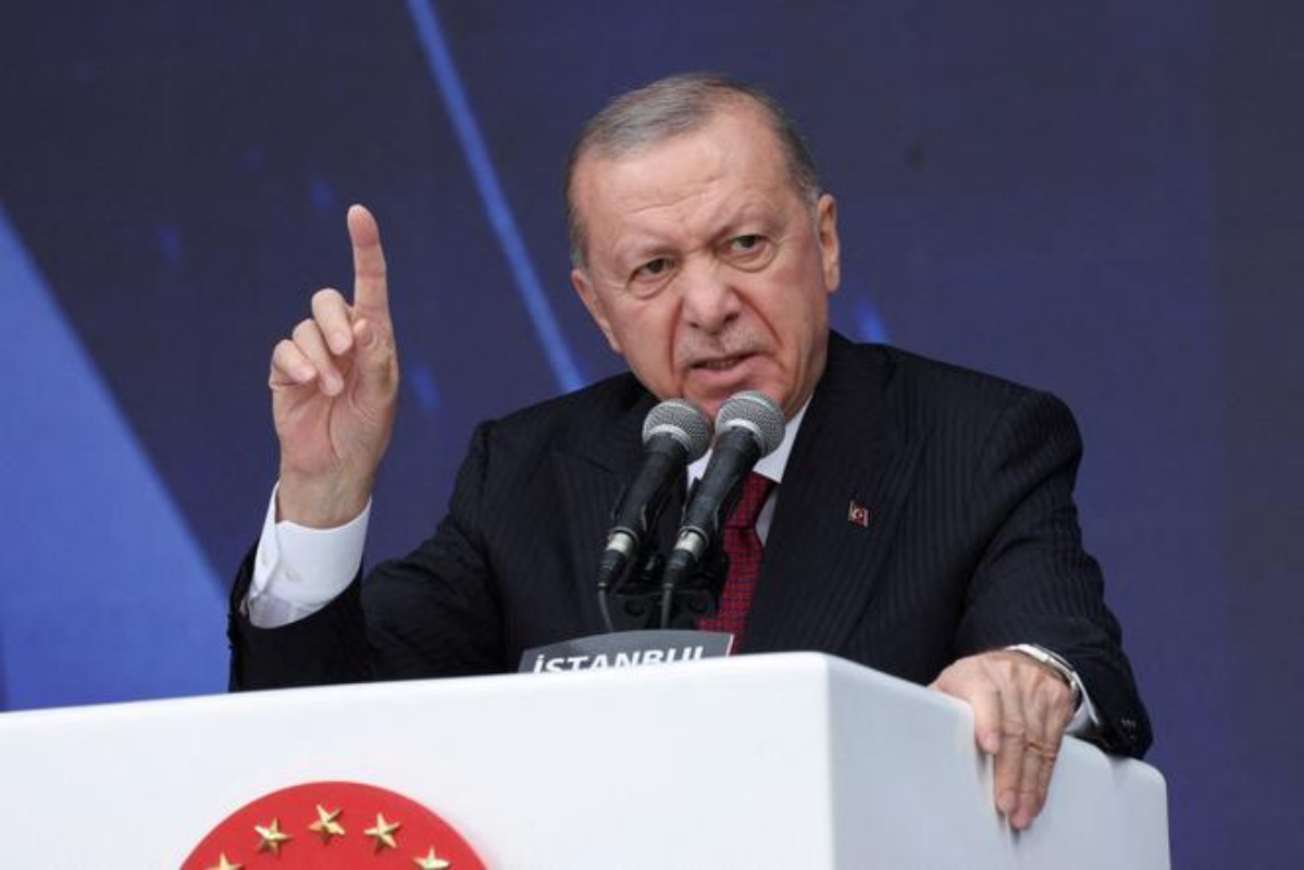
This is not just another hard-line statement from Recep Tayyip Erdoğan.
The Turkish president’s latest intervention on Greece comes at the end of a sequence of moves by Ankara that, within a matter of weeks, has brought almost the entire traditional catalogue of Greek-Turkish disputes back to the surface.
Demilitarization of the islands.
Disputed sovereignty over geographical formations.
Maritime zones.
Turkish marine parks.
Greek spatial-planning frameworks.
Research activity in the Eastern Mediterranean.
And, in the background, the “Blue Homeland” doctrine, the Greece-Cyprus electricity interconnector and Greece’s new air and missile defense architecture.
The era of “calm waters” has not formally collapsed.
But its substance is changing.
Turkey appears to be returning to a strategy of controlled pressure: keeping diplomatic channels open while simultaneously restoring claims that Athens considers outside any legitimate framework of negotiation.
And this time Erdoğan himself has stepped directly into the dispute.
Erdoğan: “Greece Must Understand This Once and for All”
Returning from Bishkek, Kyrgyzstan, Erdoğan chose to revive the issue of the military presence on Greek islands.
He first tried to combine a reassurance about Turkish intentions with a clear warning:
“Turkey has no designs on anyone’s territory, but it will not allow anyone to violate its rights.”
He then turned directly to Greece:
“Greece must abandon the wrong path it has taken and stop militarizing islands that have demilitarized status.”
And he added a historically loaded warning:
“History is a very good guide for those who know how to learn from it.”
“We Will Do Whatever Is Necessary”
The most consequential moment came when Erdoğan was asked what Turkey would do if what Ankara calls the militarization of the islands continued.
His answer was deliberately open-ended:
“We will do whatever is necessary.”
On its own, that sentence does not amount to an announcement of military action.
Nor should it be presented as a Turkish decision to seek confrontation.
But it is clearly intended as a deterrent signal, precisely because Erdoğan chose not to define what measures he had in mind.
He then followed with a second warning:
“Those who mistake our calm and prudent stance for weakness are making a grave mistake.”
This is where the statement becomes geopolitically significant.
Erdoğan is not rejecting dialogue.
He is rejecting the interpretation that de-escalation over the past few years means Turkey has abandoned its longstanding claims.
The Timing of the Achilles Shield Agreement
The remarks did not come in a strategic vacuum.
On August 31, Greece and Israel signed an approximately €3 billion agreement for the Achilles Shield, Greece’s new multilayered air and missile defense architecture.
The program includes advanced Israeli systems such as David’s Sling and SPYDER, a new command-and-control structure and a separate counter-drone element.
Erdoğan has not publicly said that his latest remarks were a direct response to Achilles Shield.
That distinction matters.
But the timing is difficult to ignore.
And the deeper point is that Achilles Shield is not merely another procurement package.
It raises the potential cost of future military pressure against Greece.
What Ankara Really Sees in the Islands Question
Turkey’s pressure over demilitarization is not new.
Ankara cites the Lausanne Treaty of 1923 and the Paris Peace Treaty of 1947 to argue that certain eastern Aegean islands and the Dodecanese are subject to military restrictions.
Athens rejects Turkey’s legal interpretation and invokes, among other arguments, Greece’s inherent right of self-defense in the current security environment.
This is the core issue.
Achilles Shield, new drone defenses, surveillance systems, upgraded combat aircraft and the wider Greek rearmament program are creating a different military environment in the Aegean.
So the demilitarization debate is no longer only an old legal argument about treaties.
It is also about who will possess credible deterrent power in the Aegean during the next decade.
The Escalation Started Before Erdoğan Spoke
The critical point is that Erdoğan did not begin this new phase.
He escalated it.
On August 15, Turkey established two “national marine parks,” one in the northeastern Aegean and another in the Eastern Mediterranean.
Athens responded officially that the parks extend beyond Turkish territorial waters and, where they cover international waters or areas of the Greek continental shelf, are unlawful and produce no legal effect.
The Greek Foreign Ministry stressed that unilateral measures cannot create faits accomplis or affect rights arising under international law.
Three Turkish Challenges in August
At the same time, Ankara began systematically challenging Greek Special Spatial Planning Frameworks.
On August 7 it reacted to the tourism framework.
On August 19 it responded to the renewable energy framework.
And on August 28 it objected to the framework for industry and supply chains.
The wording used repeatedly by Ankara is significant.
Turkey refers to geographical formations whose sovereignty, it claims, “has not been transferred to Greece by international treaties.”
In substance, this is the revival of the “grey zones” theory in institutional language.
And that may be more consequential than the temperature of any television statement.
Because Turkey is attempting to place its claims on the record every time Greece adopts an administrative act affecting the Aegean.


Athens: “Baseless and Unacceptable Claims”
Greece’s response on August 29 was equally clear.
The Foreign Ministry called the Turkish argument “baseless and unacceptable” and said repetition does not give it either legal foundation or substance.
It added:
“Greece’s position regarding the sovereignty regime in the Aegean is absolutely clear, is based on the international treaties in force and is not subject to further comment.”
That formulation matters.
Athens does not want to allow the sovereignty of Greek islands to become a subject of bilateral negotiation.
And Now Kastellorizo
Turkish activity south of Kastellorizo adds another layer.
Ankara is attempting to move its maritime claims from diplomatic maps into operational practice through research activity and NAVTEX notices.
This is the pattern that requires the closest monitoring.
There is a major difference between:
a statement,
a map,
and an actual vessel operating in a maritime area that Turkey disputes.
The more Ankara moves from the first category toward the third, the greater the possibility of operational friction.
Athens Takes the Issue to Europe
Greece’s response is not limited to bilateral protests.
Foreign Minister George Gerapetritis briefed his EU counterparts at the September 2 informal Foreign Affairs Council, the Gymnich, on developments in the Aegean and Eastern Mediterranean, including issues concerning violations of international law.
After the meeting he sent an unmistakable message:
“There is no possibility whatsoever that we will accept any retreat regarding our sovereignty and sovereign rights.”
He added:
“Aggression, wherever it comes from, has no color. It must be confronted uniformly and consistently.”
Athens is therefore attempting once again to Europeanize the pressure, linking Turkish behavior to the wider question of respect for international law.
Gerapetritis: “We Answer Empty Threats With Actions”
This line did not begin yesterday.
As early as August 23, Gerapetritis argued that Turkish moves in the Aegean and Eastern Mediterranean were partly a reaction to Greek initiatives aimed at exercising sovereign rights.
And he articulated a noticeably more assertive doctrine:
“Greek foreign policy is not determined by others.”
“We consistently follow our strategic planning, respond to empty threats with actions and elevate the strength of our national defense and geopolitical position to new levels.”
The phrase that best captures the shift was even sharper:
“The Greece of passive diplomatic immobility is irrevocably a thing of the past.”
The Deeper Rift: Greece and Turkey Do Not Even Agree on What Is Negotiable
Behind all of this lies an old but fundamental disagreement.
Athens recognizes the delimitation of the continental shelf and Exclusive Economic Zone as the central bilateral dispute that could potentially be submitted to international adjudication.
Turkey treats a much broader set of issues as interconnected:
demilitarization,
territorial waters,
airspace,
sovereignty over islets and rocks,
and maritime zones.
That is why Gerapetritis reiterated on September 1 that, in Greece’s view, international jurisprudence is clear:
“All islands have full sovereign rights, meaning full effect in terms of continental shelf and Exclusive Economic Zone.”
The First Major Test: Blue Homeland
The next important question is how far Turkey will go in further institutionalizing its maritime doctrine.
If Ankara attempts to turn Blue Homeland maps and claims into an even more binding state framework, the dispute moves to another level.
Because there is a difference between:
a strategic doctrine,
a map,
and a legal or administrative act of the Turkish state designed to embed those claims.
That will show how far Ankara is actually prepared to push.
The Second Test: The Greece-Cyprus Cable
Potentially even more dangerous operationally is the Great Sea Interconnector.
The resumption of survey work for the Greece-Cyprus electricity cable will test both sides in practice.
The 2024 precedent showed how quickly the activities of a research vessel can turn a legal disagreement over maritime zones into a real-world standoff.
This may become the most important test of the so-called calm waters.
Not what Athens and Ankara say.
But what they do when a ship reaches the precise area where their competing maritime claims overlap.
Why Erdoğan Is Raising the Pressure Now
At least four factors are converging.
First, Greece has moved from defensive waiting toward a long-term military modernization program.
Second, Achilles Shield dramatically deepens the strategic and technological relationship between Greece and Israel. The roughly €3 billion agreement is the largest defense deal ever signed between the two countries.
Third, Athens is increasingly using spatial planning, marine parks and energy projects to exercise in practice rights it believes derive from international law.
Fourth, Turkey is trying to consolidate its own position as a regional power in an Eastern Mediterranean where the balance is changing.
There does not need to be one single explanation for Erdoğan’s sharper rhetoric.
More likely, we are watching a reaction to a broader shift in the strategic environment.
Is This a Return to the 2020 Crisis?
Not necessarily.
That needs to be stated clearly.
There is currently insufficient evidence to conclude that Turkey has decided to recreate an Oruc Reis-style confrontation.
Diplomatic channels remain open.
The 2023 Athens Declaration is still the formal framework, and in February 2026 Mitsotakis and Erdoğan reaffirmed their commitment to good-neighborly relations, peaceful coexistence and the continuation of Political Dialogue, the Positive Agenda and confidence-building measures.
That is precisely why the latest shift matters.
It is not a complete rupture.
It is the return of pressure inside a relationship where both sides continue to talk.
And that can be more complex than an openly declared crisis.
The Bigger Picture: From “Calm Waters” to Armed Deterrence
The real question is not whether Erdoğan suddenly became tougher toward Greece.
Turkey’s core positions are old.
What has changed is the concentration of multiple fronts at the same time.
Ankara is recording claims.
Issuing diplomatic statements.
Challenging Greek administrative acts.
Publishing its own maritime maps.
Using NAVTEX and research activity.
And now the Turkish president himself has returned to the demilitarization question with the warning:
“We will do whatever is necessary.”
Athens, meanwhile, is no longer responding only diplomatically.
It is building military power.
Signing Achilles Shield.
Deepening international partnerships.
Taking Turkish moves to the European level.
And declaring:
“There is no possibility whatsoever that we will accept any retreat regarding our sovereignty and sovereign rights.”
That means Greek-Turkish relations are entering a new and potentially more demanding phase.
Not yet a crisis.
Not necessarily a return to 2020.
But not the same “calm waters” either.
The decisive test will come when words meet operational reality: over the Greece-Cyprus cable, maritime surveys, new Turkish maps and the deployment of Greece’s new defense architecture.
Because the question this autumn is no longer whether Athens and Ankara disagree.
It is whether they can manage that disagreement while both sides are simultaneously trying to reshape the balance of power in the Aegean and Eastern Mediterranean.
Source: pagenews.gr