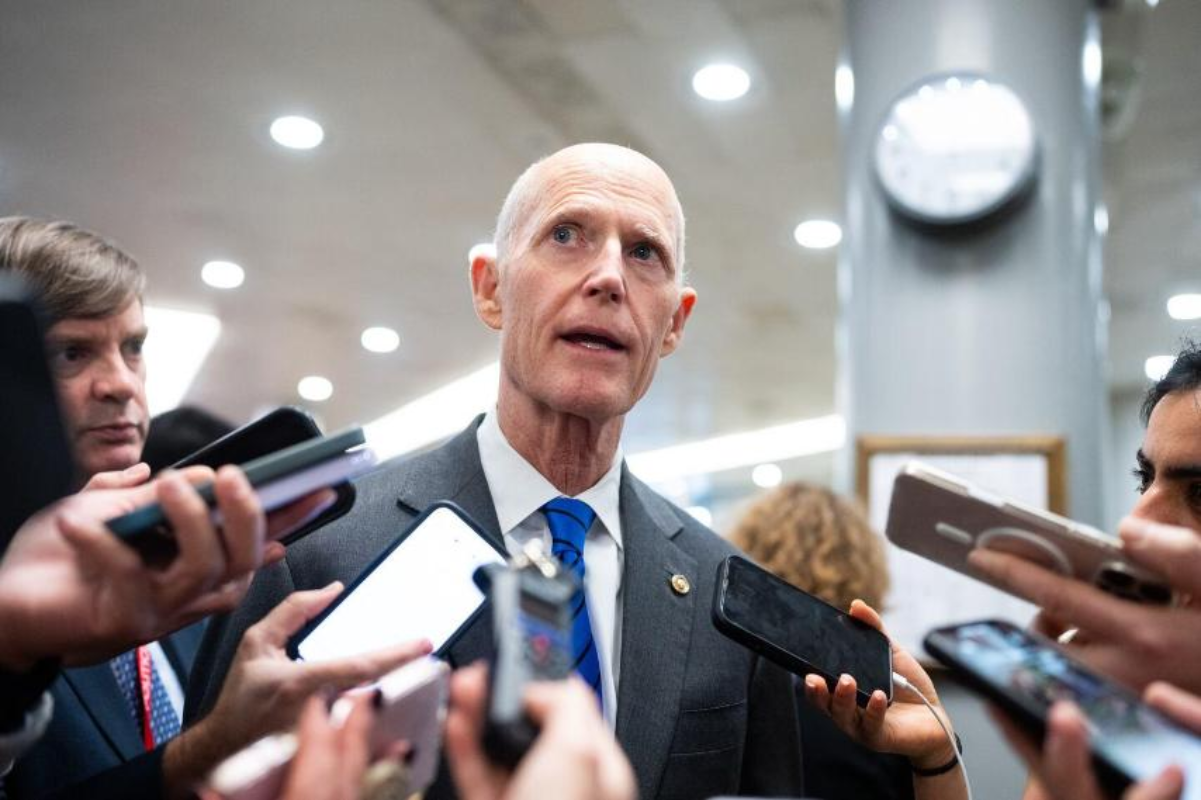
U.S. Senator Rick Scott delivered a sharp message to Ankara from Athens, describing Turkey’s conduct toward Greece and Cyprus as “thuggish behavior.” His intervention combined criticism of Turkish actions in the Eastern Mediterranean with support for the planned electricity interconnection between Greece and Cyprus, which could eventually extend to Israel.
The Florida Republican, who serves on the Senate’s Armed Services and Foreign Relations committees, questioned whether Turkey’s behavior was consistent with its responsibilities as a NATO ally.
His remarks put both regional security and energy infrastructure at the centre of the discussion, highlighting the political significance of cooperation between Athens, Nicosia and Jerusalem.
“You’re Not Acting Like a NATO Ally”
Scott referred to military overflights and the continuing presence of Turkish troops in northern Cyprus, using unusually blunt language toward a fellow NATO member.
“You’re not acting like a NATO ally when you get F-16s and fly over somebody else’s country. You’re not much of an ally when you occupy part of another country’s land. And that’s what they’re doing,” he said.
“I hope that changes, but if you look at it, it’s thuggish behavior.”
The central point of his criticism was allied credibility. Scott connected Turkey’s standing within NATO to its treatment of Greece and the Republic of Cyprus.
The two countries occupy different institutional positions: Greece belongs to NATO, while Cyprus does not. Nevertheless, the senator placed both within a broader argument about Ankara’s regional conduct and its implications for cooperation in the Eastern Mediterranean.


The Electricity Interconnection Takes Centre Stage
Scott’s intervention comes as the Greece–Cyprus electricity interconnection returns to the diplomatic spotlight.
The project carries substantial significance for Cyprus’s energy security and for the development of interconnected electricity networks across the Eastern Mediterranean. Its potential extension to Israel would add a further dimension to regional energy cooperation.
Turkey’s objections to the surveys required for the project have introduced additional diplomatic complications. Against that background, Scott presented cooperation between Greece, Cyprus and Israel as beneficial to the United States as well as the participating countries.
“I think what Greece, Cyprus and Israel are doing will be good. It’s good for them, good for us,” he said.
That formulation gives the project a broader political meaning. By explicitly connecting it to American interests, Scott strengthened the argument that its implementation matters beyond the electricity markets directly involved.
A Senate Signal With Diplomatic Weight
Scott’s membership of the committees responsible for defence and foreign relations gives his intervention institutional significance.
The Senate is an important arena for shaping U.S. policy on security, military equipment and international partnerships. Support expressed there can help sustain attention on regional projects and the obstacles facing them.
For Athens and Nicosia, the practical objective is to translate political backing into consistent diplomatic engagement as the interconnection advances.
Scott’s remarks express his position as a senator; they do not themselves constitute an executive decision or an operational security guarantee for the project. Their importance lies in the clear political support they provide and the pressure they place on Turkey to avoid obstructing regional cooperation.
Greek–American Relations Beyond Changes of Personnel
Scott also stressed the strength of Greek–American relations, saying they were not expected to be affected by Kimberly Guilfoyle’s departure as U.S. ambassador to Greece.
His comments emphasised the continuity of bilateral cooperation beyond changes in diplomatic personnel.
Read alongside his support for the electricity interconnection, that message places the relationship within a wider framework of security and energy interests in the Eastern Mediterranean.
The clearest commitment in his remarks concerned assistance for the project and efforts to prevent Turkish interference:
“We’ll do everything we can to help. We’ll do everything we can to make sure Turkey doesn’t cause problems.”
Source: pagenews.gr