The Eastern Mediterranean is entering another critical phase of geopolitical competition, with Greece seeking to advance the Greece–Cyprus electricity interconnection while reinforcing its diplomatic opposition to Turkey’s maritime claims.
At the center of the dispute are two closely connected developments: preparations for the resumption of marine surveys associated with the Great Sea Interconnector (GSI), and a coordinated diplomatic intervention at the United Nations challenging the legal validity of the Turkey–Libya maritime memorandum.
Athens is attempting to establish a clear distinction between technical notification and political recognition of maritime jurisdiction — a distinction that could prove decisive for the future of the multibillion-euro energy infrastructure project.
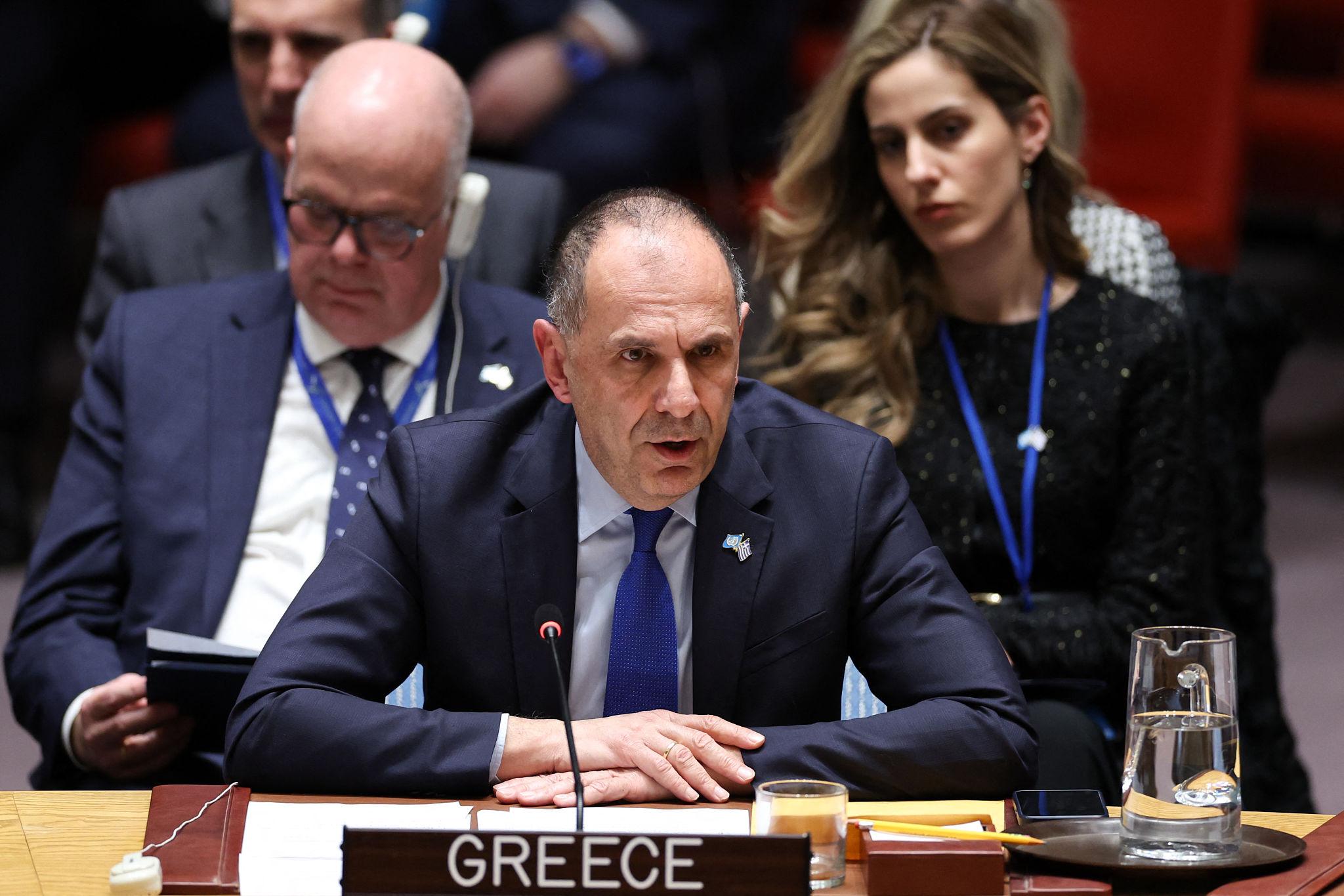
Meanwhile, Greek Foreign Minister George Gerapetritis has taken the dispute to the UN Security Council, presenting a joint position supported by Greece, Cyprus, Egypt, Bahrain, the United Arab Emirates and the European Union.
The immediate challenge is whether the project can move forward without triggering another confrontation similar to the tensions recorded near the Greek island of Kasos in July 2024.
The French Dimension: Technical Notification or Recognition of Turkish Authority?
The potential involvement of French cable manufacturer Nexans in communications concerning upcoming maritime surveys has emerged as a sensitive diplomatic issue.
Athens has emphasized that any notification to countries potentially affected by the surveys must remain strictly technical and must not be interpreted as a request for authorization.
However, an important distinction has emerged between reports of a proposed notification procedure and the company’s own position.
Nexans has publicly denied that it had contacted, or planned to contact, Turkish authorities regarding the forthcoming surveys. Consequently, direct French notification to Ankara cannot be treated as a confirmed development.
The broader question nevertheless remains politically significant.
Under international maritime procedures, notifications may be used to communicate information about planned offshore activities. Such communications do not automatically establish the jurisdiction of the recipient state.
For Greece, maintaining that distinction is essential.
Athens argues that the implementation of the electricity interconnection must not create a precedent that could be interpreted as recognition of Turkish maritime claims in areas where Greece asserts sovereign rights.
This is particularly important because Ankara relies in part on its maritime agreement with Libya to support its position in the Eastern Mediterranean.


Greek Government: “No Authorization Will Be Requested From Any Other State”
Greek government spokesperson Pavlos Marinakis delivered an unequivocal message concerning the authorization procedures for the project.
“We state clearly once again that no authorization will be requested from any authority of any other state beyond the Greek authorities,” Marinakis said in response to a question from Business Daily.
He explained that the relevant licensing procedures would be followed by the standard process of informing states that might be connected to the planned activities.
According to Marinakis, this involves:
“The standard procedure applicable to such projects of simply notifying all states that may be concerned.”
He emphasized that such notification does not produce legal consequences regarding maritime jurisdiction.
The distinction is central to the government’s argument.
A request for authorization could imply recognition that the recipient state has the legal authority to approve or reject the activity.
A technical notification, by contrast, does not necessarily carry that implication.
Marinakis maintained that an authorization request “could not be made to any other country or authority beyond a Greek authority.”
The government’s position is therefore designed to protect Greece’s legal claims while allowing the technical preparation of the interconnection project to proceed.
Angelos Syrigos: The Notification Must Explicitly State That It Is Not a Permit Request
New Democracy lawmaker and professor of International Law and Foreign Policy Angelos Syrigos reinforced the importance of legal precision.
Speaking to ERTNEWS, Syrigos stressed that the Greece–Cyprus electricity interconnection must advance, while highlighting the need for carefully worded documentation.
He argued that any written notification should explicitly state:
“At the bottom of the notification, it must be expressly stated that this does not constitute an application for authorization.”
His intervention illustrates how even the wording of a technical document can acquire geopolitical significance in contested maritime areas.
The concern is not simply administrative.
An ambiguous communication could potentially be cited in subsequent diplomatic exchanges as evidence of an acknowledgment of jurisdiction.
For that reason, Syrigos emphasized the importance of eliminating any such ambiguity.
PASOK: The Project Must Be Completed Without Recognizing Turkish Claims
The issue has also prompted a response from opposition leader Nikos Androulakis, president of PASOK.
Androulakis stated that the electricity interconnection “must be completed,” while warning against any procedure that could be interpreted as acknowledging Turkish rights.
He insisted that Greece must not tolerate:
“Any recognition, even indirect, of rights claimed by Turkey that it does not possess.”
His position highlights an area of convergence between the government and the main opposition regarding the strategic importance of the interconnection.
Disagreements remain over diplomatic handling and implementation, but both sides have emphasized the need to complete the project without compromising Greece’s legal position.
Gerapetritis at the UN: “The Turkey–Libya Memorandum Remains Null and Void”
The second major diplomatic front unfolded at the United Nations.
Greek Foreign Minister George Gerapetritis delivered a joint statement on behalf of Greece, Cyprus, Egypt, Bahrain, the United Arab Emirates and the European Union, challenging the Turkey–Libya maritime memorandum.
The statement directly questioned the agreement’s compatibility with international law.
“The memorandum in question remains null and void, is contrary to international law and cannot constitute a lawful basis for the delimitation of maritime zones or produce legal effects for third states,” Gerapetritis declared.
The intervention followed reports of the memorandum’s ratification by the Libyan parliament, a development that the participating governments warned could increase regional tensions.
The Greek position rests on the argument that bilateral maritime agreements cannot disregard the lawful maritime entitlements of third countries.
Athens maintains that the Turkey–Libya memorandum fails to respect the maritime rights of Greek islands and cannot legitimately determine maritime boundaries affecting Greece.
Turkey disputes that interpretation and continues to defend its agreement with Libya.
The competing positions remain at the heart of the Eastern Mediterranean maritime dispute.


The European Union Enters the Diplomatic Confrontation
The intervention at the UN was reinforced by a separate European statement.
Following Gerapetritis’s remarks, the EU representative presented a joint statement issued by High Representative for Foreign Affairs and Security Policy Kaja Kallas on behalf of the Union’s 27 member states.
The European dimension is particularly important for Athens.
The EU has repeatedly maintained that the Turkey–Libya maritime memorandum does not comply with the Law of the Sea and cannot affect the rights of third states.
By placing the dispute within a European institutional framework, Greece seeks to demonstrate that the disagreement extends beyond a bilateral confrontation with Ankara.
The issue concerns broader questions of maritime jurisdiction, regional stability and the legal foundations of international energy infrastructure.
Nevertheless, European diplomatic statements do not themselves resolve contested maritime boundaries or eliminate the possibility of incidents at sea.
Their principal significance lies in establishing and reinforcing a common political and legal position.
Egypt’s Role: A Strategic Partner in the Eastern Mediterranean
Egypt’s participation adds another important dimension to the diplomatic effort.
Cairo has direct interests in the maritime boundaries of the Eastern Mediterranean and has developed extensive cooperation with Greece and Cyprus in the energy and security sectors.
The Turkey–Libya memorandum has long been a source of disagreement between Ankara and Cairo, although the two countries have also pursued diplomatic normalization.
According to reports in Arab media, Egypt is considering additional legal initiatives concerning the memorandum, potentially including a submission to the UN Security Council.
These reports have not, in the material available, been accompanied by confirmation of a formal submission.
If implemented, such measures could broaden the diplomatic debate over the agreement.
The participation of Bahrain and the United Arab Emirates further demonstrates the regional significance of the dispute.
It also reflects the wider intersection of maritime security, diplomatic alignments and energy interests in the Eastern Mediterranean.
António Guterres: The Law of the Sea Must Be Respected
UN Secretary-General António Guterres, speaking during a visit to Egypt, also addressed the importance of international maritime law.
Asked about the controversy, he stated:
“Anything that is not compatible with the Convention on the Law of the Sea should neither be respected nor accepted.”
The remarks reinforced the importance of the UN Convention on the Law of the Sea as a framework for assessing maritime claims.
They should not, however, be interpreted as a binding judicial ruling specifically invalidating the Turkey–Libya memorandum.
Turkey is not a party to UNCLOS, although several principles governing maritime entitlements are also recognized under customary international law.
The legal dispute therefore involves both treaty provisions and broader principles of international maritime law.
Washington’s Position: A Sharper American Response
The United States has also entered the diplomatic discussion.
According to the reported statements, the US State Department adopted a more critical tone following its initial reaction to the reported Libyan ratification of the maritime memorandum.
Washington subsequently described the development as provocative and noted that it had increased tensions in the region.
The change in wording attracted attention in Athens, where US diplomatic positions are closely monitored.
The Eastern Mediterranean remains strategically important to Washington because of its location, energy infrastructure, maritime routes and security relationships.
Nevertheless, a sharper diplomatic statement should not be confused with a binding legal determination of maritime boundaries.
The significance of the American response lies primarily in its political message and its potential influence on regional diplomatic calculations.
Erdoğan Defends the Turkey–Libya Agreement
Turkish President Recep Tayyip Erdoğan rejected criticism of the maritime memorandum and reiterated Ankara’s position.
“I repeat to those attempting to exclude Turkey from the Eastern Mediterranean that we expect respect for the common will of our country and Libya,” Erdoğan said.
He also argued that objections to the agreement “lack a legal basis.”
Turkey maintains that its maritime agreement with Libya reflects legitimate maritime entitlements.
Greece and Cyprus reject that position, particularly regarding the effect of islands on maritime delimitation.
These conflicting interpretations explain why the Great Sea Interconnector has acquired a geopolitical significance extending far beyond its engineering and financial dimensions.
Why the Great Sea Interconnector Matters to European Energy Security
The Greece–Cyprus electricity interconnection is one of the most strategically significant energy infrastructure initiatives in the Eastern Mediterranean.
Cyprus remains electrically isolated from the interconnected continental European power grid.
The Great Sea Interconnector is designed to help overcome that isolation by establishing a high-capacity submarine electricity connection.
Its objectives include improving energy security, enabling cross-border electricity exchanges and supporting the integration of renewable energy sources.
The project could also create new opportunities for regional energy cooperation.
Yet its geopolitical importance is equally substantial.
The interconnector raises a fundamental question: can strategically important European energy infrastructure be developed in maritime areas where competing jurisdictional claims remain unresolved?
The answer will depend not only on diplomacy, but also on regulatory decisions, financing, technical implementation and the management of security risks.
Three Critical Tests Ahead
The coming phase of the dispute will be shaped by three closely connected developments.
First, the resumption of offshore surveys. The response of Turkish authorities to any renewed activity will be crucial in determining whether tensions can be contained.
Second, the diplomatic campaign against the Turkey–Libya memorandum. Greece will seek to maintain cooperation with Cyprus, Egypt, European institutions and other regional partners while defending its interpretation of international maritime law.
Third, the project’s commercial and regulatory viability. Even if diplomatic tensions ease, the interconnector must still overcome the technical, financial and institutional challenges associated with major cross-border energy infrastructure.
Progress on one front will not automatically guarantee success on the others.
Athens Seeks to Advance the Project Without Conceding Jurisdiction
The latest developments highlight the dual objective of Greek foreign policy in the Eastern Mediterranean.
Athens wants the Great Sea Interconnector to proceed as a strategically important European energy project while preventing technical procedures from being interpreted as recognition of contested Turkish maritime claims.
Marinakis’s insistence that no Turkish authorization will be requested, Syrigos’s warning about the precise wording of any notification and Gerapetritis’s intervention at the United Nations all reflect different aspects of this approach.
At the same time, Turkey continues to defend the legal and political foundations of its maritime agreement with Libya.
The decisive test will not be the strength of diplomatic statements alone, but whether offshore operations can resume without another confrontation and without creating new legal ambiguities.
For Greece, Cyprus and the European Union, the Great Sea Interconnector is more than an electricity cable.
It is an energy security investment, a test of regional cooperation and an example of how infrastructure development increasingly intersects with the geopolitical balance of the Eastern Mediterranean.
Source: pagenews.gr