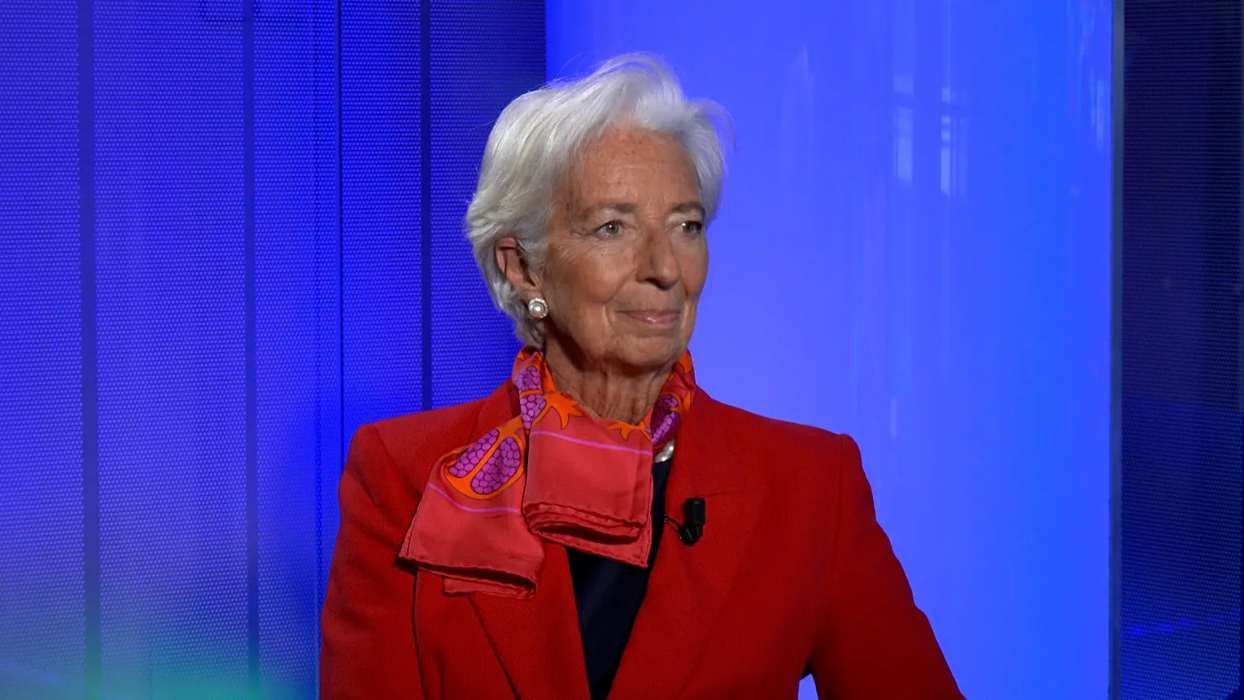
Christine Lagarde has announced that she will leave the presidency of the European Central Bank on February 7, 2027, triggering an early succession process at one of Europe’s most influential institutions.
Her term was scheduled to end in late October 2027. Leaving roughly nine months early gives European leaders an opportunity to appoint her successor before France’s presidential election — a contest that could reshape the political balance surrounding major European appointments.
The departure date is official. Lagarde’s full personal and political reasoning is not explained in the ECB’s brief announcement.
That leaves two questions: who will lead the institution through its next monetary challenges, and why is the transition being brought forward now?
A succession before France’s political uncertainty
The ECB confirmed that Lagarde had informed its Governing Council and European Council President António Costa of her decision.
The political significance of the timetable is clear. Negotiations over her successor can proceed while Emmanuel Macron remains France’s president, ahead of an election in which Marine Le Pen is polling strongly, according to Reuters.
France does not choose the ECB president alone. As one of the euro area’s largest economies, however, it carries substantial weight in the negotiations.
A change of leadership in Paris could alter priorities, alliances and negotiating positions. Lagarde’s early departure creates room for an agreement before that potential shift. That is a political consequence of the decision, rather than an officially stated explanation for it.
Davos remains a possibility, not a confirmed destination
For months, reports have linked a possible early departure to a future role at the World Economic Forum.
Reuters identifies the organisation behind the Davos gathering as a possible destination. The ECB announcement does not confirm a new appointment or agreement.
The distinction matters: the resignation settles whether Lagarde will complete her term. It does not establish where she will go next.
Pierrakakis signals a rapid appointment process
The announcement immediately activates Europe’s succession machinery.
Eurogroup President Kyriakos Pierrakakis thanked Lagarde for her contribution to euro-area stability and said:
“The Eurogroup will act swiftly” to prepare the recommendation on the appointment.
The European Council appoints the next president following a recommendation from the Council of the EU and consultations with the European Parliament and the ECB Governing Council.
The procedure is established, but reaching an agreement requires political negotiation. Governments will seek a candidate combining technical credibility with broad support.


Knot and Hernández de Cos move into focus
Former Dutch central bank governor Klaas Knot and former Bank of Spain governor Pablo Hernández de Cos are regarded as leading contenders.
Their prominence does not amount to an agreement, nor does it exclude other candidates.
The next president will face a demanding task: preserving confidence in the ECB’s independence, coordinating policymakers with different national economic experiences and explaining difficult decisions to governments, businesses and households.
A new appointment will not resolve the economic problems the next president inherits.
Energy inflation meets weaker growth
The transition comes as energy prices and the Iran war generate renewed inflationary pressure.
Higher oil and fuel costs affect transport, production and household budgets. The ECB must assess whether that initial shock is spreading into wages, services and broader prices.
Higher interest rates can restrain demand and limit those effects. They cannot increase energy supply, and they also weigh on investment and borrowers.
Before Thursday’s policy announcement, the ECB was widely expected to keep its deposit rate at 2.5%, while leaving open the possibility of another increase, potentially in December.
That was a pre-meeting expectation, rather than a confirmed outcome of the decision.
French debt adds another complication
Rising government bond yields, particularly in France, are creating an additional financing challenge.
Higher borrowing costs can extend beyond government budgets to businesses, mortgages and economic activity.
This complicates the ECB’s judgment. Financial conditions may already be restraining demand while energy costs continue pushing prices higher.
Containing inflation without unnecessarily deepening an economic slowdown requires careful balancing. An early leadership transition adds succession negotiations to that difficult equation.
Europe seeks continuity before the handover
Lagarde remains president until February 7, and monetary policy continues to be decided collectively by the Governing Council.
Her departure does not, by itself, signal a change in interest rates or an abandonment of the current policy approach. It does bring forward negotiations that would otherwise unfold under a potentially different French political landscape.
For European leaders, the immediate challenge is to agree on a successor in time. For the next president, it will be to take over without weakening confidence in the euro while pressures on energy, inflation and public finances persist.
Source: pagenews.gr