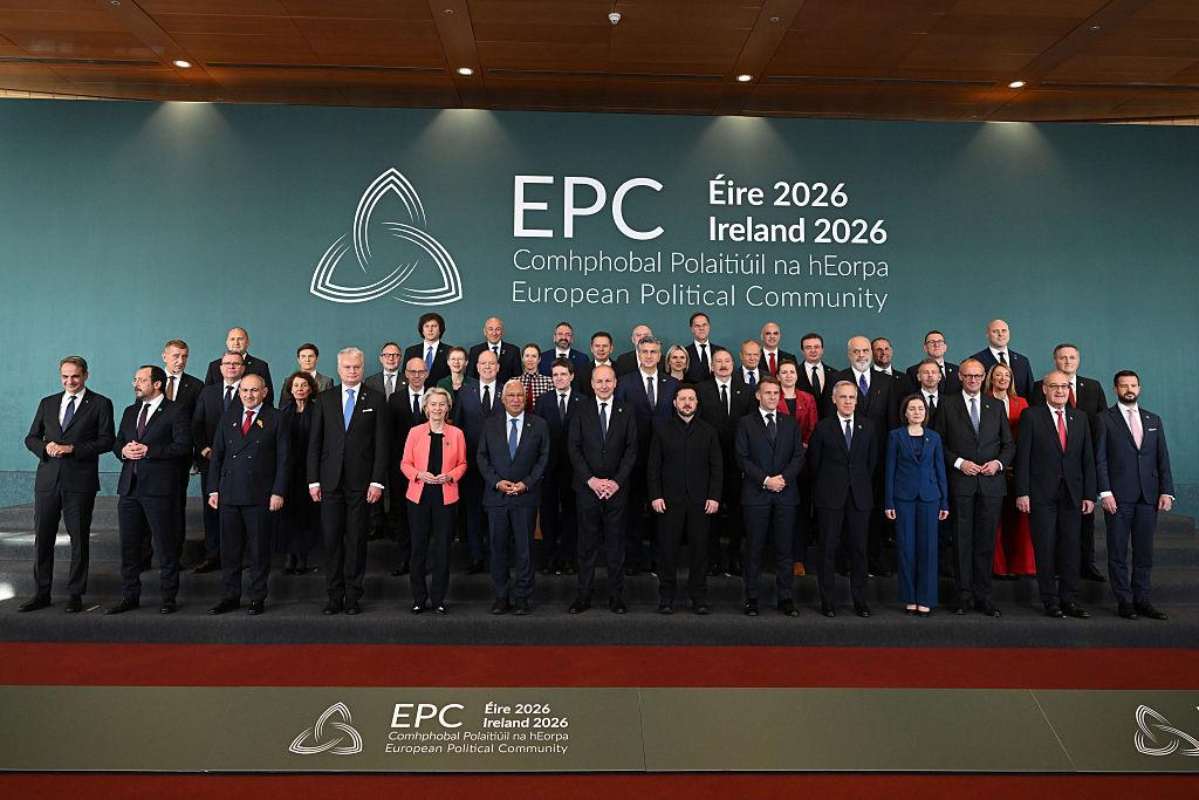
Europe faces one of its most consequential diplomatic challenges since Russia launched its full-scale invasion of Ukraine: Will it help negotiate the terms of peace, or will it be expected to implement an agreement largely shaped by Washington, Kyiv and Moscow?
The ninth European Political Community summit in Dublin brought that question into sharp focus.
European leaders reaffirmed their unwavering support for Ukrainian President Volodymyr Zelenskyy and Ukraine’s sovereignty. Yet behind the declarations of unity, disagreements remain over who should represent European interests in future negotiations with Russia.
Meanwhile, US envoys Jared Kushner and Steve Witkoff have emerged as central figures in the diplomatic process, with negotiations in Abu Dhabi and contacts with Moscow generating cautious expectations of progress towards a possible peace agreement.
The stakes extend far beyond Ukraine.
They concern the future of European security, NATO’s strategic role, transatlantic relations and the European Union’s ability to influence decisions that will shape the continent for decades.
Costa and von der Leyen: Europe Must Remain Part of the Peace Process
European Council President António Costa and European Commission President Ursula von der Leyen sought to project unity during the Dublin summit.
In a joint statement, they welcomed the talks taking place in Abu Dhabi and the renewed diplomatic momentum surrounding efforts to end the war.
“The EU has been involved in these peace talks and will continue to be engaged in this process,” they said.
They also reiterated Europe’s commitment to supporting Ukraine.
“We will continue to stand by Ukraine – as we have done since the first day of Russia’s war of aggression – supporting efforts to achieve a just and lasting peace that safeguards Ukraine’s sovereignty and territorial integrity, as well as the security of our own continent.”
The statement carries considerable political significance.
Brussels is not merely expressing solidarity with Kyiv. It is asserting that Europe must remain actively involved in shaping any eventual settlement.
However, an important distinction remains unresolved: whether European participation will mean direct representation at the principal negotiating table or continued consultation through parallel diplomatic channels.
For EU leaders, the difference is fundamental.
A peace agreement negotiated without meaningful European involvement could leave the bloc responsible for implementing security, financial and political commitments it had little influence over.


Abu Dhabi and Moscow: Washington Sets the Diplomatic Pace
The diplomatic centre of gravity has increasingly shifted away from Brussels towards Abu Dhabi, Moscow and Washington.
American envoys Jared Kushner and Steve Witkoff have played prominent roles in the Trump administration’s efforts to establish a framework for ending the conflict.
Their contacts with Russian and Ukrainian representatives have raised expectations that negotiations could enter a more substantive phase.
During the Dublin summit, particular attention focused on a planned meeting between the American negotiators and President Zelenskyy at Ireland’s Baldonnel airfield.
For European governments, the central question was whether Moscow would accept European representatives in future negotiating rounds.
The issue is not simply one of diplomatic prestige.
Any settlement could involve security guarantees for Ukraine, the future of sanctions against Russia, reconstruction financing and possible European military commitments.
These are areas in which European governments would be expected to assume substantial responsibilities.
Consequently, European leaders argue that they cannot be excluded from decisions that directly affect their security and economic interests.
Costa Questions Moscow’s Intentions: Does Russia Really Want Peace?
Despite welcoming renewed diplomatic engagement, European leaders remain cautious about the Kremlin’s intentions.
Addressing the approximately 40 leaders gathered in Dublin, António Costa identified what he regarded as the central unresolved question: “Whether Russia is genuinely interested in peace.”
The remark reflected a broader concern among European governments that diplomatic activity should not be confused with a credible commitment to ending the war.
NATO Secretary-General Mark Rutte expressed similar reservations.
“Is Russia actually willing to cooperate? That is precisely what we need to assess,” he said.
European policymakers are concerned that an agreement lacking enforceable guarantees could produce only a temporary suspension of hostilities.
From their perspective, a durable settlement must address the underlying security conditions that could otherwise allow renewed military confrontation.
That makes the design of any peace agreement as important as the immediate objective of securing a ceasefire.
Who Speaks for Europe? The Costa Versus E3 Dilemma
One of the most politically sensitive questions emerging from Dublin concerns European representation in negotiations with Moscow.
Several leaders reportedly suggested that António Costa could serve as Europe’s principal interlocutor.
As president of the European Council, Costa has an institutional mandate to represent the EU externally at the level of heads of state and government within his responsibilities.
His appointment could reinforce the legitimacy of the EU’s role and demonstrate that European institutions are acting collectively.
Yet the European Union is not the only relevant diplomatic framework.
The E3 grouping — Germany, France and the United Kingdom — has played an important role in coordinating European responses to the war.
These three countries possess significant diplomatic influence, economic resources and military capabilities.
Britain’s participation is particularly important because, despite leaving the European Union, London remains a major European security actor and a leading NATO member.
The choice therefore presents two competing approaches.
An EU-led format would emphasise institutional unity and collective European representation.
An E3-led approach could offer greater flexibility, particularly where negotiations involve military commitments and national security guarantees.
Neither model automatically resolves the central problem: the need for a common European negotiating position.
Macron: “The Format Is Determined by the Substance”
French President Emmanuel Macron avoided endorsing a specific negotiating structure during the summit.
“The format is determined by the substance,” he said upon arrival.
His remarks suggested that the identity of Europe’s representative should depend on the issues under negotiation.
If discussions focus on EU sanctions, financial assistance or economic arrangements, the European institutions would have a central role.
If negotiations move towards military guarantees, troop deployments or bilateral defence commitments, national governments and NATO would become more directly involved.
Macron’s position reflects the complexity of Europe’s institutional architecture.
The EU possesses substantial economic and regulatory power, but military authority remains largely in the hands of individual member states.
As a result, choosing one representative would not necessarily mean that person could commit every European government to all aspects of a peace agreement.
Europe’s Institutional Problem: Many Voices, Different Powers
The disagreement over representation exposes a longstanding weakness in European foreign policy.
The European Union has developed mechanisms for coordinating diplomacy, sanctions and financial assistance, but major security decisions still depend heavily on national governments.
The European Commission plays a central role in economic support, regulatory measures and the implementation of EU programmes.
The European Council establishes the Union’s broad political priorities.
The EU’s High Representative for Foreign Affairs and the European External Action Service coordinate important aspects of common foreign and security policy.
Individual member states, however, retain decisive authority over many military commitments.
This institutional division creates practical difficulties when negotiating a comprehensive peace settlement.
A European representative would require a clearly defined mandate, agreed objectives and an understanding of which commitments could be made on behalf of the EU and which would require national approval.
Without such clarity, Europe’s participation could become symbolically important but operationally limited.
Security Guarantees: The Real Test of European Influence
Behind the debate over diplomatic representation lies the most consequential question for Ukraine’s future: security guarantees.
Any credible settlement would have to address several difficult issues.
Who would guarantee compliance with a ceasefire?
How would violations be monitored and investigated?
What would Ukraine’s future relationship with NATO look like?
Could European countries provide military guarantees, and under what conditions?
How would sanctions relief be linked to Russia’s implementation of an agreement?
These questions directly affect the security of European states, particularly those on NATO’s eastern flank.
They also raise broader concerns about deterrence, military preparedness and the credibility of Western security commitments.
For European governments, participation in negotiations is therefore essential not merely because of their support for Ukraine, but because the outcome could reshape their own strategic environment.
November 26–27: Ukraine’s 2027 Financing Needs Move to the Forefront
The next important date on the European diplomatic calendar is the European Council meeting scheduled for November 26–27.
According to the joint statement by Costa and von der Leyen, EU leaders will discuss Ukraine’s urgent financing requirements for 2027.
The issue is critical to Kyiv’s economic resilience.
Ukraine requires continued support to maintain essential government services, protect critical infrastructure and sustain economic stability.
Any transition towards a ceasefire or peace settlement would also generate additional reconstruction and recovery needs.
European financial assistance is therefore more than an expression of political solidarity.
It represents a significant source of negotiating influence.
By helping sustain Ukraine’s institutions and economy, the EU contributes to Kyiv’s ability to negotiate without being driven solely by immediate financial pressures.
The 22nd Sanctions Package: Economic Pressure as Diplomatic Leverage
The European Commission is also preparing to present a 22nd package of sanctions against Russia, according to the statement cited in the summit reporting.
The objective is to maintain economic pressure on Moscow while diplomatic efforts continue.
Costa and von der Leyen explained the rationale:
“Ukraine must negotiate from a position of strength. And Russia must be convinced to come to the negotiating table with a genuine intention to achieve peace.”
The European strategy rests on the assumption that economic restrictions can increase the costs of prolonging the war and strengthen incentives for a negotiated settlement.
However, the effectiveness of sanctions depends on enforcement, international coordination and the ability to limit circumvention through third countries.
A future peace agreement could also require complex decisions about the conditions under which particular sanctions might be modified, suspended or lifted.
Such decisions would involve the European Union directly, reinforcing the argument that Brussels must participate in shaping the broader settlement.
The Geopolitical Question: Can Europe Shape Its Own Security?
The Dublin summit highlighted a central contradiction in Europe’s ambitions for strategic autonomy.
The European Union is a major economic power, has imposed extensive sanctions on Russia and remains one of Ukraine’s most important international supporters.
Yet Washington continues to play a leading role in direct diplomatic engagement with Moscow.
This imbalance raises fundamental questions about Europe’s position in the international system.
A settlement in Ukraine could determine the future of Russia-West relations, NATO’s posture in Eastern Europe and the broader balance of power across the continent.
It could also influence how future European security crises are managed.
If European governments remain dependent on American diplomacy to negotiate arrangements affecting their own territory and security, their ambitions for greater strategic autonomy will face a significant credibility test.
Conversely, meaningful European participation could strengthen the EU’s role as a geopolitical actor capable of translating economic influence into diplomatic power.
The Next Phase: United in Support, Divided Over Representation
The European Political Community summit reaffirmed broad support for Ukraine but did not produce a definitive answer on European representation in future talks.
António Costa remains one possible institutional choice.
The E3 grouping offers an alternative based on the diplomatic and military influence of France, Germany and Britain.
The European Commission and other EU institutions retain essential responsibilities for financing, sanctions and economic policy.
The challenge is to bring these different actors together around a coherent negotiating strategy.
Ultimately, the question is not simply who will sit across the table from Russian representatives.
It is whether Europe can agree on the principles, security commitments and political objectives it wants any peace agreement to reflect.
Europe’s real test is not merely securing a seat at the negotiating table. It is arriving with a united strategy, credible commitments and sufficient influence to shape a peace that could determine the continent’s security for generations.
Source: pagenews.gr