Is NATO’s 5% Defense Spending Target a Strategic Necessity—or a Fiscal Time Bomb?
 ΧΡΟΝΟΣ ΑΝΑΓΝΩΣΗΣ 6 '
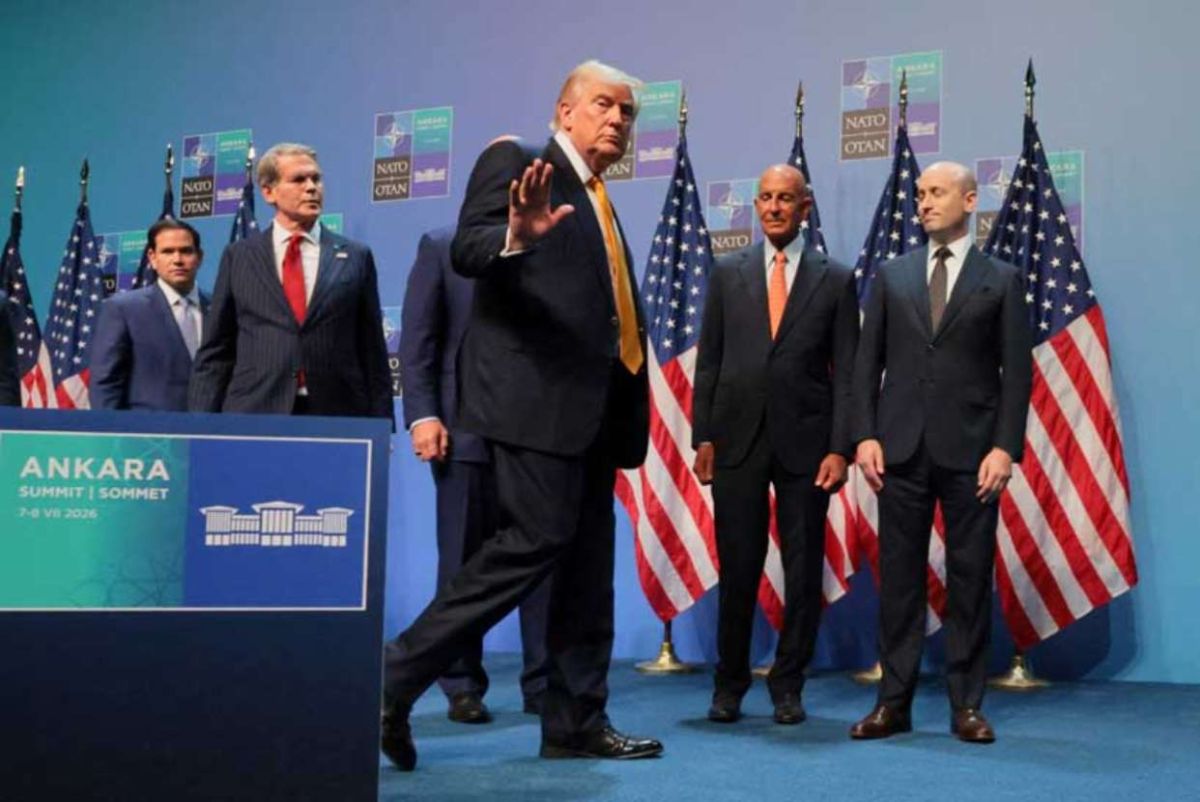
Πηγή Φωτογραφίας: U.S. President Donald Trump leaves after a press conference at the end of his participation in the NATO leaders summit at the Bestepe Presidential Compound in Ankara, Turkey, July 8, 2026. REUTERS/Jonathan Ernst



NATO’s decision to raise its collective defense spending target to 5% of GDP by 2035 has been hailed as a watershed moment in the Alliance’s evolution. Framed as a necessary response to Russia’s long-term military threat and an increasingly unstable global order, the pledge reflects a profound shift in Western strategic thinking.
Yet beneath the appearance of unity lies an uncomfortable question that policymakers are becoming increasingly reluctant to ignore: can Europe and North America simultaneously finance rearmament, aging populations, high debt burdens, and slowing economic growth?
This is no longer merely a defense debate. It is a debate about the future sustainability of Western power itself.
Security Comes at a Price
The new NATO framework requires member states to devote 3.5% of GDP to core military expenditures, while an additional 1.5% may be invested in resilience, cybersecurity, critical infrastructure, civil preparedness, and defense-related industries.
The objective is clear: build credible deterrence against Russia while preparing NATO societies for an era of prolonged geopolitical competition.
From a military perspective, the logic is difficult to dispute. Russia’s invasion of Ukraine fundamentally ended the post-Cold War assumption that Europe could indefinitely enjoy a “peace dividend.” Defense has once again become the primary responsibility of the state.
Economically, however, the equation is far more complicated.
A Two-Speed NATO Is Emerging
Not every NATO member begins this race from the same fiscal starting line.
Countries such as Germany, Poland, Finland, Sweden and Norway possess comparatively stronger public finances and lower debt burdens, giving them greater flexibility to expand defense budgets.
Southern Europe presents a different picture.
Italy, France, Spain and Belgium already face elevated public debt, persistent fiscal deficits, slower economic growth and mounting social welfare obligations driven by rapidly aging populations.
For these governments, every additional euro allocated to defense inevitably competes with healthcare, pensions, education and public investment.
This explains why Spain openly resisted the new target, arguing that 5% of GDP is economically disproportionate to its strategic needs.
The disagreement exposed an increasingly visible fault line inside NATO—not over Russia, but over affordability.
The American Paradox
Perhaps the greatest irony of the new defense doctrine lies in Washington itself.
The United States has consistently urged its European allies to spend more on defense while simultaneously confronting one of the most challenging fiscal outlooks in its modern history.
Federal deficits remain historically large, public debt continues to rise faster than economic output, and interest payments on government borrowing are consuming an ever-growing share of the federal budget.
Historian Sir Niall Ferguson famously warned:
“Any great power that spends more servicing its debt than defending itself will not remain a great power for long.”
That observation increasingly resonates in Washington.
America remains the world’s indispensable military power—but maintaining that role becomes progressively more expensive as debt servicing crowds out fiscal flexibility.
The challenge is not military capability.
It is economic endurance.
Defense and Debt Are Becoming Strategic Variables
For decades, defense policy and fiscal policy were often discussed separately.
That distinction is disappearing.
Military strength ultimately depends upon economic strength.
Countries can borrow heavily to finance rearmament during emergencies.
Doing so permanently is another matter entirely.
Higher defense spending financed primarily through debt eventually translates into:
- higher borrowing costs;
- larger budget deficits;
- increased tax pressure;
- pressure to reduce social spending;
- weaker long-term economic growth.
At that point, national resilience itself begins to erode.
Security can no longer be measured solely in tanks, aircraft and missiles.
It must also be measured in sustainable public finances.
Europe’s Strategic Autonomy Returns
Donald Trump’s renewed pressure on NATO members has unexpectedly accelerated another strategic debate inside Europe.
Can the continent continue relying overwhelmingly on American security guarantees while Washington’s foreign policy changes dramatically from one administration to the next?
European leaders increasingly believe the answer is no.
The objective is no longer simply spending more.
It is spending differently.
Investment in European defense industries, ammunition production, satellite capabilities, cyber defense and advanced technologies is increasingly viewed not only as military policy but as industrial policy.
The long-discussed concept of European strategic autonomy is quietly becoming less theoretical and more practical.
The Real Strategic Dilemma
Virtually no serious policymaker argues that defense spending should remain at pre-2022 levels.
The world has changed.
Russia remains Europe’s principal military threat.
China has become a systemic geopolitical competitor.
Instability across the Middle East continues to affect energy markets and global supply chains.
The question therefore is not whether NATO should spend more.
The question is how much can democracies spend before military preparedness begins undermining economic resilience?
History offers numerous examples of great powers weakened not by military defeat but by fiscal exhaustion.
The Soviet Union collapsed under economic strain.
Imperial Spain defaulted repeatedly despite military supremacy.
Britain emerged victorious from two world wars only to confront decades of financial retrenchment afterward.
Economic power ultimately determines strategic staying power.
The Next Decade Will Test the Alliance
NATO is entering perhaps its most demanding period since the end of the Cold War.
Its members face simultaneous military, technological, demographic and fiscal pressures unlike anything experienced in recent decades.
The commitment to spend 5% of GDP undoubtedly strengthens deterrence against external adversaries.
Whether it simultaneously strengthens—or weakens—the long-term resilience of Western democracies remains an open question.
The Alliance’s greatest challenge may ultimately prove not to be Russia’s military capabilities, but its own ability to finance security without compromising economic stability.
In geopolitics, military power and fiscal credibility have always been inseparable.
The coming decade will determine whether NATO can preserve both.
Source: pagenews.gr
Διαβάστε όλες τις τελευταίες Ειδήσεις από την Ελλάδα και τον Κόσμο