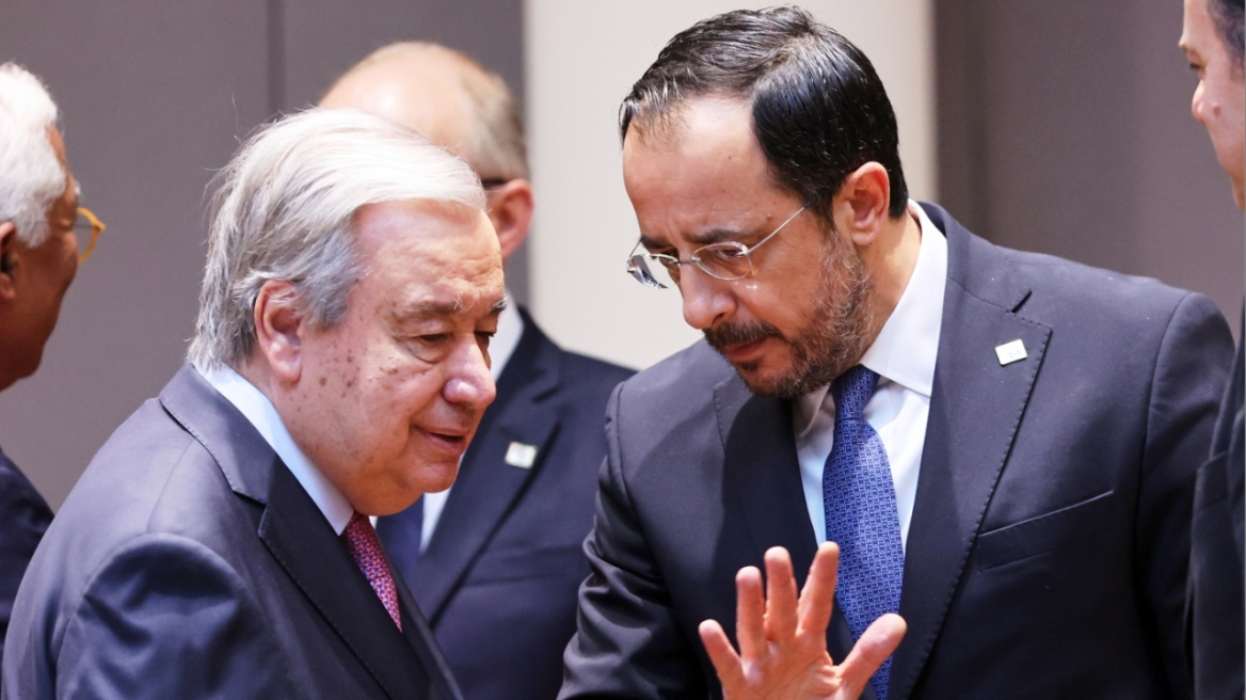
The arrival of António Guterres in Cyprus is not another ceremonial visit by the head of the United Nations.
The UN Secretary-General comes to Nicosia at a moment when the Cyprus issue stands between two radically different prospects: either it returns to a structured political process with a clear destination, or it moves further toward the consolidation of occupation-related realities and permanent division.
In a post following his arrival, Guterres reaffirmed his commitment to supporting a “comprehensive and lasting settlement”, while also underlining the limits of international mediation:
“The United Nations cannot impose peace. Only Cypriots, through their leaders, can build it.”
This is not merely diplomatic language. It places responsibility directly on the two leaders and signals that the United Nations is prepared to facilitate an agreement—but not to replace the political will required from both communities.
A rare visit carrying considerable political weight
The physical presence of the Secretary-General on the island carries significant symbolism.
Guterres’ decision to travel personally to Cyprus indicates that the UN Secretariat believes a limited but genuine window of opportunity may have emerged. There is still no agreement on the substance, nor a mutually accepted timetable for full negotiations. Yet there is renewed movement after years of stagnation following the collapse of the Crans-Montana conference in 2017.
His mission is to determine whether this momentum can develop into a political process or whether it will remain confined to lower-risk technical initiatives.
A tightly packed diplomatic schedule
The Secretary-General begins his contacts with a separate meeting with the President of the Republic of Cyprus, Nikos Christodoulides. This will be followed by talks with Turkish Cypriot leader Tufan Erhürman, while the three are scheduled to attend a private dinner in the evening at the residence of the UN’s special representative in the buffer zone.
On Wednesday, the decisive joint meeting between the two Cypriot leaders will take place under Guterres’ chairmanship. A press conference will follow, during which the UN chief is expected to present his assessment of the visit and indicate whether there is a path toward the next stage.


His programme also includes:
- a wreath-laying ceremony at the Peacekeepers’ Memorial outside the Ledra Palace;
- a visit to the laboratory of the Committee on Missing Persons;
- meetings with the negotiators;
- discussions with the Technical Committees;
- contacts with representatives of civil society.
The choice of these stops is deeply political. The peacekeepers symbolise the international presence on a divided island, the missing persons represent the unresolved human cost of the conflict, and the Technical Committees embody the effort to give bicommunal cooperation practical, everyday substance.
Holguín prepared the diplomatic ground
A central role in the current effort belongs to the Secretary-General’s personal envoy, María Ángela Holguín.
The Colombian diplomat held meetings with both Christodoulides and Erhürman before Guterres’ arrival, attempting to identify the real red lines and possible areas of convergence.
Her mission is not simply to record the official positions of the two sides. It is to determine whether a shared understanding can be reached on:
- the agreed basis of a settlement;
- the sequence of future steps;
- confidence-building measures;
- the participation of the guarantor powers;
- the role of the European Union;
- the format of a possible new multilateral conference.
Holguín’s presence alongside Guterres allows the United Nations to combine high-level political engagement with continuous technical and diplomatic preparation.
The central question: Is there a common basis?
The main obstacle in the Cyprus issue is not a shortage of subjects for discussion. It is the distance between the two sides regarding the final destination.
The Greek Cypriot side insists that negotiations should resume from where they ended at Crans-Montana, on the basis of UN Security Council resolutions and a bizonal, bicommunal federation with political equality.
The Turkish side has in recent years promoted the concept of “sovereign equality” and a two-state settlement—a position that is not recognised by either the United Nations or the European Union.
Erhürman’s rise to the leadership of the Turkish Cypriot community has created expectations of a more constructive dialogue. It has not yet been demonstrated, however, that he can alter Ankara’s strategic objectives.
Guterres must therefore answer one decisive question: is there a genuine common basis for formal negotiations, or merely a willingness to discuss limited practical matters?


A federation remains the only internationally recognised framework
The UN position remains centred on a bizonal, bicommunal federation with political equality, in accordance with Security Council resolutions.
The same framework is supported by the European Union, which rejects a two-state solution and insists that reunification must be compatible with the EU acquis and the Union’s fundamental principles.
This framework is not merely a diplomatic formula. It defines:
- a single sovereignty;
- a single international legal personality;
- a single citizenship;
- the political equality of the two communities;
- the functioning of a federal government;
- the distribution of powers between the two constituent states.
The difficult task is translating these principles into a functional EU member state.
The European Union cannot remain a spectator
From an EU policy perspective, the Cyprus issue is not simply a regional dispute involving the United Nations, Greece, Turkey and the United Kingdom.
The Republic of Cyprus is an EU member state. Any settlement must therefore be fully compatible with:
- the EU acquis;
- the four freedoms;
- the rule of law;
- democratic governance;
- the protection of human rights;
- the Union’s common foreign and trade policies.
The European Union also has the technical and financial capacity to support implementation—from legal harmonisation and institutional reform to the financing of reunification and economic convergence.
A comprehensive settlement could strengthen security and stability throughout the Eastern Mediterranean. Conversely, continued division leaves a permanent geopolitical and legal anomaly inside the Union itself.
The EU acquis is both a guarantee and a challenge
The application of the EU acquis across a reunified Cyprus would be one of the greatest advantages of a settlement.
It could provide a common framework of rights, judicial protection, economic security and access to European policies. At the same time, it would raise demanding legal and political questions.
These include:
- freedom of establishment and property ownership;
- property restitution or compensation;
- possible temporary derogations from EU law;
- Cyprus’ representation in the EU institutions;
- the implementation of European legislation in the Turkish Cypriot constituent state;
- financing for economic convergence.
The European Union can become a guarantor of functionality, provided it is involved early in shaping the technical parameters and not merely asked to finance a settlement after the political decisions have already been made.
Turkey remains the decisive external actor
No serious negotiation can proceed without Turkey’s active involvement.
Ankara maintains a military presence in the northern part of the island and holds decisive influence over questions of security, guarantees and territorial arrangements. It also views Cyprus as a central component of its wider Eastern Mediterranean strategy.
The true test, therefore, is not only whether the two Cypriot leaders can reach common ground. It is whether Turkey is prepared to:
- return to the federal framework;
- discuss the future of its troops;
- reconsider the system of guarantees;
- accept full implementation of the EU acquis;
- abandon efforts toward international recognition of a separate state.
Guterres knows that even the most positive atmosphere in Nicosia will not be sufficient without coordination with Ankara.
Greece and the United Kingdom in the next phase
Greece, Turkey and the United Kingdom remain the three guarantor powers of the Republic of Cyprus. Should Guterres’ visit lead to a renewed process, they will be called upon to participate at a later stage, particularly on security and guarantees.
Athens supports a settlement based on UN resolutions and argues that Cyprus, as an EU member state, cannot remain under an outdated system of guarantees and unilateral intervention rights.
London, for its part, retains sovereign base areas on the island and a formal role in the process, although it lacks the ability to impose a political settlement on its own.
Any future multilateral stage will have to reconcile the traditional guarantor framework with Cyprus’ status as a member of the European Union.
Confidence-building measures are necessary—but not sufficient
The United Nations has invested in lower-intensity initiatives aimed at preserving contact between the two communities.
Among the issues discussed or promoted are:
- new crossing points;
- cooperation on environmental and air-quality matters;
- the exchange of cultural objects;
- greater participation by civil society;
- youth initiatives;
- joint action on microplastics and other common challenges.
Such measures cannot replace a comprehensive settlement. They can, however, reduce mistrust, create shared interests and demonstrate that cooperation is possible.
The risk is that confidence-building measures become a permanent substitute for political negotiations—improving the management of division without overcoming it.
New crossing points as a test of political will
Agreement on additional crossing points is seen as one of the most practical tests of the new political atmosphere.
Crossings directly affect citizens’ daily lives, economic activity and contact between the communities. Failure to reach agreement even on such a practical issue would send a negative signal regarding the ability to address far more difficult chapters.
Conversely, an agreement could provide the first tangible proof that the two leaders are capable of transforming dialogue into results.
For Guterres, the issue is not simply how many measures are announced, but whether they are accompanied by a timetable and an effective implementation mechanism.
The missing persons and the human cost of division
The Secretary-General’s visit to the Committee on Missing Persons serves as a reminder that the Cyprus issue is not merely a dispute over constitutional structures, territory and international guarantees.
It remains an open human wound.
Families continue to seek answers decades after the events. The Committee’s work is one of the few sustained examples of bicommunal cooperation producing concrete humanitarian results.
Guterres is seeking to emphasise that reconciliation cannot be built without truth, acknowledgement of suffering and respect for the victims of both communities.
The private dinner may matter more than the formal talks
A private dinner, away from cameras and public statements, allows Guterres to assess the true intentions of both leaders.
Such a setting permits questions that are difficult to address in formal negotiations:
- How much political cost is each side prepared to accept?
- How decisive is Ankara’s influence over Turkish Cypriot decisions?
- How quickly could an official process begin?
- Are previous convergences still accepted?
- Can a roadmap be agreed without preconditions that destroy the process before it starts?
The dinner may not produce a joint communiqué. It could nevertheless determine the tone and substance of Wednesday’s joint meeting.
Nicosia approaches the visit with cautious optimism
The Christodoulides government has adopted a tone of cautious optimism, avoiding inflated expectations.
The Greek Cypriot side seeks:
- clear reaffirmation of the agreed basis for a settlement;
- the resumption of substantive negotiations;
- a more active role for the EU;
- continued engagement without another prolonged interruption;
- a specific timetable for the next meeting.
Nicosia understands that failure would not simply leave the Cyprus issue frozen. It would strengthen those arguing that a federal settlement is no longer viable and that permanent division should be accepted as the new reality.
What Erhürman seeks
The Turkish Cypriot leader must balance the expectations of his community, his relationship with Turkey and the requirements of an international process.
For his position to be seen as meaningfully different from that of the previous period, he will need to demonstrate a willingness to negotiate within the UN framework rather than on the basis of two sovereign states.
At the same time, he is expected to emphasise political equality, effective Turkish Cypriot participation in federal decision-making and the implementation of earlier convergences.
The challenge is to address legitimate Turkish Cypriot concerns without creating a dysfunctional system of permanent vetoes capable of paralysing the federal state.
The Cyprus issue as a European security challenge
The European Union has additional reasons to pursue a settlement, as the Eastern Mediterranean faces overlapping crises:
- wars in the Middle East;
- energy competition;
- migration pressures;
- Russian influence;
- Greek-Turkish tensions;
- security risks to maritime routes and critical infrastructure.
A reunified Cyprus could serve as a bridge between Europe and the Middle East, a hub for humanitarian operations and a pillar of energy and diplomatic stability.
Continued division, by contrast, preserves a permanent source of tension within the European Union itself.
Energy can become an incentive—or another source of conflict
The energy resources of the Eastern Mediterranean form another critical part of the equation.
A settlement could create shared economic benefits, facilitate regional cooperation and enable safer development of resources and infrastructure.
Without a political agreement, however, energy can have the opposite effect: intensifying competition, creating new claims and linking the Cyprus issue to wider disputes involving Turkey, Greece and the Republic of Cyprus over maritime zones.
The EU has a strategic interest in placing energy within a framework of cooperation and shared prosperity rather than allowing it to become a vehicle for legitimising faits accomplis.
Three possible outcomes from the visit
1. Agreement to resume substantive negotiations
The best possible result would be the announcement of a clear roadmap for a return to formal talks, accompanied by reaffirmation of the settlement framework and preparations for a new multilateral meeting.
This would be a significant diplomatic achievement for Guterres and would return the Cyprus issue to the international agenda as a process of conflict resolution rather than conflict management.
2. Progress limited to confidence-building measures
The more likely intermediate outcome would be a package of practical agreements and continued contacts without the immediate launch of full negotiations.
This would keep the process alive, but it would leave untouched the fundamental disagreement over the basis of a settlement.
3. A renewed period of stagnation
The negative scenario would see the visit end with general statements, no common ground and no fixed date for the next step.
Such an outcome would accelerate the gradual entrenchment of partition and further weaken confidence in the UN-led process.
Guterres is searching for a diplomatic legacy
As his tenure at the United Nations moves toward its final phase, António Guterres knows that Cyprus remains one of the longest-running unresolved disputes in international diplomacy.
It would be unrealistic to expect a two-day visit to solve a conflict lasting decades. It could, however, create the institutional and political foundation for one final serious attempt under his leadership.
His direct involvement raises expectations. It also increases the political cost of failure, as a comparable high-level initiative is unlikely to emerge soon without concrete evidence of political will.
Peace cannot be imposed—but it cannot wait indefinitely
The Secretary-General’s message is twofold.
On the one hand, the United Nations cannot impose a solution on Cypriots. On the other, time is not neutral. Every year without a settlement deepens the economic, social and political distance between the two communities and makes reunification more difficult.
A new generation is growing up without shared experiences. Facts on the ground acquire permanence. Regional balances shift, while permanent partition is increasingly presented as political realism.
For that reason, Guterres’ visit will not be judged only by whether it produces a positive communiqué. It will be judged by whether the two leaders agree to move from managing division to negotiating reunification.
Cyprus once again faces a narrow window of opportunity. The United Nations has opened it. The European Union can help sustain it. Yet only political will in Nicosia and Ankara can prevent it from closing once again.
Source: pagenews.gr