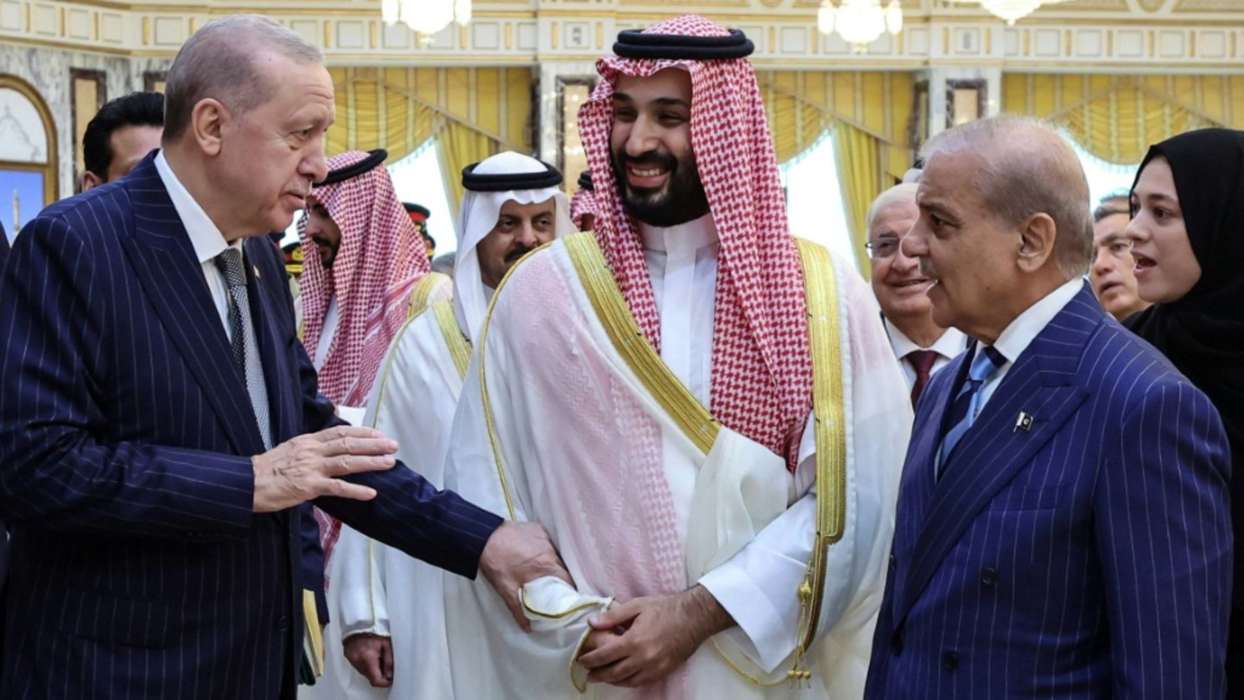
In the city at the spiritual heart of Islam, three leaders signed an agreement that immediately raised an unavoidable question:
Is a “Muslim NATO” being born in Mecca?
For now, the answer is no.
But the substance of the agreement is significant enough that the comparison can no longer be dismissed as mere headline-making.
Saudi Crown Prince Mohammed bin Salman, Turkish President Recep Tayyip Erdogan and Pakistani Prime Minister Shehbaz Sharif signed the Mecca Joint Defense Agreement on August 7, establishing a collective-defence mechanism between the three states.
Its central provision is strikingly clear:
an armed attack against one member is to be considered an attack against all three.
That is, politically, the same fundamental logic underpinning NATO’s celebrated Article 5.
And that alone is enough to force new calculations in Tehran, Tel Aviv, New Delhi and Washington.
It is not NATO — but it is more than a summit photo
The first mistake would be to describe the agreement as a ready-made Middle Eastern NATO.
It is not.
NATO rests on decades of joint military planning, permanent headquarters, integrated command structures, interoperability, common procedures, extensive exercises and an institutional machinery designed to function before a crisis begins.
Mecca is nowhere near that level.
But neither is this simply another declaration of friendship.
Turkey has indicated that the framework will include regular meetings of foreign and defence ministers as well as a permanent secretariat in Saudi Arabia. Assistance following an attack could potentially range from intelligence cooperation to direct military support.
That distinction matters.
This is not yet a “Muslim NATO.” But it is beginning to acquire some of the institutional characteristics of a durable security structure.
Riyadh is buying something weapons cannot provide: options
For Saudi Arabia, the logic is straightforward.
The kingdom is not abandoning the United States.
Far from it.
Washington remains Riyadh’s most important external military partner, and Saudi forces remain deeply connected to American aircraft, air-defence systems, munitions, training, maintenance and logistics.
The shift is therefore not a Saudi-American divorce.
It is something subtler and potentially more important:
strategic diversification.


For decades, Saudi security rested on an implicit assumption: if the survival of the kingdom were genuinely threatened, the United States would ultimately be there.
Riyadh increasingly wants insurance against a world in which that assumption may not always be enough.
Saudi Arabia still wants America.
It simply does not want only America.
Erdogan is building a second security network
Turkey may be the most fascinating member of the new triangle.
It already belongs to NATO and possesses the alliance’s second-largest military.
Yet Ankara is now simultaneously positioning itself inside another collective-defence framework.
That does not necessarily mean Turkey is turning away from the West.
It fits Erdogan’s broader strategy of ensuring that Turkey occupies as many centers of geopolitical power as possible.
NATO.
The Black Sea.
The Caucasus.
Syria.
The Gulf.
And now an institutionalized security triangle linking Ankara to Riyadh and Islamabad.
There is also a major industrial dimension.
Turkey has transformed its defence sector into an instrument of foreign policy. UAVs, missiles, electronic-warfare systems, naval platforms and increasingly sophisticated domestically produced weapons have given Ankara a degree of strategic autonomy that few regional powers possess.
The Saudi relationship gives those industries access to one of the world’s richest defence markets.
For Erdogan, therefore, Mecca is not merely about protection.
It is about reach, markets and power.
Then there is Pakistan — and the nuclear question
Pakistan changes the equation.
Islamabad possesses something neither Saudi Arabia nor Turkey has:
nuclear weapons.
That does not mean Mohammed bin Salman has suddenly acquired a Pakistani nuclear umbrella.
No public provision establishes such a guarantee, and there is no disclosed NATO-style nuclear-sharing or joint nuclear-planning mechanism.
But deterrence is shaped not only by written commitments.
It is also shaped by uncertainty.
Any state contemplating a major military confrontation with one of the three members must now factor into its calculations that one member of this collective-defence structure is the Muslim world’s only nuclear-armed state.
That does not automatically extend Pakistani nuclear deterrence to Riyadh or Ankara.
But it unquestionably makes the strategic equation more complicated.
For Iran.
For India.
For Israel.
And for Washington.
The great irony: America is the invisible fourth partner
There is, however, a remarkable contradiction at the heart of this attempt at greater strategic autonomy.
America is embedded inside much of the military power represented at the Mecca table.
Saudi Arabia operates large quantities of American military equipment and depends on an extensive ecosystem of spare parts, training, technical support, upgrades and maintenance.
Turkey is a NATO member.
Pakistan has decades of military interaction with Washington, even as its defence relationship with China has become increasingly important.
Modern military power is not simply the weapon sitting on the runway or in the hangar.
It is the supply chain behind it.
The software.
The ammunition.
The spare parts.
The technicians.
The upgrades.
The training.
The intelligence architecture.
The logistics.
That means Washington may not have signed the Mecca agreement, but American fingerprints remain embedded in a significant part of the military capacity supporting it.
The United States is absent from the document.
It is not absent from the battlefield architecture.


The Iran question
The agreement’s architects have been careful not to present it as an anti-Iranian alliance.
That is important.
Neither Ankara nor Islamabad has an interest in creating an explicitly Sunni military bloc against Shiite Iran.
Doing so could transform a security mechanism into a sectarian geopolitical confrontation stretching from the Gulf into South Asia.
But intentions and strategic effects are not always the same thing.
Tehran must now consider the possibility that a major attack on Saudi Arabia could trigger assistance from both Turkey and Pakistan.
Even if that assistance were limited to intelligence, air defence, logistics or conventional military support, the calculation has changed.
And changing an adversary’s calculation is the essence of deterrence.
Israel cannot ignore it either
The same applies to Israel.
There is no evidence that the agreement was formally designed against the Jewish state.
But serious military planners assess capabilities as well as intentions.
The new framework potentially combines three very different sources of power:
Saudi Arabia’s financial and energy weight;
Turkey’s large conventional military and rapidly expanding defence industry;
and Pakistan’s nuclear deterrent.
Even if the triangle remains politically loose, its existence introduces a new variable into Israeli strategic planning.
The key question is not whether the three countries intend to confront Israel today.
It is what this structure could become tomorrow.
What if Egypt joins?
This may be the next major story.
Turkey has openly discussed the possibility of additional states participating in the emerging framework, with Egypt an obvious heavyweight candidate.
Egypt would fundamentally alter its geopolitical scale.
Cairo would bring one of the Arab world’s largest militaries, control of the Suez Canal, enormous geographic importance and the political weight of the Arab world’s most populous country.
But Egypt would also bring complications.
It has a deep military relationship with Washington.
It has a peace treaty with Israel.
And Cairo traditionally guards its strategic autonomy carefully.
That is why Egyptian participation should be watched closely.
If the structure remains a three-country arrangement, it will still represent an important new regional axis.
If it begins attracting other major Muslim powers, the phrase “Muslim NATO” will start to carry very different weight.
The real game is not the clause — it is who calls whom
For decades, the Middle East security system resembled a wheel.
The United States occupied the hub.
Around it stood regional partners linked primarily to Washington through bilateral relationships.
Riyadh–Washington.
Ankara–Washington.
Cairo–Washington.
Amman–Washington.
What is changing is that the spokes are increasingly connecting directly to one another.
Riyadh no longer speaks only to Washington about its security.
It speaks directly to Ankara and Islamabad.
It buys weapons from different suppliers.
It builds alternative relationships.
It creates overlapping guarantees.
Regional states are beginning to construct what might be called horizontal security architecture.
This does not remove America from the Middle East.
But it reduces the assumption that every serious security arrangement must first be designed, convened or approved in Washington.
That is the deeper shift.
“Muslim NATO”? Not yet
There is still no reason to pretend the Mecca structure is NATO.
Its military credibility remains untested.
What happens if one of the three countries actually invokes the agreement?
Do Turkish aircraft deploy?
Does Pakistan provide air defence?
Does Saudi Arabia finance a joint operation?
Are warships dispatched?
Is intelligence shared?
Are weapons supplied?
Or does collective defence ultimately mean diplomatic solidarity and consultations?
The first genuine crisis will provide the answer.
Until then, however, one conclusion is already difficult to escape.
Mecca has changed the psychology of the regional game.
Three major Muslim powers have not abandoned America.
They have done something potentially more consequential:
they have started preparing for a world in which America may not always be enough.
That is the real message to Washington.
They are not saying:
“Leave.”
They are saying:
“We will no longer wait only for you.”
So, no — a “Muslim NATO” does not exist yet.
But if the Mecca framework develops joint exercises, integrated air defence, permanent military planning, a credible command structure and additional members — particularly a heavyweight such as Egypt — then August 7 may eventually be remembered as more than the date another Middle Eastern agreement was signed.
It may be remembered as the day a new architecture of power began to emerge across the Muslim world.
Source: pagenews.gr