Ceuta Shock: 72,000 Migrants, 100 Dead and Sánchez Points to Russia and Israel
 ΧΡΟΝΟΣ ΑΝΑΓΝΩΣΗΣ 10 '
Πηγή Φωτογραφίας: AP Photo//Ceuta Shock: 72,000 Migrants, 100 Dead and Sánchez Points to Russia and Israel



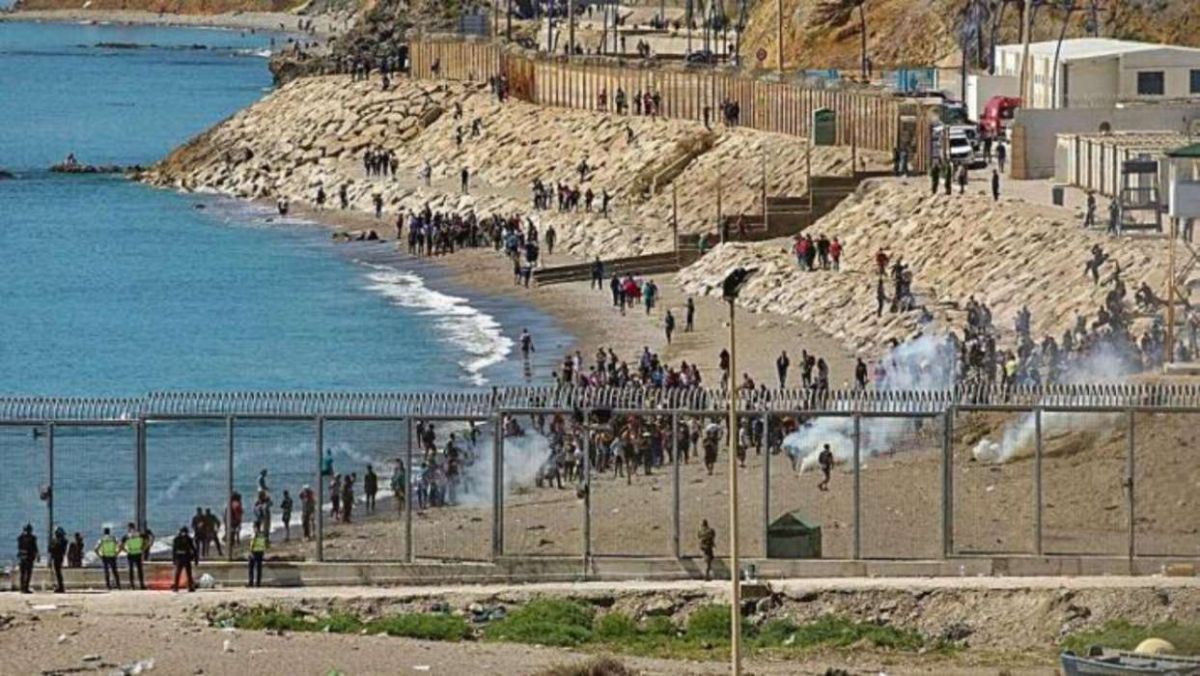
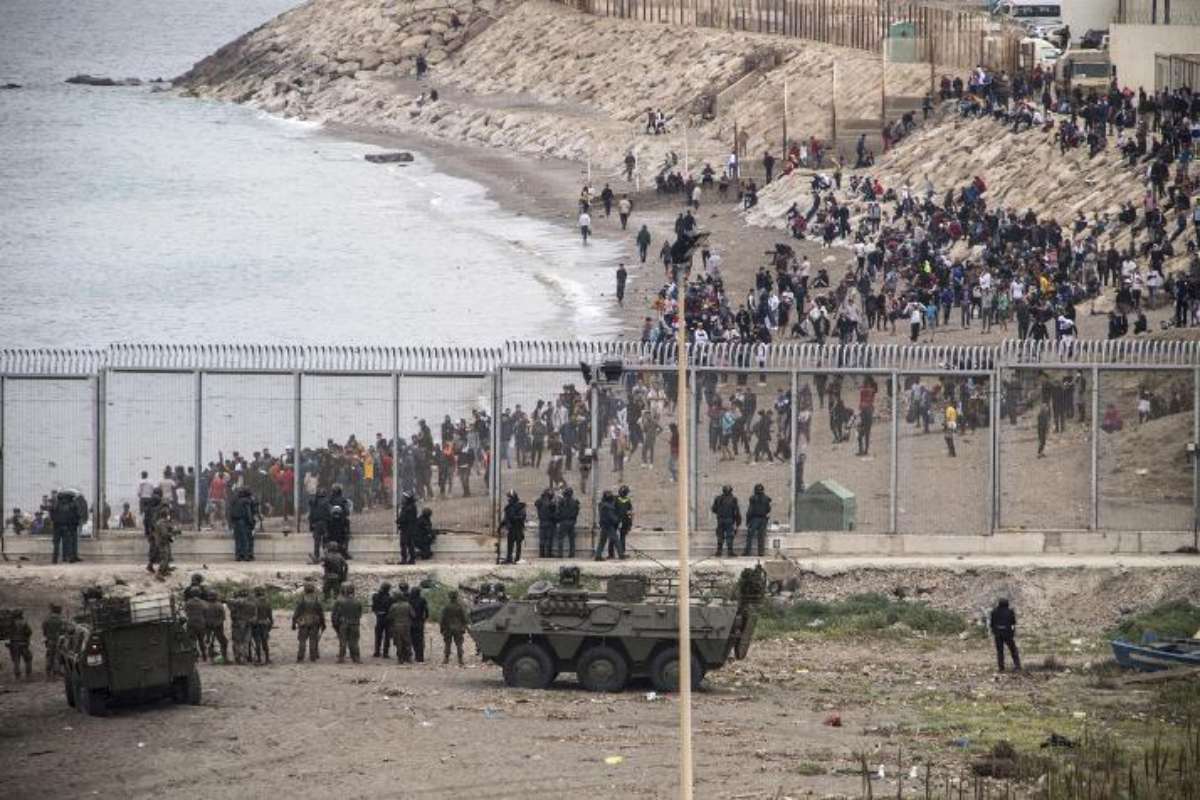
Ceuta, Spain’s small enclave on the northern coast of Africa, has become the epicentre of a crisis that now extends far beyond migration.
More than 72,000 people attempted to cross from Morocco into Ceuta at the end of July in an unprecedented surge at one of the European Union’s most sensitive external borders. At least 100 people died, while thousands remained inside the Spanish territory.
One month later, however, the focus has shifted from Ceuta’s physical border to the information space.
Spanish Prime Minister Pedro Sánchez has alleged that networks linked to Russia and Israel, alongside international far-right networks, helped spread or amplify false information about Spanish migration policy.
According to Sánchez, the claims were based on findings from the European External Action Service.
The Ceuta crisis is therefore increasingly raising a wider question for Europe: can disinformation be used to transform existing migration pressure into a real-world border and security crisis?
When False Information Triggers Real Migration
At the centre of the controversy was a claim circulated online suggesting that migrants who reached Ceuta by swimming could not be returned to Morocco.
According to Sánchez, the claim was false and distorted the meaning of a Spanish Supreme Court ruling.
The narrative nevertheless spread across social media and, according to the Spanish government, was also amplified through criminal networks.
Its importance lies in what happened next.
The information did not remain confined to the digital world.
It potentially influenced the decisions of thousands of people who believed that a temporary legal loophole had opened a route into Spanish — and therefore European Union — territory.
In that sense, disinformation may have translated into physical pressure on an EU external border.
Sánchez Points to Russian and Israeli Networks
Sánchez has made an unusually serious allegation.
“There were Russian and Israeli networks that spread a lie,” he said, referring to claims that migrants entering Ceuta by sea could not be returned.
The Spanish prime minister also argued that Russia and Israel had an interest in exploiting the crisis because of Madrid’s positions on the wars in Ukraine and Gaza.
Those allegations require careful qualification.
They are claims made by the Spanish prime minister, who says they are supported by European diplomatic-service findings. Publicly available information has not yet established the full methodology behind those findings or demonstrated the degree, if any, of direct state control over the networks concerned.
The distinction between activity originating from networks located in or linked to a country and a state-directed information operation is crucial.
Madrid Does Not Blame Morocco
Equally important is the country Sánchez has declined to accuse: Morocco.
The Spanish prime minister said Madrid had not received intelligence establishing that Moroccan authorities deliberately facilitated the mass crossing.
That position carries considerable geopolitical weight.
Spain depends heavily on cooperation with Rabat to manage irregular migration from North Africa.
An open confrontation with Morocco could therefore turn a border emergency into a much broader diplomatic crisis.
Sánchez has instead emphasised cooperation with Rabat as essential to resolving the situation.
That is a significant contrast with previous European migration crises, where neighbouring states have sometimes been accused directly of deliberately facilitating migrant movements for political leverage.
Why Ceuta Matters So Much
Ceuta is tiny, but strategically extraordinary.
The Spanish enclave has an area of only around 18 square kilometres and a population of roughly 80,000.
Yet together with Melilla it constitutes one of the European Union’s only land borders with Africa.
For migrants attempting to reach Ceuta, the objective is therefore not merely entry into a Spanish city.
It is entry into European Union territory.
That geography makes Ceuta particularly vulnerable whenever migration flows increase or relations between Madrid and Rabat deteriorate.
Thousands Remain as Pressure Builds
Although most of those involved in the July surge returned to Morocco, several thousand migrants have remained in Ceuta.
Estimates have varied, underscoring the difficulty of establishing the exact number after such a large and rapid movement of people.
For a territory with a population of around 80,000, even several thousand additional people represent enormous pressure on accommodation, public services and security.
Residents have staged demonstrations over security and sanitary conditions, while tensions have emerged around makeshift migrant accommodation.
Madrid has responded with substantial financial assistance, including an additional €168 million emergency package for Ceuta.
The crisis is therefore no longer solely humanitarian or security-related.
It has become an economic and domestic political problem for Spain as well.
The New Weapon May Be Information, Not the Border Fence
Ceuta illustrates a potentially important evolution in the weaponisation of migration.
Traditionally, using migration as geopolitical pressure required some form of physical intervention.
A government could relax border controls, transport people toward a frontier or facilitate crossings.
The digital environment creates another possibility.
It may be enough to convince a sufficiently large group of people that “the border is open,” that a legal loophole exists or that authorities cannot return those who successfully cross.
If such a narrative spreads rapidly through the right communities, it can potentially generate physical migration pressure even when the official policy of the destination country has not changed.
That possibility is what makes Ceuta relevant far beyond Spain.
From Belarus to Ceuta: A Different Form of Hybrid Pressure
Europe has already confronted allegations of migration being used as a geopolitical weapon.
Poland, Lithuania and Latvia have accused Belarus of deliberately facilitating migrant movements toward their borders as a means of pressuring the European Union.
Ceuta is different.
There is currently no publicly established evidence that Russia, Israel or another foreign state organised the physical movement of tens of thousands of migrants toward Spain.
The emerging issue is instead the information layer: whether external networks can exploit genuine migration pressures through misleading narratives and social-media amplification.
Such activity can be harder to detect than physical border manipulation.
It can also be harder to attribute.
Why Russia and Israel Enter the Equation
Sánchez’s allegations cannot be separated from Spain’s foreign policy.
Madrid remains firmly opposed to Russia over the war in Ukraine.
At the same time, relations between Spain and Israel have become highly contentious over Gaza and Madrid’s recognition of a Palestinian state.
The Spanish prime minister argues that the Ceuta crisis was exploited by actors hostile to his government’s positions on both conflicts.
That does not, by itself, establish a centrally organised operation by either government.
But it illustrates how quickly a domestic European migration crisis can become entangled with wider geopolitical disputes.
Spain’s Morocco Dilemma
For Madrid, there is another delicate balancing act.
Morocco is both the country from which the immediate migration pressure originates and one of Spain’s most important partners in controlling that pressure.
Spain therefore needs Rabat’s cooperation while simultaneously managing domestic demands for tighter border enforcement.
This helps explain why Sánchez has been particularly careful not to accuse the Moroccan government without evidence.
The relationship extends well beyond migration.
Security cooperation, trade, Western Sahara and the wider balance of power in North Africa all make Morocco strategically important to Spain.
The Ceuta crisis consequently tests Madrid’s ability to defend its border without destabilising the partnership that helps secure it.
Europe’s Biggest Vulnerability Is Speed
Disinformation itself is not new.
What has changed is the speed at which misleading information can produce real-world consequences.
TikTok, Instagram, Telegram and other platforms can carry a claim to hundreds of thousands of people within hours.
Governments move much more slowly.
Authorities must detect a narrative, establish whether it is false, determine where it originated, coordinate a response and then convince the intended audience that the information is unreliable.
By the time that process is complete, people may already be moving toward the border.
That creates a new challenge for European security policy.
Border protection increasingly begins before anyone reaches the border.
Migration Becomes Part of Information Warfare
The broader European implications are significant.
Migration is already among the continent’s most politically divisive issues.
It influences elections, fuels polarisation between governments, strengthens anti-immigration parties and places pressure on frontline communities.
That makes migration an attractive target for influence operations.
An adversarial information campaign does not necessarily need to invent a crisis from nothing.
It only needs to amplify an existing vulnerability.
That distinction is fundamental.
Ceuta Is a Warning for Europe
The significance of the Ceuta crisis therefore extends beyond Spain and Morocco.
If the Spanish government’s allegations are substantiated, the episode could become an important European case study in how migration, social media and information operations interact.
For the EU, the challenge would no longer be limited to stronger borders, coast guards and migration agreements with neighbouring countries.
It would also require the ability to detect and counter false information capable of influencing population movements before those movements reach European territory.
For Spain, the immediate priorities remain restoring stability in Ceuta, maintaining cooperation with Morocco and establishing exactly how the misleading narratives spread.
But the larger lesson is already emerging.
Europe’s migration frontier is no longer only physical. It is increasingly digital — and a viral falsehood can potentially create a real border crisis before governments have time to respond.
Πηγή: pagenews.gr
Διαβάστε όλες τις τελευταίες Ειδήσεις από την Ελλάδα και τον Κόσμο