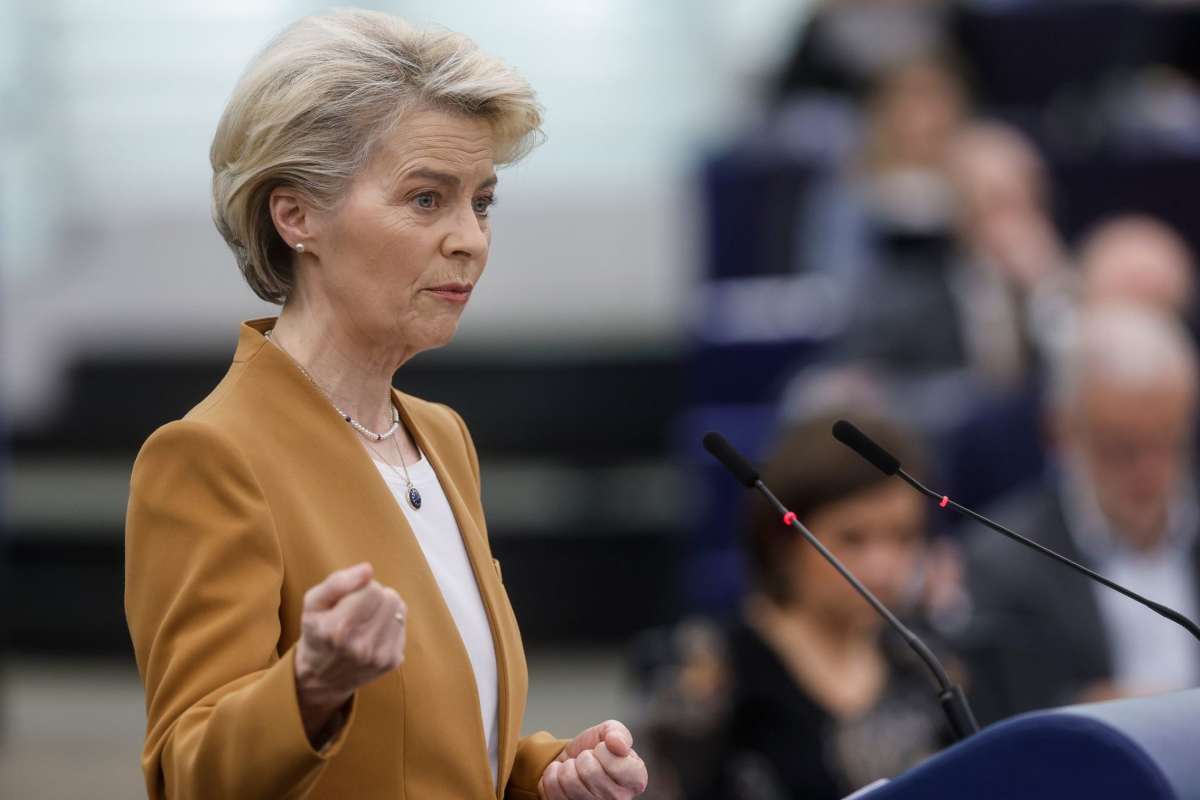
Ursula von der Leyen is entering what could prove to be the most consequential three years of her decade at the helm of the European Commission.
Her second term ends in 2029. If it is also her last, her political legacy will increasingly be judged not by the crises she was forced to manage — the pandemic, Russia’s invasion of Ukraine, the energy shock and wars on Europe’s wider periphery — but by whether she managed to address some of the European Union’s deepest structural weaknesses.
POLITICO identifies six major challenges capable of defining her legacy: competitiveness, Europe’s regulatory confrontation with the United States, the future of the Green Deal, defense and Ukraine, enlargement, and the EU’s next long-term budget.
Together, they lead to a much bigger question:
Can Europe transform its enormous economic and regulatory weight into genuine geopolitical power?
1. Europe’s Industrial Survival Battle
The first challenge is economic — and potentially existential for Europe’s industrial model.
The EU must determine whether it can reverse its relative decline against the United States and China while preventing traditional European industrial powerhouses from steadily losing competitiveness.
Mario Draghi has put a staggering number on the challenge: Europe needs roughly €800 billion in additional investment every year to close its investment and productivity gap.
High energy prices, fragmented capital markets, regulatory burdens and weaker productivity growth are all putting pressure on European companies.
Then there is China.
European manufacturers are competing with Chinese electric vehicles, batteries, solar panels and steel while remaining heavily dependent on Beijing for several critical raw materials and industrial supply chains.
Von der Leyen therefore faces an extraordinarily difficult balancing act: de-risk from China without triggering an economic confrontation that further weakens European industry.
2. Trump vs. Brussels: Who Writes Europe’s Rules?
The second battle is transatlantic.
The EU has built one of the world’s most ambitious regulatory regimes for digital platforms through the Digital Markets Act and Digital Services Act.
American technology giants including Apple, Meta and Google have consequently found themselves under increasingly assertive European scrutiny.
But under Donald Trump, the regulation of American Big Tech has also become a source of political friction between Washington and Brussels.
Von der Leyen therefore faces a strategic dilemma.
Can Europe continue to defend its regulatory sovereignty when enforcement against a major American company risks becoming a broader political dispute with Washington?
The Commission’s principle is straightforward: European rules are decided in Europe.
The complication is equally straightforward: Europe simultaneously needs the United States for its security.


3. Is Von der Leyen Dismantling Her Own Green Deal?
This may be the greatest political irony of her second term.
The European Green Deal was the signature project of the first von der Leyen Commission.
Now she is under pressure to simplify — and in some areas soften — parts of the regulatory architecture that her first administration constructed.
Farmers have protested across Europe.
Industrial groups are demanding lower regulatory costs.
National governments increasingly want Brussels to reduce administrative burdens.
Yet wildfires, heatwaves, drought and other extreme weather events mean that the climate challenge is becoming more urgent, not less.
European climate policy is therefore caught between two powerful pressures: competitiveness and social affordability on one side, climate security on the other.
Von der Leyen’s legacy will partly depend on whether she can reconcile them.
4. Defense and Ukraine: Money Is No Longer Enough
The fourth challenge may ultimately determine Europe’s geopolitical credibility.
The EU is no longer debating “strategic autonomy” as an abstract concept.
Europe needs weapons.
It needs ammunition.
It needs air defense.
It needs industrial capacity.
And simultaneously, it must ensure Ukraine can continue resisting Russia.
The EU’s SAFE instrument provides €150 billion to support defense investment, while a €90 billion Ukraine Support Loan for 2026-2027 has been established, with around €60 billion intended for defense capabilities and procurement.
The Commission also approved another €6.1 billion package on August 24 for Ukrainian defense procurement, targeting air and missile defense systems, missiles, ammunition and radars.
Overall European support for Ukraine and Ukrainians since Russia’s full-scale invasion has surpassed €220 billion.
But money alone does not manufacture a Patriot interceptor.
Europe’s deeper challenge is industrial.
It must finance Ukraine, rebuild its own military capabilities and expand weapons production — all while uncertainty persists over the future scale of the American security commitment to the continent.
Von der Leyen’s task is therefore bigger than finding billions.
It is keeping Europe politically united against Vladimir Putin while building the military capacity to back that position with hard power.
5. An EU of 30-Plus: Can Europe Enlarge Without Breaking?
The fifth challenge could redraw the political map of Europe.
Ukraine and Moldova have moved closer to EU membership, while the Western Balkans remain in the accession waiting room.
But promising enlargement is much easier than delivering it.
Rule-of-law standards, corruption, judicial independence and economic reform remain significant obstacles for candidate countries.
There is also an uncomfortable question for Brussels:
Is the European Union itself ready to become a bloc of more than 30 members?
How would decisions be taken?
Would unanimity survive?
How would agricultural subsidies and cohesion funding be distributed?
Which existing members would receive less in order to finance new entrants?
And how long can the EU leave Western Balkan countries waiting without increasing the influence of competing powers such as Russia and China?
Enlargement has therefore ceased to be merely a bureaucratic accession process.
It has become a geopolitical instrument.
6. The €2 Trillion Question: Who Pays?
The sixth challenge connects virtually all the others.
Money.
The Commission has proposed an EU long-term budget approaching €2 trillion for 2028-2034.
That sets the stage for one of the most consequential distributional battles in the Union.
On one side are the so-called Friends of Cohesion, including countries such as Greece, Italy, Poland and Spain, which have strong interests in protecting cohesion funding and the Common Agricultural Policy.
On the other are countries pressing for tighter spending discipline and a greater shift toward new priorities such as defense, innovation and industrial competitiveness.
The conflict is therefore not simply about whether Europe spends more.
It is about what Europe stops funding in order to finance its new priorities.
For Greece and other major beneficiaries of traditional EU policies, the stakes are particularly high.
Every additional euro directed toward defense, technology or geopolitical security potentially intensifies the battle over agriculture and regional development.
And all of this must be negotiated while major European countries enter difficult national electoral cycles.
One Word Will Define Von der Leyen’s Legacy: Power
There is a common denominator connecting all six battles.
Europe must decide whether it wants — and whether it is capable — of becoming something more than an enormous market and regulatory superpower.
It needs to produce more.
It needs to protect European industry without retreating into protectionism.
It needs to enforce its digital rules even when Washington objects.
It needs to finance and arm Ukraine.
It needs the capacity to defend itself.
It needs to enlarge without becoming institutionally paralyzed.
And it needs to find the money to do all of this.
Von der Leyen’s first term was largely defined by crises that arrived unexpectedly at Brussels’ door.
Her final three years will be judged differently.
Not simply by how effectively she manages the next crisis — but by whether she leaves behind a Europe more powerful, more competitive and more capable of defending its own interests than the one she inherited.
Source: pagenews.gr