EU–China: Brussels Wants Beijing to Curb Exports as the Trade Gap Hits €360 Billion
 ΧΡΟΝΟΣ ΑΝΑΓΝΩΣΗΣ 9 '
Πηγή Φωτογραφίας: AP Photo//EU–China: Brussels Wants Beijing to Curb Exports as the Trade Gap Hits €360 Billion


The European Union’s trade relationship with China is entering a potentially decisive new phase.
Brussels is no longer relying only on tariffs, anti-subsidy investigations or defensive measures aimed at protecting individual industries.
It now wants something much more ambitious:
to convince China itself to reduce the export pressure it is placing on the European market.
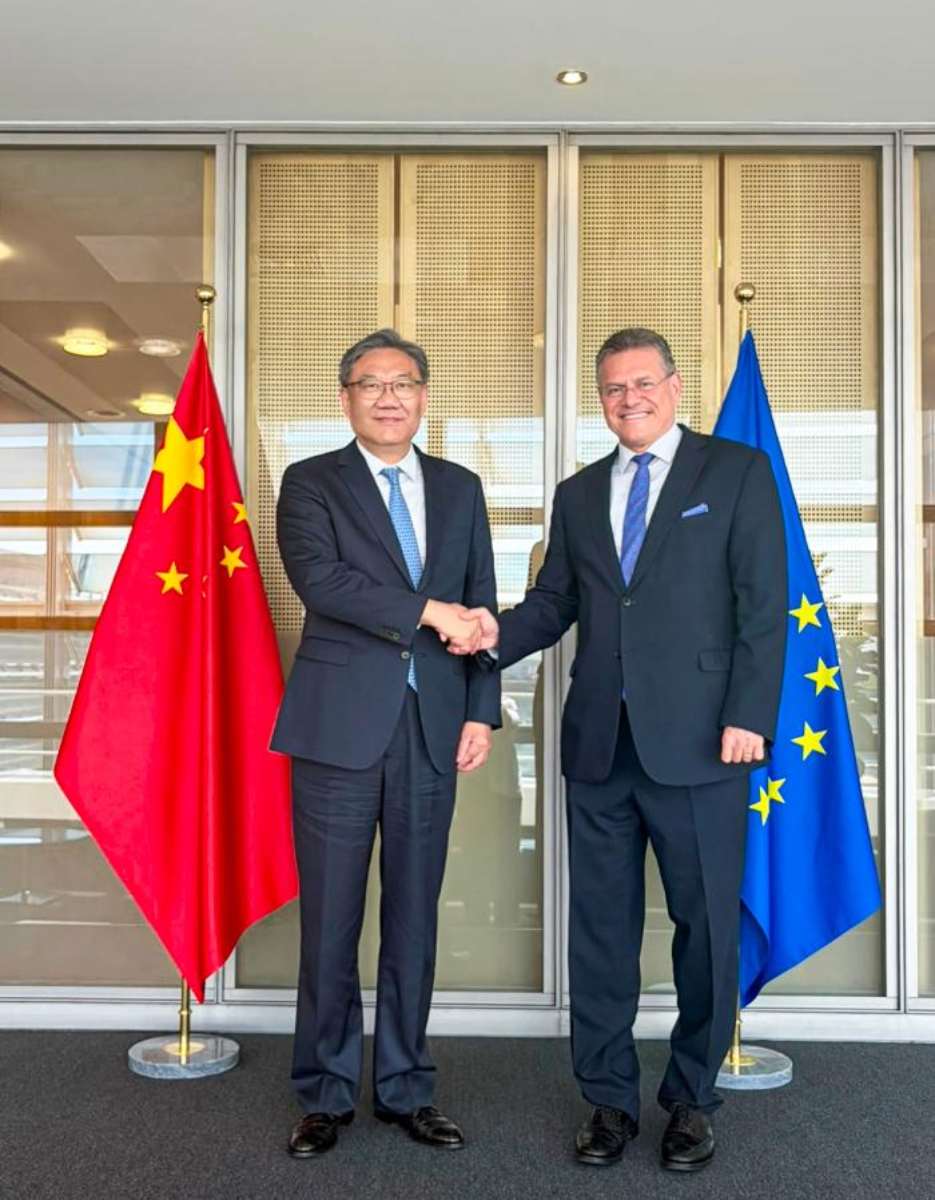
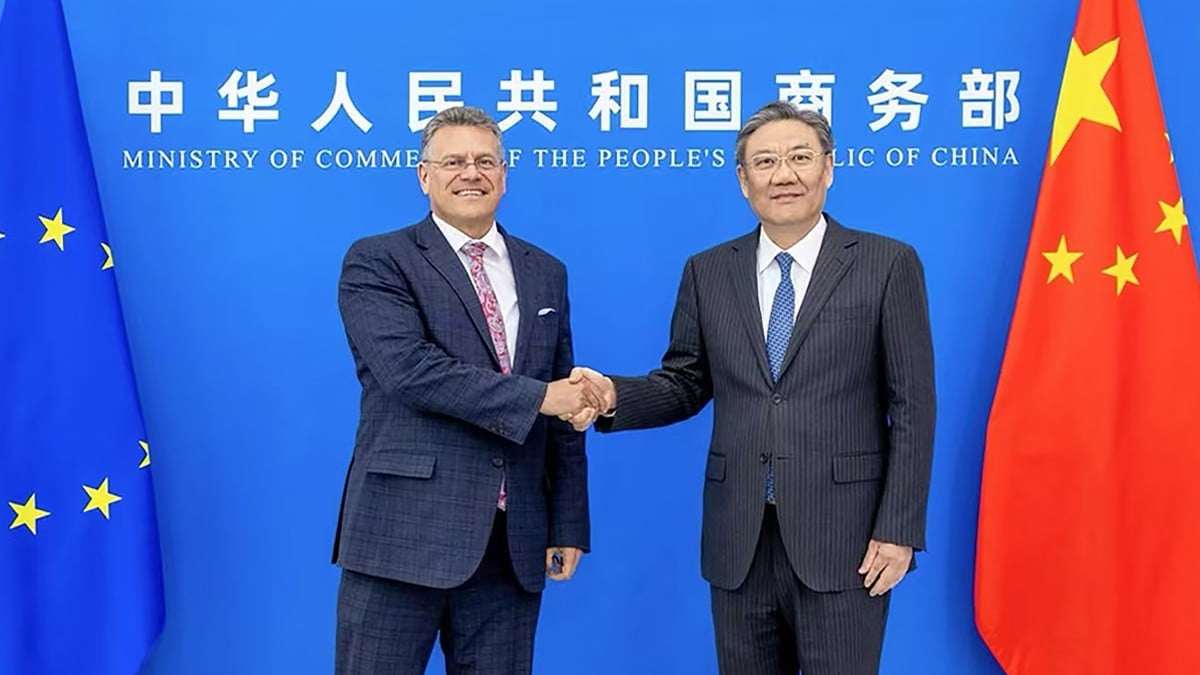
EU Trade Commissioner Maroš Šefčovič has argued that relations between Brussels and Beijing would be better served “if this problem is being tackled from both sides.”
Behind the diplomatic language lies a much tougher message:
Europe no longer considers the current trade imbalance sustainable.
€559 Billion Coming In — Only €200 Billion Going Out
The numbers explain why Brussels is increasingly alarmed.
In 2025, the European Union imported around €559.4 billion worth of goods from China.
EU exports to China amounted to only about €199.6 billion.
That left the bloc with a trade deficit of approximately:
€359.8 billion.
Even more worrying for European policymakers is the direction of travel.
EU exports to China fell, while Chinese exports to Europe continued to rise.
The issue therefore is no longer simply that Europe buys much more from China than China buys from Europe.
The gap itself is widening.
Šefčovič: Both Sides Must Act
Šefčovič’s approach is significant because Brussels is trying, at least for now, to avoid a simple escalation of tariffs.
The EU wants a negotiated rebalancing.
In practical terms, Brussels is asking Beijing for two things:
a reduction in the pressure created by Chinese industrial overcapacity entering Europe,
and greater access for European companies and products inside the Chinese market.
The European message is therefore not simply:
less China in Europe.
It is also:
more Europe in China.
Europe’s Fear: A Second “China Shock”
A growing concern in Brussels is the possibility of a second major China Shock.
The first wave of Chinese integration into the global economy mainly transformed markets for lower-cost consumer and industrial goods.
The new wave is different.
China is increasingly exporting products in sectors Europe considers central to its own economic future:
electric vehicles,
batteries,
solar equipment,
industrial machinery,
chemicals,
electronics,
and advanced manufacturing technology.
Those are precisely the industries in which Europe wants to remain globally competitive.
China Is Moving Into Europe’s Own Industrial Territory
For years, the EU–China trade relationship was at least partly complementary.
Europe sold China cars, machinery, industrial technology and other high-value products.
China supplied Europe with lower-cost manufactured goods.
That division is eroding.
Chinese companies have moved rapidly up the value chain and increasingly compete directly with European firms in sectors where Europe once held a strong technological advantage.
This is the deeper structural problem.
China is no longer merely Europe’s factory. It is becoming Europe’s industrial rival.
The €1 Billion-a-Day Warning
The scale of the imbalance has prompted growing concern across European industry.
At current levels, the deficit is roughly equivalent to around €1 billion every day.
That turns the issue from a conventional trade dispute into something closer to a question of economic security.
If European industrial capacity disappears because domestic firms cannot compete with heavily scaled or subsidized imports, Europe loses much more than jobs.
It loses:
production capacity,
technological know-how,
critical supply chains,
and, in some sectors, strategic autonomy.
Brussels’ Dilemma: Dialogue or Trade War?
For now, the European Commission is trying to avoid a generalized commercial confrontation.
Šefčovič and Chinese Commerce Minister Wang Wentao have been discussing a new mechanism designed to manage trade and investment disputes.
The talks cover areas including:
trade and investment rebalancing,
export controls,
intellectual property,
and reform of the World Trade Organization.
But Brussels wants concrete results.
The political patience of European governments is not unlimited.
And the more the deficit widens, the harder it becomes for the Commission to argue that dialogue alone is enough.
If Beijing Does Not Move, Europe Already Has Defensive Tools
The EU has already become substantially more interventionist in its trade policy.
It has imposed additional duties on Chinese electric vehicles.
It is using anti-subsidy and anti-dumping instruments more aggressively.
It is examining strategic procurement rules.
And the broader “Made in Europe” debate is gaining momentum.
The logic is becoming increasingly clear:
European money should, where possible, support European production in strategically important sectors.
That represents a major shift from the more open-market philosophy that dominated much of the previous two decades.
China’s Powerful Counterweight: Critical Minerals
Europe, however, cannot simply close the door.
It remains heavily dependent on China for critical parts of global supply chains.
Rare earths are the most obvious example.
China has enormous leverage in the processing of rare-earth materials, permanent magnets and other inputs vital to:
electric vehicles,
renewable energy,
electronics,
defense systems,
and advanced manufacturing.
Beijing has already demonstrated that export controls can be used as a geopolitical instrument.
That creates a difficult European dilemma:
Brussels needs to defend itself against Chinese industrial power without triggering retaliation in areas where Europe remains vulnerable.
Beijing Rejects the European Narrative
China does not accept the argument that its trade surplus is simply the result of unfair industrial practices.
Beijing argues that many Chinese exports are intermediate goods that reduce production costs for European companies.
It also points out that European multinational companies themselves manufacture in China and export some of those products back into the European market.
China has also signaled that it could purchase more European goods — but in return wants Europe to loosen restrictions on exports of advanced technologies to China.
That is where the negotiation becomes much more strategic.
The Real Bargain: Market Access for Market Access
The European Union possesses one extremely powerful instrument:
the single market of roughly 450 million consumers.
China needs access to that market.
That matters even more as access to the United States becomes more politically difficult and Chinese manufacturers look for large external markets capable of absorbing their output.
Europe can therefore tell Beijing:
if you want continued privileged access to our market, then we need greater reciprocity.
Fewer barriers for European companies.
More European exports.
Less distortion from state support.
And less pressure from industrial overcapacity.
Europe’s Internal Weakness: The 27 Do Not Always Agree
Beijing also understands that the EU does not always speak with one voice.
France has generally favored a tougher approach toward Chinese industrial practices.
Germany has historically been more cautious because of the exposure of major German companies to the Chinese market, although Berlin’s stance has gradually hardened.
Other member states still see China primarily as an investor and commercial opportunity.
These different national interests have repeatedly made it harder for Brussels to construct a unified China policy.
And that fragmentation remains one of Beijing’s greatest advantages.
Europe Is Being Squeezed From Both Sides
The broader geo-economic picture is even more difficult.
Europe increasingly finds itself between the world’s two largest economic powers.
From the East, Chinese industrial exports are placing pressure on European manufacturers.
From the West, the United States has become more protectionist and more willing to use tariffs as an instrument of economic policy.
That creates a double squeeze:
more competitive imports from China — and more difficult export conditions in the United States.
This is one of the main reasons the EU is moving toward a more defensive economic strategy.
The Real Question: Can Europe Remain an Industrial Power?
The €360 billion trade deficit is an extraordinary number.
But it is not the real problem.
The real question is what sits underneath it.
If Europe loses production capacity in:
cars,
batteries,
chemicals,
green technology,
electronics,
and advanced manufacturing,
its dependency on external powers will deepen.
And that is no longer only an economic issue.
It affects:
defense,
energy security,
technology,
industrial resilience,
and the EU’s ability to conduct an independent foreign policy.
This is why trade policy is increasingly becoming security policy.
The Bigger Picture: Brussels Is Offering Beijing a Choice
Šefčovič’s message can be read as an invitation to cooperate.
But it can also be read as a warning.
Help us rebalance the relationship — or Europe will increasingly rebalance it itself.
The EU does not want a full-scale trade war with China.
The economic interdependence is too deep, and the costs would be enormous on both sides.
But the old model is increasingly broken.
Cheap Chinese imports were once balanced by growing European access to a rapidly expanding Chinese market.
That exchange is no longer functioning in the same way.
What is emerging instead is a new model:
managed interdependence, stronger European industrial protection and the use of the single market as a geopolitical instrument.
The next few months will show whether Beijing is willing to make meaningful concessions.
If it does, Brussels and China may buy time.
If it does not, the EU is likely to move further toward economic defense.
And then the debate will no longer be about how to reduce the trade deficit.
It will be about whether Europe and China are entering a much harder era of geo-economic competition.
Source: pagenews.gr
Διαβάστε όλες τις τελευταίες Ειδήσεις από την Ελλάδα και τον Κόσμο