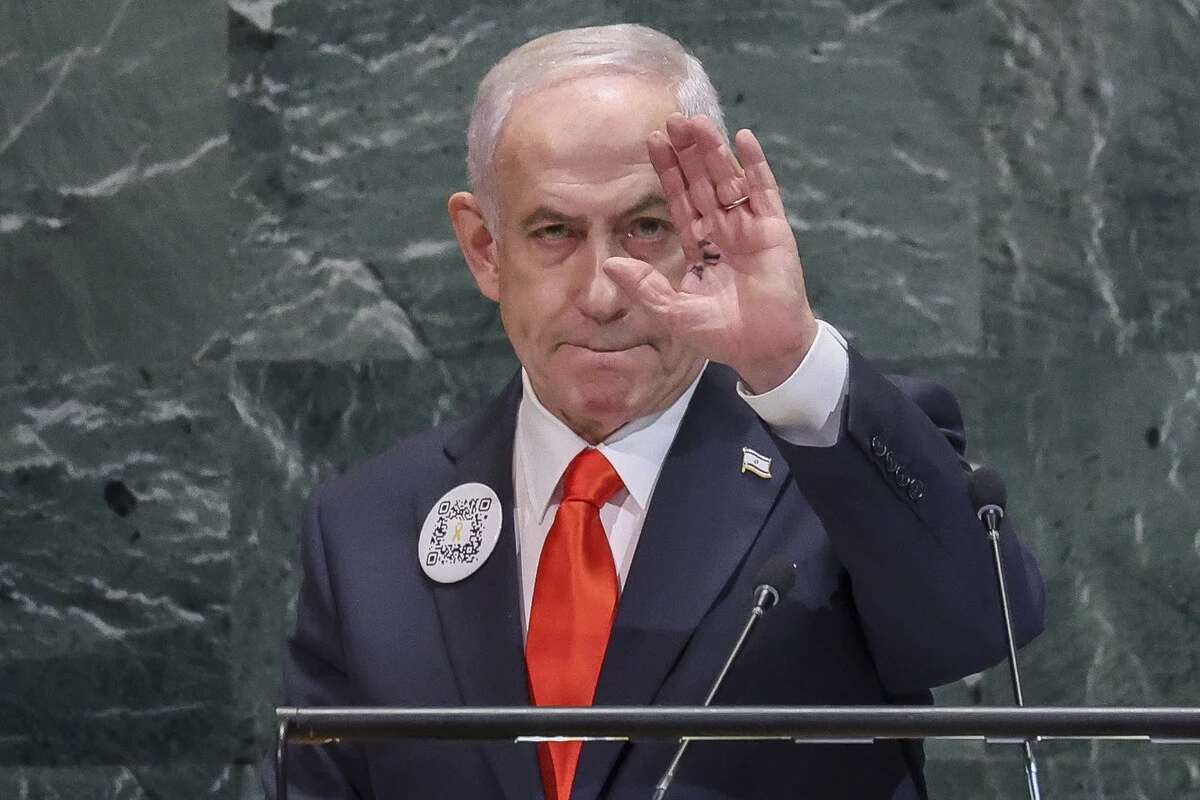
It was one of the defining images of this year’s UN General Assembly.
Benjamin Netanyahu approached the podium.
Dozens of diplomats rose from their seats and walked out.
From the gallery, supporters of the Israeli prime minister applauded and chanted “Am Yisrael Chai” — “The people of Israel live.”
Netanyahu responded with confrontation rather than restraint.
“If there are any other moral cowards who haven’t yet left this hall, please do so now,” he said.
The walkout provided a striking visual representation of the international opposition Netanyahu faces over Israel’s conduct in Gaza and the occupied West Bank.
But the Israeli prime minister was not speaking only to the diplomats sitting — or no longer sitting — in front of him.
Israel is scheduled to hold a general election on October 27.
And much of Netanyahu’s roughly 40-minute address could be understood through that dual lens: an international defence of Israeli policy and a domestic political message delivered from the world’s most prominent diplomatic stage.


“You Tried to Silence Me. You Can’t”
Netanyahu chose confrontation from the outset.
He defended Israel’s military actions, attacked his critics and presented the country as fighting not only armed enemies across the Middle East but also an international battle over the legitimacy of its actions.
“You tried to stop me from coming here. You tried to silence me. Well, you can’t silence me,” Netanyahu told his critics.
At the centre of that confrontation was the accusation of genocide in Gaza.
Netanyahu rejected it categorically.
“Israel didn’t commit genocide. Israel prevented genocide,” he said.
The Israeli government argues that its military campaign is directed against Hamas and that it has taken measures intended to protect civilians and facilitate humanitarian assistance.
Critics, humanitarian organisations and international bodies have challenged Israel’s account of its conduct, pointing to the scale of civilian suffering, restrictions affecting humanitarian assistance and the destruction caused by the war.
The competing claims have become one of the central diplomatic and legal disputes surrounding the conflict.
Mamdani Becomes a Target
Netanyahu then turned his attention to an unusual target for a UN speech: the mayor of the city hosting the General Assembly.
Zohran Mamdani.
Mamdani has repeatedly criticised Netanyahu and has cited the International Criminal Court arrest warrant against the Israeli leader. He has also accused Israel of committing genocide in Gaza, a characterisation rejected by the Israeli government.
Netanyahu responded from the UN podium with a personal attack, accusing Mamdani of antisemitism and of supporting figures associated with Hamas.
Mamdani denies supporting Hamas.


After the speech, he accused Netanyahu of repeating what he called “baseless lies” to defend Israel’s actions in Gaza.
The exchange demonstrated how the Gaza conflict has increasingly entered American domestic politics as well as Israeli politics.
The ICC Warrant Still Shadows Netanyahu’s International Travel
Behind the dispute with Mamdani lies a more consequential legal issue.
The International Criminal Court issued an arrest warrant for Netanyahu in 2024 alleging war crimes and crimes against humanity. Netanyahu and the Israeli government reject the allegations.
The United States is not a party to the Rome Statute establishing the ICC.
That significantly limits the practical implications of the warrant during Netanyahu’s visit to New York, and Mamdani has acknowledged that New York City authorities do not possess the legal authority simply to enforce the ICC warrant themselves.
Nevertheless, the warrant continues to complicate Netanyahu’s international diplomacy and has become another symbol of the widening dispute between his government and parts of the international community.
Then Netanyahu Turned on Erdogan
For Greece and the Eastern Mediterranean, however, one of the most significant geopolitical sections of the speech concerned Turkey.
Netanyahu launched a direct attack on Turkish President Recep Tayyip Erdogan, calling him a “tyrant.”
But he went further.
He referred to Turkey’s presence in northern Cyprus and accused Ankara of threatening Greece, explicitly inserting the Greek-Turkish and Cyprus disputes into his confrontation with Erdogan.
Turkey rejected Netanyahu’s accusations.
For Athens, the significance is not whether Netanyahu’s characterisations are accepted.
It is that Greece and Cyprus are now being invoked publicly by the Israeli prime minister as reference points in the escalating Israel–Turkey confrontation.


And the timing matters.
Netanyahu’s remarks came during the same UN week in which he met Greek Prime Minister Kyriakos Mitsotakis in New York, with security, energy, regional developments and Greece–Cyprus–Israel cooperation on the agenda.
Turkey and Qatar: The Information War
Netanyahu also grouped Turkey and Qatar into what he presented as another battlefield facing Israel: the struggle over international narratives.
He accused Qatar of using its financial influence over universities and media to shape international perceptions of Israel.
He accused Turkey of maintaining ties with Hamas figures and spreading false claims about Israeli conduct.
Both governments reject Netanyahu’s accusations.
Doha argues that Israeli attacks on Qatar are intended to divert attention from events in Gaza, while Ankara maintains that Netanyahu’s rhetoric cannot obscure the humanitarian situation or the international legal scrutiny facing Israel.
The result is an Israel–Turkey confrontation that increasingly extends beyond diplomatic rhetoric.
Gaza, Syria, Hamas, Cyprus, Greece and the wider regional balance of power are becoming interconnected elements of a broader geopolitical dispute.
The Pager and Starlink: Netanyahu Returns to His Props
As in previous appearances before the General Assembly, Netanyahu also relied on physical props to reinforce his message.
This time, he held up a pager, invoking the operation targeting Hezbollah members in Lebanon.
He also displayed a Starlink satellite internet receiver, saying he would leave it to be delivered to the Iranian delegation.
The second prop was aimed squarely at Tehran.
Netanyahu argued that Iran’s political system would eventually face a challenge from its own population and presented Israel’s military confrontation with Tehran as part of a broader struggle for Israeli security.
The imagery was unmistakably designed for television.
And television mattered particularly this year.


Seven Military Fronts — And an Eighth Battle Over the Narrative
Netanyahu sought to portray Israel as confronting multiple simultaneous threats across the region.
Iran.
Hamas.
Hezbollah.
The Houthis.
And other Iran-aligned actors.
But he effectively added another front: the battle over Israel’s international legitimacy and the interpretation of the Gaza war.
That is why the walkout carried such symbolic weight.
Two competing images existed simultaneously.
One was the Israel Netanyahu wanted to present: militarily capable, unwilling to yield to pressure and prepared to confront multiple adversaries.
The other was the image visible inside the General Assembly chamber: dozens of diplomatic representatives leaving as the Israeli prime minister spoke.
Military power and diplomatic pressure were on display in the same room.
Outside the UN, Another Battle in the Streets
The confrontation was not confined to the General Assembly.
Hundreds of demonstrators gathered outside UN headquarters to protest Israel’s military campaign and US support for Israel.
Some blocked traffic and chanted slogans calling for Washington to stop supplying arms.
Police detained several demonstrators.
Supporters and critics of Netanyahu were also present, reflecting a political divide that extends beyond Israel’s relationship with the international community.
It runs through Israeli society itself.
And Trump? The Meeting That Did Not Happen
There was another notable feature of Netanyahu’s short US visit.
He did not have a scheduled meeting with President Donald Trump.
Yet Netanyahu repeatedly praised Trump from the UN podium, portraying the US president as a critical partner of Israel.
For Netanyahu’s domestic audience, the message was useful even without a bilateral meeting: the strategic relationship with Washington remained central to his presentation of Israeli power and security.
The Next Battle Is October 27
This is where the second layer of the UN appearance becomes particularly important.
Israel’s election is approaching.
Recent polling has shown a fragmented parliamentary picture rather than a clear majority for either of the principal political blocs. Polls are snapshots of voter intention rather than forecasts of the final result.
That uncertainty gives the UN speech an unavoidable domestic political dimension.
It was broadcast live during Israeli prime time.
Netanyahu used the world’s largest diplomatic stage to present a clear argument to Israeli voters: Israel is facing intense pressure abroad, but he will not retreat; the country is fighting multiple enemies, but remains militarily powerful; and he portrays himself as the leader capable of navigating that regional confrontation.
That is Netanyahu’s political message.
Whether Israeli voters accept it will be decided at the ballot box.
An Emptying UN Hall — and a Full Election Agenda
The images from New York ultimately capture the paradox surrounding Netanyahu’s position.
Internationally, his government faces sustained criticism over Gaza, diplomatic protests and the continuing consequences of the ICC arrest warrant.
Domestically, he is entering the final stretch of an election campaign amid an unsettled parliamentary landscape.
And regionally, Israel’s confrontation is no longer confined to Gaza.
Iran, Turkey, Syria, Lebanon, Cyprus and Israel’s relations with Arab states increasingly form part of a much wider geopolitical arc.
That is why Netanyahu’s New York appearance was more than a defence of Israeli policy.
It was both an international confrontation and a domestic political intervention.
The next crucial chamber for Benjamin Netanyahu will not be the UN General Assembly.
It will be the Knesset that emerges after Israel votes on October 27.
Source: pagenews.gr