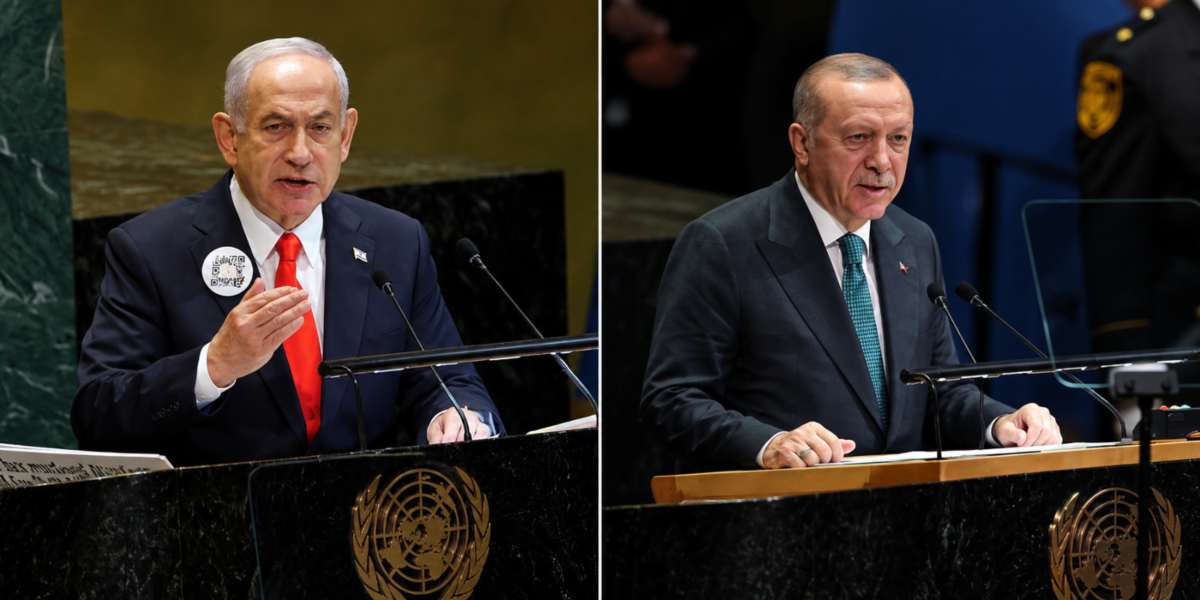
The confrontation between Benjamin Netanyahu and Recep Tayyip Erdogan is no longer just about Gaza.
That may be one of the most important geopolitical conclusions from the Israeli prime minister’s address to the United Nations General Assembly.
Netanyahu launched a fierce personal attack against Erdogan while accusing Turkey of playing a central role in the campaign against Israel.
But his argument went much further.
Netanyahu referred to Turkey’s presence in northern Cyprus, raised Greece in his criticism of Ankara and portrayed Turkey’s expanding role in Syria as part of a broader regional struggle.
Those were Netanyahu’s own political claims and characterizations — not neutral assessments of Turkey’s policies.
What matters strategically, however, is the map behind the rhetoric.
Syria Changes Everything
This is where the real geopolitical story begins.
Turkey has significant influence over the emerging Syrian order.
Israel, meanwhile, wants to prevent the creation of a new strategic threat along its northern frontier.
Those two objectives can coexist only up to a point.
The further Ankara expands its political or military influence inside Syria, the more closely Israel is likely to examine Turkish moves through the prism of its own security.
And that is where the Golan Heights return to the equation.


The Golan Is Back at the Center
Syrian President Ahmed al-Sharaa has declared that the Golan Heights will “remain Syrian territory.”
Netanyahu rejected Damascus’ position and used his UN appearance to reinforce Israel’s claim that control of the territory is vital to its security.
The international legal position remains contested by Israel: the United Nations does not recognize Israel’s annexation of the Golan Heights and continues to regard the territory as occupied Syrian land.
The Golan, therefore, is no longer simply an unresolved legacy of previous Arab-Israeli wars.
It is once again becoming part of the struggle over the future of Syria.
Why Netanyahu Brought Greece Into the Speech
For Athens, there was a particularly significant detail.
Netanyahu explicitly referred to Greece while attacking Erdogan’s regional policies.
That does not mean Greece has become a party to the Israeli-Turkish confrontation.
But it does demonstrate how Israel increasingly views the Eastern Mediterranean as a connected strategic system.
Turkey, Syria, Cyprus, Greece and Israel occupy the same map of military balances, maritime zones, energy infrastructure and strategic corridors.
For Athens, that makes the deterioration of Israeli-Turkish relations important to watch — but also important to approach without assuming that Israeli and Greek interests automatically coincide on every regional issue.
And Then There Is Cyprus
Netanyahu’s reference to northern Cyprus adds another dimension.
The Cyprus issue is already part of the diplomatic agenda surrounding this year’s General Assembly, with Greece reiterating its support for a settlement within the framework of UN resolutions.
Within hours, Greece, Turkey, Israel, Syria and Cyprus were therefore being discussed as elements of the same wider geopolitical environment.
That alone shows how rapidly the regional map is changing.
Iran Remains the Bigger Shadow
Despite Netanyahu’s attack on Erdogan, Iran remains Israel’s primary strategic adversary.
The Israeli prime minister strongly defended Israel’s military campaign against Iran and argued that Israeli actions had protected not only his country but other states in the region.
Yet the weakening of Iranian influence can simultaneously create new power vacuums.
And in the Middle East, power vacuums rarely remain empty.


From Iran to Turkey?
This is the larger strategic question.
A decline in Iranian influence inside Syria does not automatically mean greater security for Israel.
If some of that space is filled by a more influential Turkey, Jerusalem will have to manage a fundamentally different type of regional competitor.
Turkey is a NATO member, a major regional power, possesses significant conventional military capabilities and shares a long border with Syria.
That makes any emerging Israeli-Turkish strategic competition fundamentally different from the Israel-Iran confrontation.
It does not mean a direct military conflict is inevitable.
It does mean that Syria could increasingly become an arena where Israeli and Turkish interests collide.
The New Fault Line Runs Through Syria
The most important part of Netanyahu’s speech was not necessarily its harsh language.
It was the geography behind it.
Syria lies between Turkey and Israel.
Cyprus sits at the heart of the Eastern Mediterranean.


Greece sits astride important maritime and energy routes linking the region to Europe.
And Iran remains a force capable of influencing the entire system.
The next major geopolitical story in the Middle East may therefore not be exclusively about Gaza or Iran.
It may increasingly be about who shapes post-war Syria and which powers dominate the strategic space connecting the Middle East to the Eastern Mediterranean.
That is why the future of Israel-Turkey relations increasingly matters to Athens as well.
Source: pagenews.gr