The Eastern Mediterranean is entering another period of heightened tension.
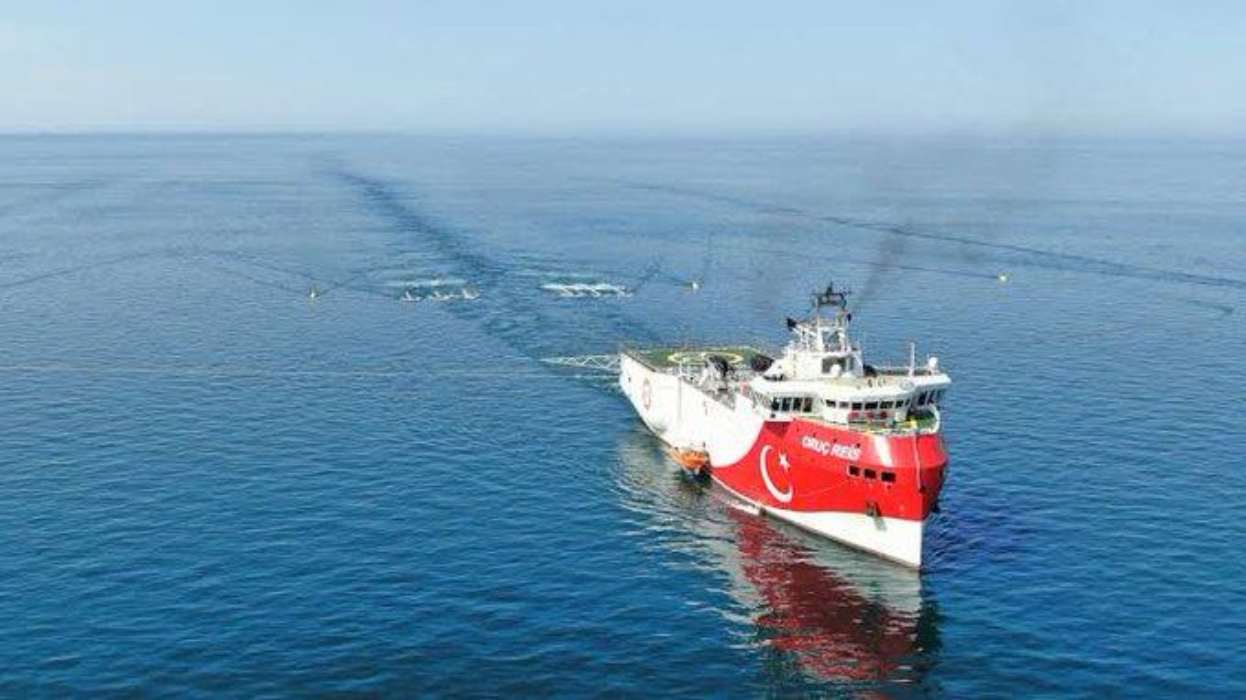
At the center of attention once again is the Oruc Reis, the Turkish research vessel that has become closely associated with repeated crises involving Greece, Turkey and Cyprus over the past several years.
The new focus is Cyprus, at a moment when the regional energy balance is shifting quickly and Ankara is determined to preserve a role in every future arrangement involving hydrocarbons, electricity interconnections and maritime jurisdiction.
The timing is significant.
Only a day earlier, Greek Foreign Minister Giorgos Gerapetritis said there was no reason to redesign the route of the Greece–Cyprus electricity interconnector and that survey and laying operations would proceed according to the contractor’s existing plans.
The vessel that became a symbol of crisis
Oruc Reis is not just another research ship.
In 2020, it stood at the heart of one of the most serious Greek-Turkish crises in decades, conducting seismic surveys in maritime areas that Athens considers part of the Greek continental shelf.
Its deployment was accompanied by Turkish naval vessels and triggered a major mobilization by the Hellenic Navy.
Since then, every return of the vessel to a sensitive area has been viewed as a geopolitical signal.
Turkey has repeatedly used seismic vessels and drilling ships to reinforce its interpretation of maritime zones, particularly around Cyprus.
Why Cyprus is back at the center
Cyprus is strategically important for three main reasons.
First, it already has licensed offshore energy blocks and continuing interest from major international energy companies.
Second, it lies along a potential axis linking Eastern Mediterranean energy resources with Europe.
Third, Turkey systematically disputes the extent of the Republic of Cyprus’ Exclusive Economic Zone, citing both its own maritime claims and what it describes as the rights of Turkish Cypriots.
That means any new activity by Oruc Reis near Cyprus is not viewed simply as a scientific mission.
It is also read as a political statement over jurisdiction and sovereignty.


The precedent of blocks 5 and 6
Ankara has previously linked its claims to areas around blocks 5 and 6 of Cyprus’ EEZ, as well as to waters extending toward the occupied Karpasia peninsula.
Turkey has in the past argued that part of block 6 lies within the Turkish continental shelf and has not abandoned the possibility of activity further west in areas close to Greece’s potential continental shelf.
This background explains why every new Turkish move is closely monitored in Athens and Nicosia.
The other major factor: the Greece–Cyprus interconnector
The latest developments are inevitably linked to the Great Sea Interconnector.
Athens has made clear that it does not believe there is any need to alter the project’s route or design. Gerapetritis has said that the surveys and cable-laying process should proceed as planned by the contractor.
That point is critical.
For Greece and Cyprus, the interconnector is not merely an energy project.
It is:
- a strategic infrastructure link,
- a tool for ending Cyprus’ energy isolation,
- and a symbolic demonstration that the two states can advance major projects in the Eastern Mediterranean.
For Turkey, by contrast, underwater survey activity in the region is directly connected to its own claims over continental shelf rights and maritime jurisdiction.
Ankara wants a seat at every table
This remains one of the most consistent elements of Turkish strategy.
Ankara does not want any new energy architecture in the Eastern Mediterranean to take shape without Turkish participation.
That applies to:
natural gas,
electricity interconnections,
hydrocarbons,
maritime zones,
pipelines.
Whenever Greece, Cyprus, Israel or Egypt move forward with a new energy plan, Turkey seeks to underline that it sees itself as an indispensable regional player.
Oruc Reis is one of the instruments through which that message is conveyed.
Athens and Nicosia avoid rhetorical escalation
Greece has in recent years pursued a dual approach:
dialogue with Turkey,
while maintaining its positions on maritime zones and sovereign rights.
Gerapetritis has reiterated that Greece is not abandoning either its right to extend territorial waters to 12 nautical miles or its planning for the electricity interconnection.
That suggests Athens wants to avoid any impression that Turkish pressure is forcing it to retreat.


Nicosia sees the broader Cyprus question
For Cyprus, Turkish energy activity is inseparable from the wider Cyprus dispute.
Ankara has repeatedly argued that Turkish Cypriots should have a say in, and receive a share of, the island’s energy resources even before a comprehensive political settlement.
The Republic of Cyprus, by contrast, maintains that its sovereign rights within its EEZ cannot be made conditional on Turkish consent.
The energy dispute therefore does not operate in isolation.
It is part of the broader balance of power surrounding the Cyprus issue.
The real danger is a “grey-zone” incident
The most dangerous scenario is not necessarily a major crisis like that of 2020.
It could be something smaller:
a NAVTEX,
a survey in a disputed area,
harassment of a research vessel,
a naval escort,
a sequence of moves that gradually raises the temperature.
The Eastern Mediterranean contains overlapping claims and conflicting interpretations of jurisdiction.
That is precisely why even technical activity can quickly become a political crisis.
The energy crisis makes everything more sensitive
The broader context adds another layer.
Europe is again facing elevated energy prices, tighter gas inventories and significant geopolitical uncertainty.
This increases the strategic value of the Eastern Mediterranean as a potential source of:
energy,
infrastructure,
interconnections.
The more strategically valuable the region becomes, the higher the political cost of disagreements over who has the right to explore where.
Oruc Reis is a message before it becomes a crisis
The biggest significance of the latest developments may not lie in whether the vessel ultimately carries out surveys in one specific zone.
It lies in the fact that Ankara is signaling that it has not abandoned its own framework for the Eastern Mediterranean.
And that the relative de-escalation of recent years does not mean the underlying disputes have been resolved.
For Athens and Nicosia, the objective is to prevent the creation of new faits accomplis.
For Turkey, the objective is to ensure that no new maritime or energy architecture becomes entrenched without Turkish participation.
And once again, Oruc Reis stands at the center of that equation.
Source: pagenews.gr