A New “Middle East NATO”? How the Abraham Accords Defense Act Could Reshape U.S. Strategy
 ΧΡΟΝΟΣ ΑΝΑΓΝΩΣΗΣ 9 '
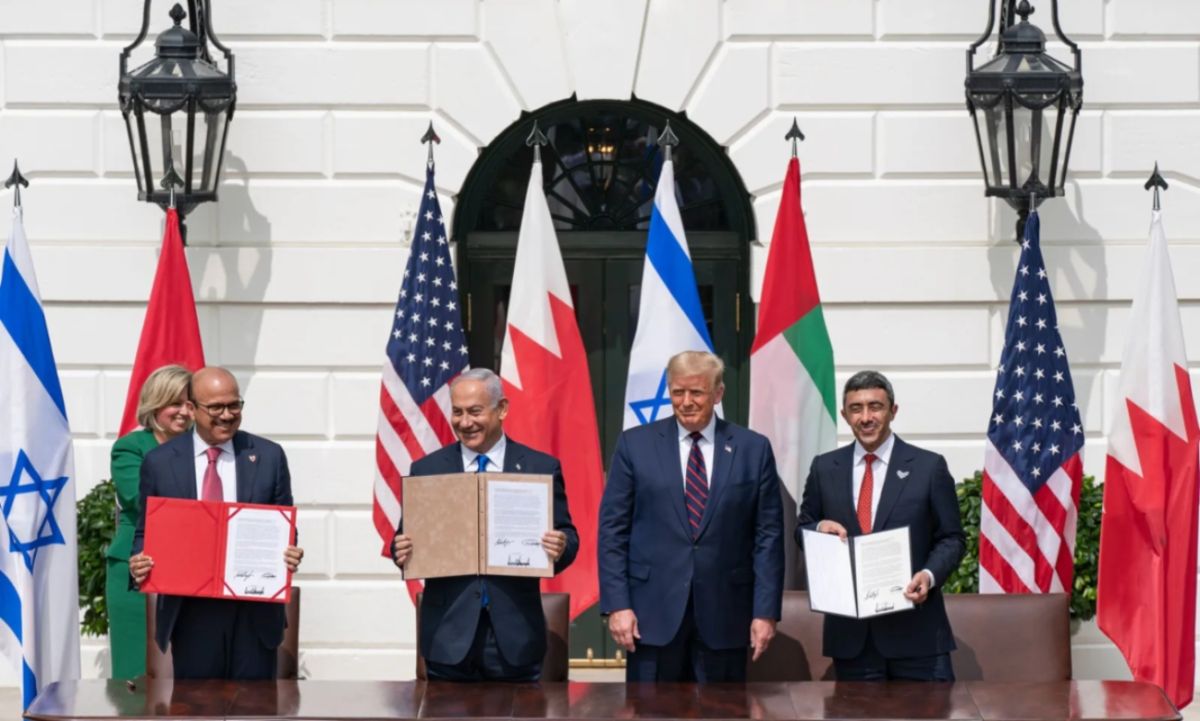
Πηγή Φωτογραφίας: AP Photo//A New “Middle East NATO”? How the Abraham Accords Defense Act Could Reshape U.S. Strategy



Two things happened within days of each other this spring, and almost nobody treated them as part of the same story.
On March 26, Senators Ted Budd and Joni Ernst introduced the Abraham Accords Defense Cooperation Act of 2026, a bill directing the Pentagon to create a funded military-cooperation initiative across a bloc of states stretching from Morocco to the Gulf and potentially into Central Asia.
Four days later, Spain closed its airspace to American aircraft linked to operations against Iran, after already barring U.S. use of the strategic bases at Rota and Morón.
Taken separately, these looked like two unrelated developments: one legislative proposal in Washington and one diplomatic dispute inside NATO.
Taken together, they point to something far more consequential: the United States is building a faster, more flexible security architecture in the Middle East at the very moment its older transatlantic architecture is showing strains it cannot easily resolve.
What the Bill Actually Does
Behind the political symbolism, S.4219 is a relatively narrow but strategically important piece of legislation.
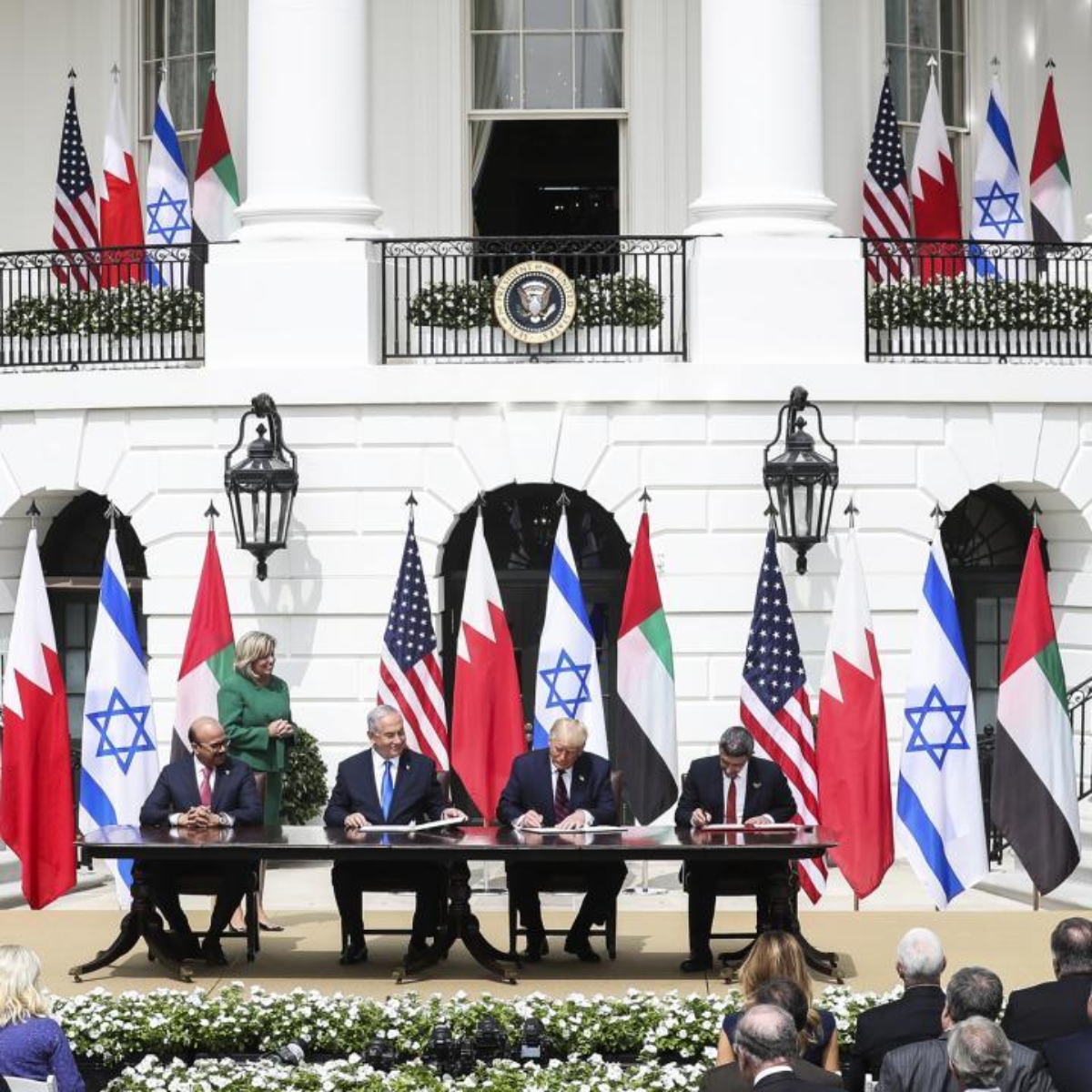
It instructs the Secretary of Defense to establish the United States–Abraham Accords Defense Cooperation Initiative, covering the countries that signed the original 2020 accords — the United Arab Emirates, Bahrain, Morocco and Sudan — as well as any state that has pursued normalization with Israel since then.
The bill requires the Pentagon to prioritize deterrence against Iranian aggression while deepening regional military planning and cooperation.
Its focus areas include:
- counter-drone and counter-UAS capabilities,
- ground-based air defense,
- special operations force development,
- joint exercises,
- interoperability among partner militaries,
- and regional defense planning.
It also requires a formal strategy report to the Senate Armed Services Committee and a dedicated budget request. That detail matters. Both Budd and Ernst sit on the committee and are seeking to fold the initiative into the annual National Defense Authorization Act, which would transform it from a standalone proposal into a recurring part of the U.S. defense budget.
The Real Target: Iran
The bill is not subtle about its strategic purpose.
Ernst’s office framed the Abraham Accords as having created a united front against Iran. Budd was equally direct, arguing that Gulf partners such as Bahrain and the UAE remain exposed to Iranian missile and drone threats and need deeper coordination with the United States and Israel.
That is why some Israeli commentary has described the proposal as the blueprint for a regional “NATO-lite” extending from the Atlantic to Central Asia.
The label may be politically loaded, but the underlying reality is clear: Washington is trying to formalize a regional defense network connecting Israel, Arab partners and the United States around a shared perception of the Iranian threat.
Spain Says No — and NATO Feels the Strain
The second part of the story unfolded in Madrid.
Spain’s position emerged gradually. First, officials indicated that the Rota and Morón bases were not being used for operations against Iran. Then Defense Minister Margarita Robles confirmed that the bases were formally off-limits. By March 30, she extended the prohibition to Spanish airspace itself, saying that neither Spanish bases nor Spanish airspace were authorized for any action related to the war in Iran, which she described as profoundly illegal and unjust.
This was not a minor logistical complication.
Flight-tracking data showed fifteen U.S. aircraft relocating out of the Spanish bases, with several landing at Ramstein in Germany. For decades, Rota and Morón have served as critical hubs for American operations into Europe, Africa and the Middle East. Spain’s decision therefore cut off both basing access and an important air corridor.
Historically, allies have said no to Washington before.
France and Italy denied U.S. airspace for the 1986 Libya raid. Turkey refused to allow U.S. ground forces to transit for the 2003 invasion of Iraq, although it still permitted overflights.
Spain’s move went further.
It was not a limited transit refusal or a one-off wartime exception. It was a blanket policy covering both bases and airspace, sustained over weeks, against a NATO ally engaged in active combat operations.
The Asymmetry Washington Is Not Naming
Here lies the deeper strategic contradiction.
The Abraham Accords Defense Cooperation Act creates a funded, institutionalized cooperation framework with states that carry no treaty obligation to the United States.
The UAE, Bahrain and Morocco are not bound by anything resembling Article 5 of the North Atlantic Treaty. Their participation is transactional, bilateral and revocable.
Yet this is the relationship Washington is now seeking to formalize with a dedicated funding stream and congressional reporting requirements.
Meanwhile, Spain — a full NATO ally protected by Article 5 — closed its airspace to U.S. combat operations and faced little beyond a tariff threat from President Trump.
This asymmetry is unlikely to be accidental.
It reflects a growing American preference for security arrangements that are faster, more discreet and less vulnerable to domestic political constraints than traditional alliances.
Why Gulf Partners Look More Reliable to Washington
From Washington’s perspective, the attraction of the Gulf model is obvious.
Gulf partners can often deliver what NATO increasingly struggles to provide: speed, discretion and operational predictability.
Spain’s coalition government answers to a domestic electorate where opposition to the war in Gaza and to military action against Iran runs deep. In that context, decisions about U.S. basing rights become politically explosive.
The UAE and Bahrain face no equivalent domestic constraint.
Their governance systems allow elite threat assessments — especially regarding Iran — to translate into policy much more quickly.
This is where neoclassical realism helps explain the shift. Systemic pressures do not produce identical state behavior everywhere. They are filtered through domestic politics. In Spain, the filter is public opinion, coalition politics and the government’s vocal criticism of the Gaza war. In the Gulf, that filter is far thinner.
For the Pentagon, that difference matters.
Predictability becomes a strategic asset.
The Eastern Flank Should Be Watching
For NATO’s eastern flank, the implications go well beyond Iran.
The Baltic states, Poland and Central Europe have long argued that NATO’s consensus-based decision-making is cumbersome but necessary because it gives deterrence collective legitimacy.
But legitimacy deters only if adversaries believe the alliance will function as a unit when it matters.
Spain’s decision offers Moscow a data point: NATO membership does not automatically guarantee operational cooperation in every crisis, even when the United States is directly involved.
The problem for eastern allies is not that Washington is about to abandon NATO.
The problem is subtler.
If the United States can build faster, better-funded and consensus-free security structures with non-treaty partners in one theater, what is the long-term incentive to keep investing political energy in slower, more difficult alliance mechanisms elsewhere?
A Parallel Architecture Without Saying So
Nothing in the Abraham Accords Defense Cooperation Act explicitly challenges NATO.
It does not mention Article 5. It does not claim to replace the transatlantic alliance. It does not present itself as an alternative to European security.
But that may be precisely why it matters.
The bill creates a parallel model of security cooperation: funded, institutionalized, operationally focused and free from NATO’s consensus rules.
The Defense Secretary executes. The partners participate. Congress funds. No alliance-wide bargaining is required.
That structure may prove attractive not because it is ideological, but because it is efficient.
The Strategic Question
The Abraham Accords Defense Cooperation Act may eventually be remembered not as a Middle East bill but as a sign of how Washington is rethinking alliances in the 21st century.
The United States is not necessarily abandoning treaty allies.
But it is increasingly rewarding partners who can deliver rapid cooperation without domestic veto points, parliamentary crises or alliance-wide bargaining.
That is the real lesson of the Abraham Accords Defense Act and Spain’s refusal.
The future of American security strategy may not be a choice between NATO and non-NATO partners.
It may be a world in which Washington keeps NATO for deterrence, but builds faster operational coalitions elsewhere for action.
And that would mark a major shift in transatlantic burden-sharing — not through a formal rupture, but through the quiet construction of alternatives.
Source: pagenews.gr
Διαβάστε όλες τις τελευταίες Ειδήσεις από την Ελλάδα και τον Κόσμο