Fidan Provokes Again Cyprus:He Calls Turkish Military Presence the Guarantee of Peace and Pushes Two States
 ΧΡΟΝΟΣ ΑΝΑΓΝΩΣΗΣ 7 '
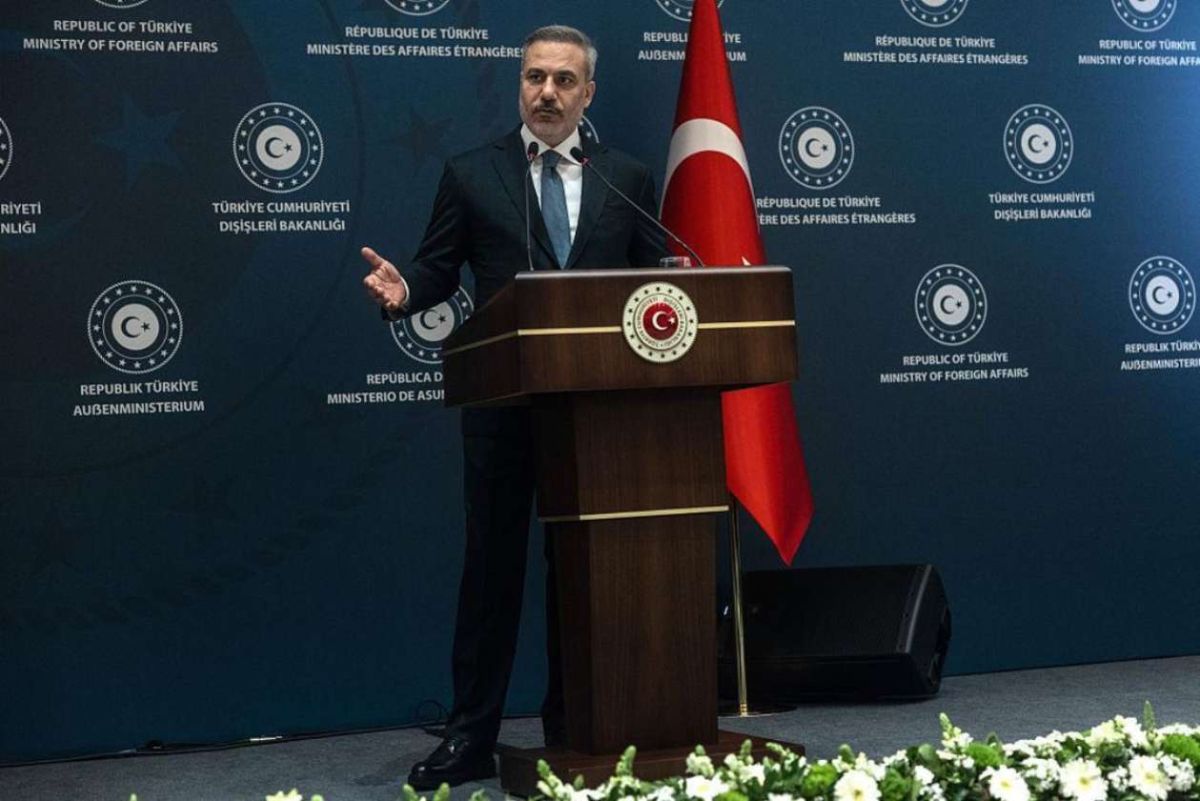
Πηγή Φωτογραφίας: AP Photo// Fidan Provokes Again on Cyprus: He Calls Turkish Military Presence the “Guarantee of Peace” and Pushes Two States



Turkish Foreign Minister Hakan Fidan has once again chosen the hardest possible line on Cyprus.
In an interview with Turkey’s Anadolu Agency, Fidan argued that peace and stability on the island over the past five decades are due to the presence of Turkish troops in the north, while reiterating Ankara’s view that a two-state solution is the only realistic path forward.
This is not merely another repetition of a familiar Turkish position.
It comes at a time when the United Nations is once again trying to create diplomatic momentum around the Cyprus issue. That makes Fidan’s language especially consequential: Ankara is not simply defending the status quo, but attempting to redefine it as the basis for a permanent settlement.
The most provocative claim: “Peace exists because Turkish troops are there”
Fidan said that the status quo has remained essentially unchanged for 50 years and concluded that this proves stability on the island exists because of the Turkish military presence.
From the Greek Cypriot and Greek perspective, this turns the issue upside down.
For Nicosia and Athens, Turkish troops are not a guarantee of peace. They are a central element of the unresolved Cyprus problem and one of the defining features of the island’s division.
In other words, Fidan is presenting as the solution something that the Greek Cypriot side sees as part of the problem.
He went further than the military issue
The Turkish foreign minister also directly challenged the current status of the Republic of Cyprus.
His position was that Ankara does not recognize the Greek Cypriot side as the state established in 1960 and that, without recognition of what Turkey calls the “sovereign equality” of the Turkish Cypriots, Ankara will not recognize the present state structure as legitimate.
That lays out Türkiye’s strategy very clearly.
Ankara is no longer merely demanding stronger constitutional rights for Turkish Cypriots inside a common federal state.
It is demanding recognition of separate sovereignty as the starting point of negotiations.
That leads directly to the logic of two states.
The problem for Ankara: this is not the UN framework
The international process on Cyprus has not adopted a two-state solution.
The United Nations framework continues to rest on the relevant Security Council resolutions and the search for an agreed settlement between the two communities.
So Fidan’s position is not simply a tougher bargaining stance.
It is an attempt to shift the entire basis of the negotiations.
And that is why the language matters so much.
Türkiye is trying to turn a fait accompli into a new normal
This is perhaps the deeper strategic meaning of Fidan’s remarks.
Türkiye knows the division of the island has hardened over decades.
It is now trying to convert that reality from a temporary condition awaiting settlement into the foundation of a permanent political arrangement.
The logic is straightforward:
50 years of separation → two separate administrations → two separate political realities → therefore, two states.
Athens and Nicosia are trying to prevent exactly that transition.
The “occupation equals peace” argument contains a major contradiction
If the presence of Turkish troops were by itself the solution, then the Cyprus problem would have been solved decades ago.
It has not been.
There is still a UN peacekeeping force.
There is still a buffer zone.
There are still negotiations.
There is still no comprehensive settlement.
So stability should not be confused with resolution.
A frozen conflict may avoid open war.
That does not mean the conflict has been solved.
The timing is especially important
Fidan’s comments were not made during a period of complete diplomatic stagnation.
They came while the UN is again trying to revive momentum.
That suggests Ankara wants to define its red lines before any renewed process gains traction.
Those red lines are increasingly clear:
sovereign equality, two states, preservation of Türkiye’s strategic role and no return to an older federal model without fundamental changes.
For Nicosia, the real danger is recognition by another name
The Republic of Cyprus faces a difficult negotiating trap.
If it accepts “sovereign equality” as Ankara defines it, it risks opening the way to the indirect recognition of two separate sovereign entities.
If it rejects that formula, Türkiye can argue that the Greek Cypriot side refuses political equality.
That is the diplomatic dilemma Ankara is trying to construct.
Greece cannot treat this as rhetoric alone
For Athens, Fidan’s statements matter even more because Türkiye is simultaneously increasing its broader geopolitical weight.
Ankara is expanding defense cooperation with Saudi Arabia and Pakistan, improving ties with Egypt, deepening its role in Syria and strengthening its defense industry.
That means Cyprus cannot be viewed as an isolated bilateral issue.
It is part of Türkiye’s wider strategy in the Eastern Mediterranean.
The EU also has a direct stake
The Republic of Cyprus is a member state of the European Union.
So the Cyprus issue is not only about the guarantor powers and the United Nations.
It is also a question of European security and sovereignty.
As EU-Türkiye relations reopen around defense, trade, migration and regional cooperation, Nicosia and Athens have every reason to ensure that progress with Ankara cannot be entirely separated from developments on Cyprus.
Türkiye’s broader contradiction
Ankara simultaneously wants:
closer economic ties with the EU,
a larger role in European defense,
greater strategic importance inside NATO,
and international acceptance of a two-state solution in Cyprus that the UN framework does not endorse.
Those objectives do not sit together easily.
And that gives both Athens and Nicosia political leverage.
Fidan is trying to rewrite the vocabulary of Cyprus
That may be the most important point.
He does not describe Turkish military presence as occupation.
He calls it stability.
He does not speak of troop withdrawal.
He speaks of peace guarantees.
He does not speak of reunification.
He speaks of two states.
And he does not treat the Republic of Cyprus as the unquestioned international political framework for the island.
He presents it as a structure that, in Ankara’s view, no longer reflects the original 1960 constitutional balance.
This is not accidental language.
It is a strategic reframing designed to turn today’s division into tomorrow’s legitimacy.
And that is the real challenge in Fidan’s message
The Turkish foreign minister is not simply saying that Turkish troops will remain.
He is saying something much more consequential:
their presence is the reason peace exists and should therefore be seen as part of the future settlement, not part of the problem.
For Athens and Nicosia, that is one of the hardest Turkish positions to accept.
Because if the argument succeeds that 50 years of military and political division create a new legitimacy of their own, then Cyprus stops being a question of reunifying a divided state.
It becomes a negotiation over the international recognition of the division itself.
Source: pagenews.gr
Διαβάστε όλες τις τελευταίες Ειδήσεις από την Ελλάδα και τον Κόσμο