The so-called “calm waters” between Greece and Turkey are facing their most serious test yet — simultaneously under the sea, in the air and across the heavily contested strategic geography of the Aegean and Eastern Mediterranean.
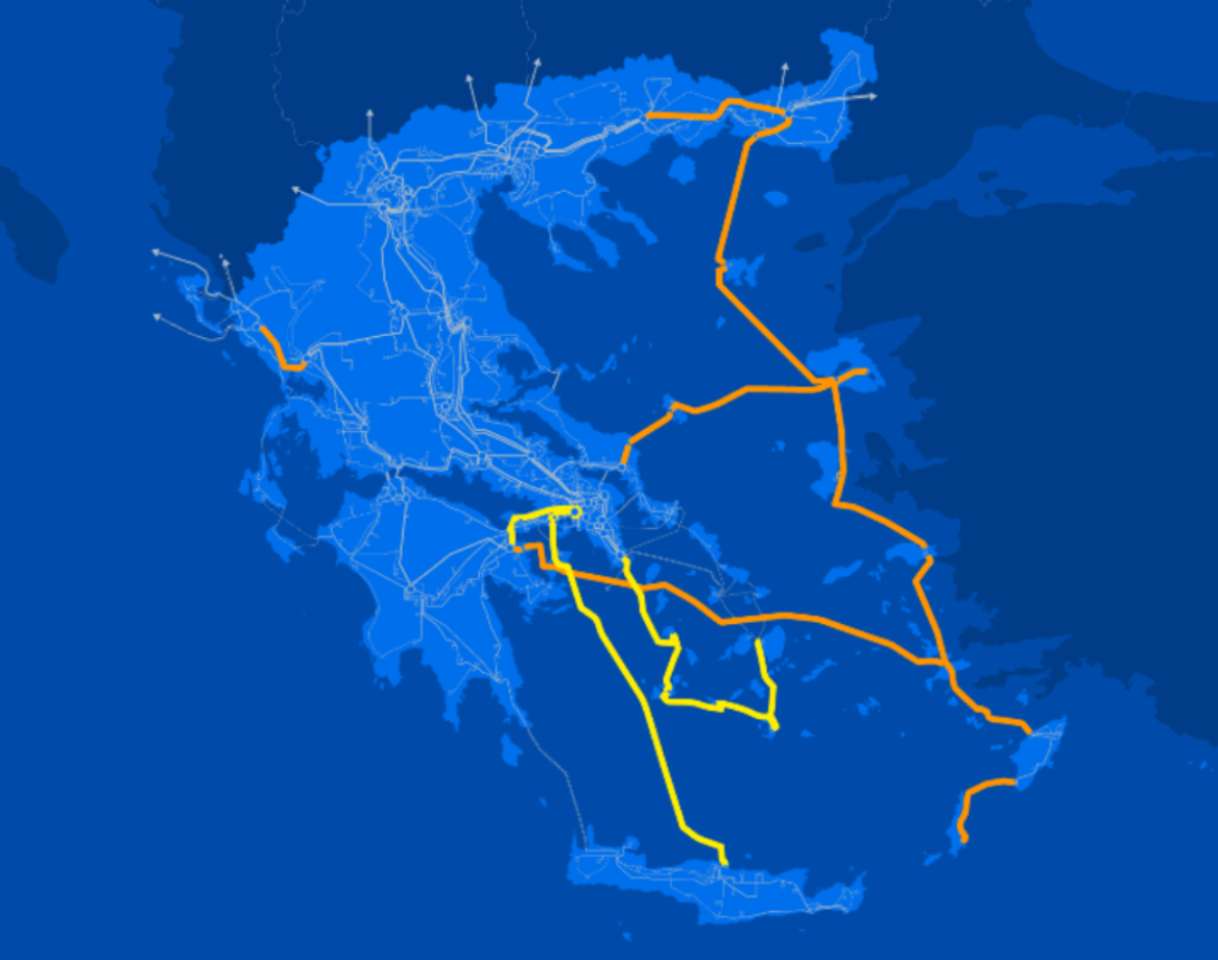
The Great Sea Interconnector (GSI) between Greece and Cyprus is returning to the center of attention as Athens prepares for new seabed surveys. Ankara is increasing pressure around Kastellorizo and reviving its longstanding demands over the demilitarization of Greek islands. At the same time, Greece’s new defense cooperation with Israel and the development of the multi-layered “Achilles Shield” are changing the military balance.
None of this means that Ankara necessarily wants an armed confrontation.
But Turkey appears increasingly willing to test how far it can push its claims without triggering one.
The Cable Could Become the First Major Test
The most immediate flashpoint is the Great Sea Interconnector.
The electricity cable is designed to connect Greece, Cyprus and ultimately Israel, ending Cyprus’s energy isolation from the European electricity grid and creating a strategically important energy corridor in the Eastern Mediterranean.
But its importance now extends well beyond energy.
Seabed surveys require vessels to operate in waters where Greek and Turkish interpretations of maritime jurisdiction diverge sharply.
There is already a precedent.
In July 2024, Turkish warships reacted to survey operations by the Italian vessel Ievoli Relume south of Kasos and Karpathos, highlighting how quickly a technical operation can become a geopolitical confrontation.
The renewed surveys will therefore test something much bigger than the construction timetable of an electricity cable.
They will test whether Ankara can effectively impose a political or operational veto on a European-backed infrastructure project.
Mitsotakis Draws a Red Line
Prime Minister Kyriakos Mitsotakis has already made Athens’s position clear.
Speaking at the Thessaloniki International Fair, he rejected the idea that Turkey has any legitimate authority to prevent the project from moving forward.
“Turkey has no legitimacy to obstruct the project. I believe it will not do so. We are also coordinating with France in order to address all possible scenarios.”
The reference to France is significant.
French infrastructure investor Meridiam’s involvement adds another layer of European and French strategic interest to the project, while Greece and France already maintain a deep defense partnership.
The next stage, therefore, will be considerably more important than another diplomatic exchange between Athens and Ankara.
The real test comes when survey vessels return to the water.
Kastellorizo Is Back at the Center of the Game
At the same time, Turkish research activity around the wider Kastellorizo area is adding pressure.
The Turkish research vessel TÜBİTAK Marmara has operated in the region under a Turkish NAVTEX, with Greek authorities closely monitoring its movements.
Kastellorizo is not simply another Greek island.
It lies at the heart of one of the most important disagreements between Athens and Ankara over the effect islands should have in the delimitation of maritime zones.
Turkey has long sought to minimize the maritime effect of the Kastellorizo complex. Greece rejects that approach and bases its position on its interpretation of international maritime law.
That makes every research mission, NAVTEX and mapping exercise around the area politically sensitive.
The strategic concern in Athens is that repeated Turkish activity could gradually create an impression of “normality” around claims Greece fundamentally rejects.
The “Achilles Shield” Changes the Military Equation
There is another reason why the current confrontation differs from earlier periods of Greek-Turkish tension.
Greece is transforming its air and missile defense architecture.
Its “Achilles Shield” is intended to integrate multiple layers of air defense, anti-ballistic missile capabilities and counter-drone systems into a more unified command-and-control structure.
Israel is a central partner in that transformation.
For Athens, this is not simply another weapons procurement program. It is part of a broader effort to adapt Greek deterrence to a battlefield increasingly dominated by drones, missiles, precision weapons and networked air-defense systems.
For Ankara, however, the implications are potentially much wider.
A more heavily protected Greek island chain changes the operational calculations that would apply in any future Aegean crisis.
Why Ankara Is So Concerned
President Recep Tayyip Erdoğan has again raised Turkey’s longstanding objections to the militarization of Greek islands.
The timing matters.
Turkey’s criticism has intensified as Greece moves forward with its new defense architecture and deepens strategic cooperation with Israel.
The Turkish argument attempts to connect the legal status of certain islands with the deployment of modern military capabilities on them.
Athens rejects that logic and points to what it regards as a direct and persistent security threat from Turkey, including the large Turkish military presence opposite the Greek islands.
Mitsotakis has now made the Greek position explicit:
“Greece has strengthened its deterrent capability in recent years and obviously will not ask anyone’s permission about how it arms itself.”
That statement effectively draws another red line.
Dialogue with Turkey may continue, but Athens does not accept that dialogue gives Ankara a veto over Greek defense planning.
Not a New Casus Belli — But a New Pressure Point
One distinction is essential.
Turkey has not formally declared a new casus belli over the “Achilles Shield.”
Its formal 1995 parliamentary threat concerning a possible Greek extension of territorial waters in the Aegean remains a separate issue.
What is emerging around the new Greek defense architecture is strong political and strategic pressure — not, at least so far, a newly declared formal threat of war.
The distinction matters because exaggerating Turkish rhetoric can obscure what Ankara may actually be attempting.
The objective may be less dramatic, but potentially more sustainable: to establish the principle that significant Greek defense decisions in the islands should carry a Turkish political cost.
Drones Bring a New Kind of Pressure
The air dimension of the rivalry is also changing.
Unmanned systems allow states to maintain surveillance and operational presence at substantially lower cost and political risk than repeated deployments of manned combat aircraft.
That makes drones particularly useful instruments in a strategy of persistent pressure.
Instead of spectacular confrontations, the Aegean could increasingly see lower-level but continuous military activity designed to probe readiness, collect intelligence and test responses.
This is precisely why the counter-drone component of Greece’s emerging air-defense network is becoming strategically important.
The next Greek-Turkish crisis may look very different from the dogfights that defined previous decades.
Ankara Does Not Need a “Hot Incident” to Gain Ground
This is perhaps the most important point.
Turkey does not necessarily need a military confrontation to advance its strategic objectives.
NAVTEX notices, research vessels, diplomatic notes, competing maps, drones, challenges to maritime jurisdiction and disputes over the military status of islands can all operate as instruments of a broader strategy.
The objective is not necessarily to seize territory.
It can instead be to create de facto constraints on how Greece exercises rights and jurisdiction.
If every major Greek project in the Aegean or Eastern Mediterranean begins to depend on whether Ankara will react, Turkey gains influence without changing a single treaty.
That is the danger of gradual normalization.
What begins as “avoiding escalation” can eventually become an informal requirement to anticipate Turkish consent.
The Limits of the “Calm Waters” Strategy
This is where the Greek-Turkish dialogue faces its fundamental test.
The reduction in tension over recent years gave both countries valuable space. Communication channels remained open and the risk of accidental escalation was reduced.
But diplomatic calm does not mean that the underlying strategic disagreements have disappeared.
Turkey has not abandoned its positions on maritime zones, the status and militarization of Greek islands or the wider concept associated with its “Blue Homeland” doctrine.
Greece, for its part, has not abandoned its own sovereign claims and is now accelerating its military modernization.
The contradiction was manageable as long as neither side tested the hardest questions.
The GSI and the new Greek defense architecture may now do exactly that.
Greece Is Also Changing Its Strategy
Athens is no longer relying solely on diplomatic protests.
The Great Sea Interconnector has acquired a broader European dimension and greater French involvement.
The “Achilles Shield” deepens the strategic relationship with Israel.
Greece’s defense partnership with France remains another major component of its deterrence strategy.
And the government is publicly signaling that Turkish objections will not determine how Greece organizes its defense.
The emerging Greek approach can therefore be summarized differently from the traditional model of simply managing Turkish pressure.
Athens is increasingly trying to raise the diplomatic, European and operational cost of that pressure.
The Real Crash Test Will Come at Sea
This is why the next seabed surveys for the Great Sea Interconnector could become far more consequential than another round of hostile statements.
If the surveys proceed without serious Turkish interference, Athens will have demonstrated that a strategically important project can move forward despite Ankara’s objections.
If Turkey attempts to obstruct them, the dispute moves from rhetoric into the operational domain.
And that would test more than Greece.
It would test the European dimension of the GSI, France’s growing involvement and the credibility of Athens’s claim that strategic infrastructure projects cannot be subjected to an informal Turkish veto.
The future of the “calm waters” strategy will therefore not be determined by how loudly Erdoğan speaks or how sharply Athens responds.
It will be determined by something much more concrete:
whether Greece can build strategic infrastructure, defend its islands and exercise the rights it claims under international law without the threat of Turkish escalation becoming a de facto veto over Greek policy.
That is the real Aegean crash test — and it may only be beginning.
Source: pagenews.gr