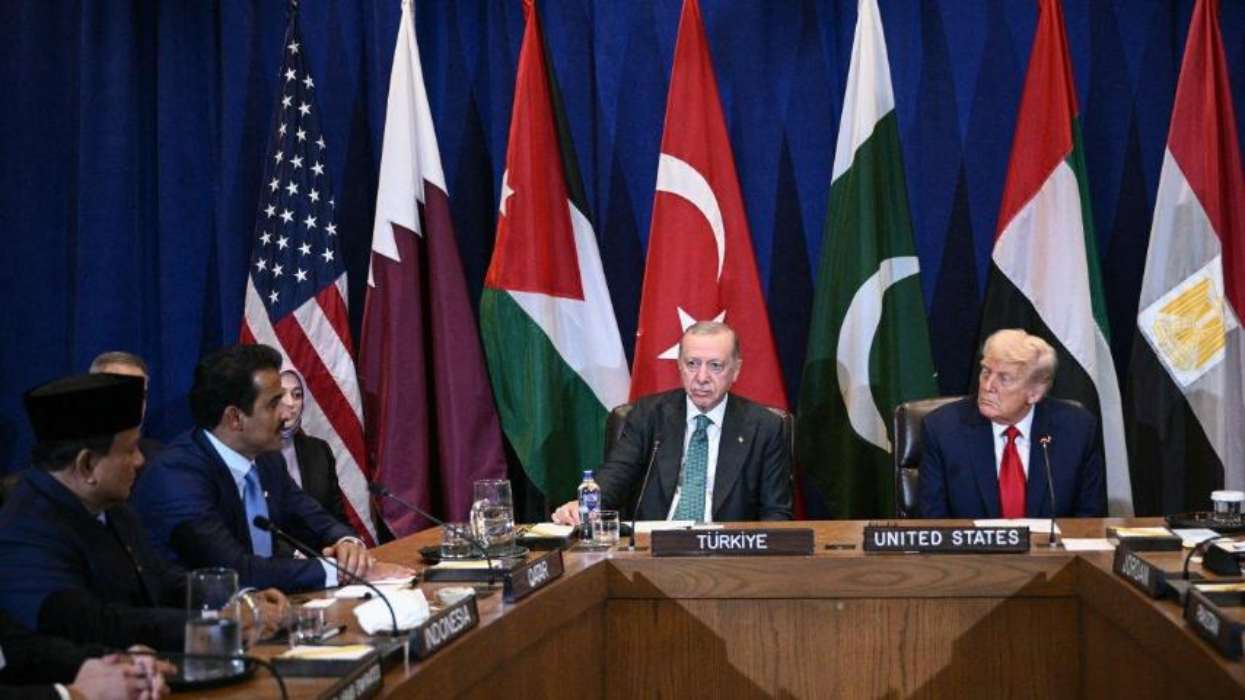
A diplomatic question mark is hanging over New York: will Donald Trump and Recep Tayyip Erdogan actually hold the much-discussed bilateral meeting that had been publicly anticipated ahead of the UN General Assembly?
So far, the answer is not straightforward.
The official U.S. presidential schedule includes Trump’s address to the General Assembly, meetings with selected foreign leaders and a broader gathering with Gulf leaders. Erdogan’s name, however, does not appear among the announced bilateral meetings.
That matters because the expectation of a Trump–Erdogan meeting had already been created publicly.
Barrack had said they would meet
U.S. Ambassador to Turkey Tom Barrack had indicated that Trump and Erdogan were expected to meet in New York on the margins of the General Assembly.
Turkish media had reported the anticipated encounter as part of Erdogan’s UN schedule, while Barrack repeatedly emphasized what he described as a strong personal relationship between the two presidents.
But there is an important distinction between a diplomatic expectation and a formally scheduled bilateral meeting.
At this stage, the latter has not been announced.


Turkey has not released a fixed Trump meeting either
The Turkish presidency announced that Erdogan would travel to the United States for the UN gathering and hold bilateral meetings with several leaders.
What it did not provide was a specific date and time for a formal meeting with Trump.
That leaves open several scenarios: a last-minute addition to the official schedule, a short pull-aside on the margins of another event, or a conversation at a reception hosted by the U.S. president.
Such encounters are common during UN week and can still carry political importance even if they do not have the protocol of a full bilateral summit.
Why the format matters
For Ankara, a formal Trump–Erdogan meeting would be more than a photo opportunity.
Turkey has several unresolved issues with Washington that require high-level political intervention, especially in defense.
A full bilateral would allow Erdogan to press directly on those files and demonstrate domestically and internationally that his personal relationship with Trump can still generate strategic dividends.
A brief corridor conversation would send a much weaker signal.
The biggest obstacle remains the S-400 dispute
At the center of U.S.–Turkish defense tensions remains Turkey’s purchase of Russia’s S-400 air-defense system.
That decision led Washington to remove Turkey from the F-35 program and impose sanctions under U.S. law.
Even though relations have improved politically, the legal and institutional obstacles have not disappeared.
Barrack has said he believes the S-400 dispute can ultimately be resolved and that U.S. and Turkish teams are continuing to work on the issue. But optimism from a diplomat is not the same as a completed agreement.
Ankara wants a path back to the F-35
Turkey’s strategic objective is clear: it wants to restore access to advanced U.S. combat aircraft and normalize defense ties.
The F-35 remains the most politically sensitive part of that agenda.
A Trump–Erdogan meeting would give Ankara an opportunity to push for a political framework that could eventually reopen the discussion, but the president alone cannot simply erase all legal restrictions.
Congress and existing U.S. law remain decisive actors.
That is why the personal chemistry between Trump and Erdogan, while important, does not automatically translate into policy.


F-16 talks continue in parallel
Even without a formal presidential meeting, defense talks between the two governments are continuing.
Discussions over Turkey’s F-16 fleet, modernization and broader military cooperation remain active.
That means the absence of a full Trump–Erdogan bilateral would not amount to a collapse in relations.
It would, however, complicate Ankara’s effort to portray the current moment as the beginning of a major strategic reset.
Syria and the Middle East are also on the table
Defense procurement is only one part of the relationship.
Turkey has expanded its role in Syria, maintains channels with Iran and seeks influence across the broader Middle East.
If Trump and Erdogan do meet, Syria, Iran, regional security and U.S.–Turkish coordination are likely to feature prominently.
The two sides share some interests but also retain important differences, including over Kurdish armed groups in Syria and the balance of regional power.
The personal relationship is warm — the alliance is still complicated
Trump has repeatedly spoken positively about Erdogan and has described the bilateral relationship in warm terms.
That personal rapport is one of Ankara’s strongest diplomatic assets in Washington.
But U.S.–Turkish relations remain institutionally complicated.
Turkey is a NATO ally, yet it has also pursued major defense ties with Russia, clashed with Washington over Syria and faced long-running disputes over sanctions, arms sales and regional policy.
So far, improved presidential chemistry has softened the tone, but it has not eliminated the structural disagreements.
What we know right now
The current picture is therefore relatively clear.
First, Barrack and Turkish reporting created a public expectation that Trump and Erdogan would meet in New York.
Second, no formal bilateral has appeared on the announced U.S. schedule so far.
Third, a shorter informal encounter remains entirely possible.
And fourth, the most important issues between Washington and Ankara — S-400, F-35, F-16 modernization, Syria and broader regional security — remain unresolved regardless of whether the two leaders exchange a few words in New York.
The real test is not the photo — it is what follows
If Trump and Erdogan do not hold a formal meeting, that should not automatically be read as a diplomatic rupture.
But it would undercut the narrative that Ankara had secured another major presidential-level breakthrough during UN week.
If they do meet informally, the real question will be whether that encounter produces anything concrete.
For Turkey, the key objective is to convert Trump’s favorable personal attitude toward Erdogan into tangible policy movement on defense and sanctions.
For Washington, the challenge is to preserve Turkey as a strategic NATO partner without abandoning the legal and security concerns that led to the F-35 rupture in the first place.
That is why the significance of the New York episode goes beyond whether Trump and Erdogan shake hands.
The real story is whether the personal relationship can finally overcome the institutional barriers that continue to define U.S.–Turkey relations.
Source: pagenews.gr