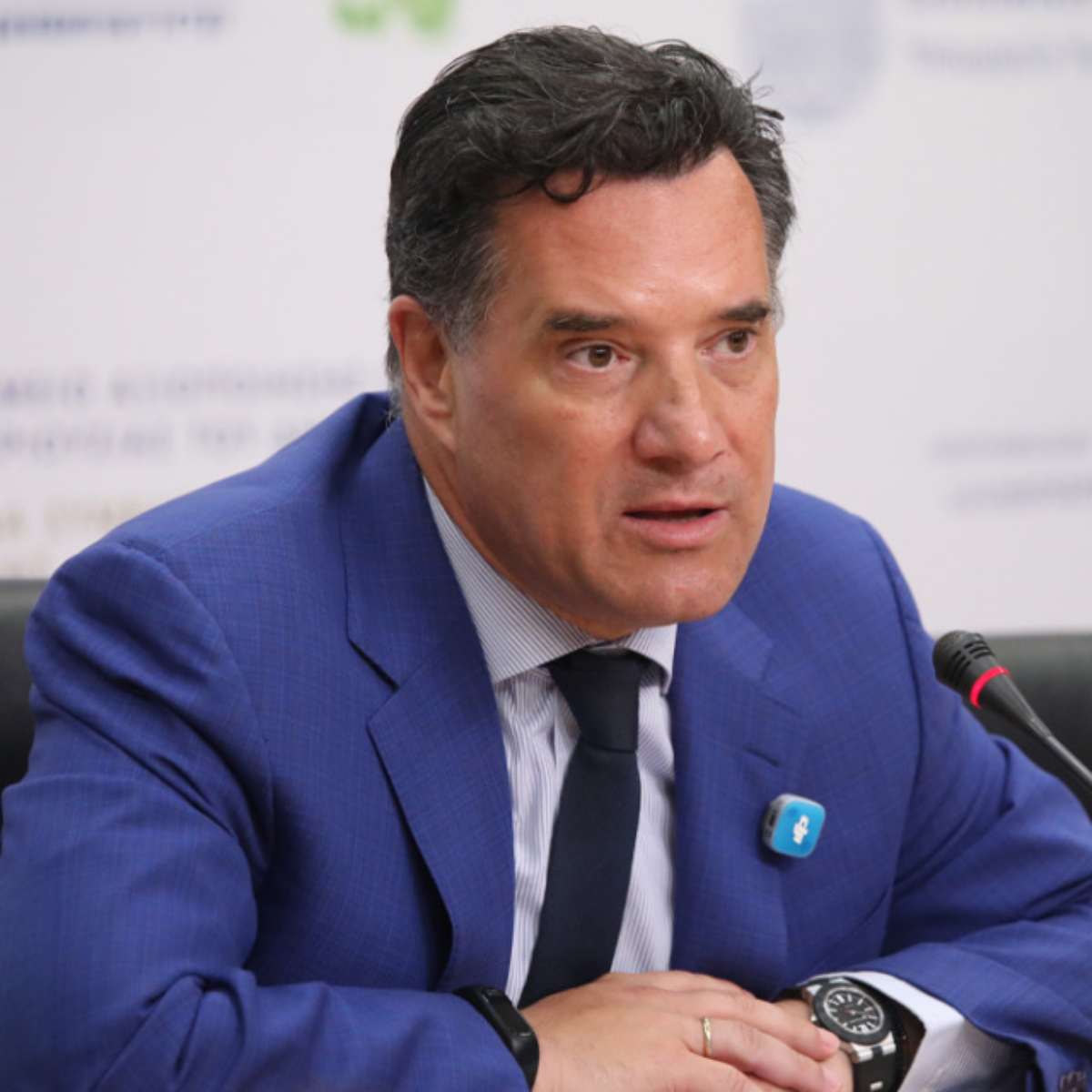
“These are the things that matter.”
That was the central message from Health Minister Adonis Georgiadis as he sought to move the discussion away from the daily cycle of domestic political confrontation and toward the much larger picture surrounding Greece.
Turkey. Israel. Russia and Ukraine. The Middle East. Energy. Oil. Inflation.
And above all, Greece’s position in a world that, in Georgiadis’ words, is moving rapidly from an era of order into an era of “global disorder.”
“Mitsotakis has gone there and done very serious work. In a rapidly changing world…” Georgiadis said.
At the center of his intervention were two developments in New York: Mitsotakis’ address to the UN General Assembly and his meeting with Israeli Prime Minister Benjamin Netanyahu.
Mitsotakis at the UN: Dialogue With Turkey — But Clear Red Lines
Kyriakos Mitsotakis chose not to answer Ankara with rhetorical escalation from the UN podium.
But he publicly placed Greece’s positions before the international community: International Law, UNCLOS, the delimitation of the continental shelf and Exclusive Economic Zones, and the continued existence of Turkey’s casus belli.
Mitsotakis presented Greece as a “pillar of stability and peace” in the Eastern Mediterranean and Middle East, while stressing the importance of international law in relations with Turkey.
Athens continues to regard the delimitation of maritime zones as the bilateral dispute that can be resolved on the basis of international law and the UN Convention on the Law of the Sea.
At the same time, the Greek prime minister has insisted on keeping channels with Ankara open and avoiding a return to the dangerous tensions of previous years.
The message is therefore twofold: dialogue and de-escalation, but without abandoning Greece’s established positions.
That is precisely the point Georgiadis highlighted on Action 24.
“For the Greek prime minister to speak and respond to the president of Turkey with confidence — not with hysteria, but with confidence — to defend the country’s sovereign rights, to show that we are not afraid of Turkey and to support Cyprus: these are the important things.”
Cyprus Back at the Center
Mitsotakis also placed Cyprus firmly inside the broader argument over international law.
Athens continues to support a settlement within the UN framework and rejects a two-state solution, while backing efforts by the UN Secretary-General to restart substantive negotiations.
The significance goes beyond the long-running Greek-Turkish dispute.
Cyprus is increasingly intersecting with a much wider Eastern Mediterranean contest involving Turkey, Israel, energy, defense and regional connectivity.
And only hours after Mitsotakis spoke in New York, that connection became even more visible.
Georgiadis: The Mitsotakis–Netanyahu Meeting Was the Most Important Development
Georgiadis gave particular weight to the Greek prime minister’s meeting with Benjamin Netanyahu.
“The most important issue is yesterday’s meeting between the prime minister and Benjamin Netanyahu in New York,” he said.
This was not merely another diplomatic photo opportunity on the sidelines of the UN.
Mitsotakis and Netanyahu discussed regional developments, energy cooperation and preparations for another Greece–Cyprus–Israel trilateral summit.
Netanyahu stressed the importance of the strategic partnership between Israel and Greece for regional stability and welcomed Athens’ decision to acquire Israeli defense systems.
That gives the relationship a concrete strategic dimension.
Defense.
Energy.
Regional security.
Cyprus.
And the next stage of trilateral cooperation in the Eastern Mediterranean.


“This Is the Alliance That Will Keep Us Safe”
Georgiadis went further in describing his own assessment of the relationship.
“He is building our alliance with the State of Israel, Greece’s natural historic ally in the Eastern Mediterranean,” he said.
And then came one of the strongest lines of the interview:
“The relationship with Israel is now being built on exceptionally solid foundations. Remember this, because this is the alliance that will keep us safe in this rapidly changing world.”
The description of Israel as a “natural historic ally,” as well as the assessment that the relationship will keep Greece safe, reflects Georgiadis’ political view.
What is documented is the increasing breadth of Greek-Israeli cooperation.
It now encompasses defense systems, military cooperation, energy and the trilateral framework with Cyprus — and the latest Mitsotakis-Netanyahu meeting again placed all those elements on the table.
Then Netanyahu Put Greece and Cyprus Into His Confrontation With Erdogan
The timing made the developments even more significant.
The broader UN debate unfolded against a backdrop of escalating confrontation across the Middle East, with Israel, Turkey, Iran, Yemen and Gulf security increasingly intersecting.
Netanyahu used his own UN appearance to launch a fierce attack on Erdogan and Turkish policy, bringing Greece and Cyprus into his criticism of Ankara.
Those were Netanyahu’s accusations and political characterizations, and they should be understood within the increasingly intense Israeli-Turkish confrontation.
But their geopolitical significance for Athens is difficult to miss.
Within hours, Greece, Turkey, Israel and Cyprus had all entered the same strategic conversation in New York.
Behind that confrontation sit Syria, the Golan Heights, Cyprus, defense cooperation, energy routes and the increasingly visible contest for regional influence between Israel and Turkey.
From the Aegean to Hormuz — The Map Is Becoming One
That broader picture is essential to understanding Georgiadis’ reference to a “rapidly changing world.”
Greece sits at the western end of a maritime chain stretching from the Persian Gulf and the Strait of Hormuz through the Red Sea and Suez into the Eastern Mediterranean and the Aegean.
Oil, LNG, commercial shipping and critical global supply chains move through that system.
Disruption in one part of it can quickly travel to another.
The current Middle East conflicts have again placed maritime security and critical shipping routes at the center of international diplomacy, with Gulf states stressing the need to keep strategic waterways open.
For Greece — home to one of the world’s most important shipping sectors and positioned between the Middle East and the European market — maritime security is therefore not an abstract geopolitical issue.
It can become an economic issue almost immediately.
From the Aegean to Israel — and From Israel to the Gulf
This also explains why Athens’ regional strategy is broader than its partnership with Israel.
Greece has simultaneously invested in strategic relationships with Egypt, Saudi Arabia, the United Arab Emirates and other Gulf partners.
The objective is not to place Athens exclusively inside one regional camp, but to expand its diplomatic, defense, energy and commercial network across the Eastern Mediterranean and the Middle East.
Mitsotakis’ UN message reflected that approach: Greece presented itself not as a regional “troublemaker,” but as a bridge and a stabilizing actor in a difficult neighborhood.
“Germany Used to Lecture Us — Now It Talks About Learning From Greece”
Georgiadis then moved from geopolitics to economics.
And he reached back to one of the defining images of the Greek debt crisis.
“Fifteen years ago, the Germans were wagging their finger at us. Remember that? Now German politicians are saying among themselves: ‘We should learn lessons from Greece.’”
The formulation is Georgiadis’ own.
But there has indeed been a striking reversal in the German economic debate.
A recent Handelsblatt interview with Greek Finance Minister and Eurogroup President Kyriakos Pierrakakis was framed around precisely that reversal: a decade ago Greece was engulfed in a debt crisis; today its reform experience is being discussed as a potential source of lessons for Germany.
Pierrakakis himself was more restrained. Rather than claiming Greece should “advise” Germany, he said the Greek experience could provide inspiration.
The Financial Times noted the transformation behind the discussion: stronger Greek growth relative to the eurozone average, primary budget surpluses and a major fall in unemployment compared with the crisis years.
That does not mean Greece’s economic problems have disappeared.
Cost-of-living pressures, housing, productivity and household purchasing power remain major domestic challenges.
But the contrast with the sovereign-debt crisis era is substantial.
A Greek finance minister who also chairs the Eurogroup is now discussing reform lessons in Berlin — rather than negotiating the survival of Greece inside the euro.
And Then Geopolitics Comes Back Through the Petrol Pump
That brought Georgiadis to the issue with the most immediate impact on Greek households: inflation.
“We all need to understand this and be prepared for greater inflationary pressure, not less,” he warned.
The link with geopolitics is direct.
Oil and natural gas affect transportation.
Transportation affects the price of goods.
Energy costs feed into industrial production.
Disruption of major shipping routes raises freight and insurance costs.
And attacks on refineries can affect not only crude supply but the availability of refined products such as diesel and gasoline.
That is why developments in Russia, the Middle East, Hormuz or the Red Sea can eventually reach a petrol station in Athens or Thessaloniki.
The War Is Increasingly Targeting Energy Infrastructure
Georgiadis specifically referred to Ukrainian attacks against Russian oil infrastructure.
That front has become increasingly important because the market is not concerned solely with how much crude oil exists.
Refining capacity matters too.
A barrel of crude has to be converted into diesel, petrol, jet fuel and other products before it can reach consumers.
So when refineries are damaged at the same time that geopolitical risk is increasing around Middle Eastern energy infrastructure and maritime routes, pressure can spread through several parts of the energy market simultaneously.
The global environment Georgiadis described is therefore not theoretical.
The UN General Assembly itself is taking place under the shadow of multiple Middle Eastern wars and continued concern about critical energy and maritime routes.
Georgiadis: “If Androulakis or Tsipras Wins, Will the Ukrainians Stop Hitting Russian Refineries?”
The minister put the issue in explicitly political terms:
“If you elect Androulakis or Tsipras, will the Ukrainians stop hitting Russian refineries?”
The international price of oil, military operations in Ukraine and conflict in the Middle East are obviously not determined in Athens.
But there is another side to the equation.
A Greek government can influence how much of an external shock ultimately reaches households through taxation, competition policy, market supervision, income measures and targeted support.
The origin of an international energy shock and the domestic management of its consequences are therefore two different questions.
“In an Era of Global Disorder, You Have a Country That Remains Stable”
Georgiadis eventually returned to where he began.
“Our world is moving very rapidly from a period of order into a period of great global disorder.”
Russia and Ukraine.
Iran and the Middle East.
The Red Sea and Hormuz.
Israel and Turkey.
Energy infrastructure and oil.
The Aegean and the Eastern Mediterranean.
Against that backdrop, the minister placed stability at the center of his assessment of Mitsotakis’ strategy.
On Turkey, Athens is pursuing dialogue while maintaining its positions on international law, maritime rights and Cyprus. Mitsotakis used the UN General Assembly to present Greece as a pillar of stability while keeping the message to Ankara explicit.
With Israel, the relationship has acquired tangible defense, energy and regional-security dimensions, while the next Greece–Cyprus–Israel trilateral summit is already on the agenda.
In Europe, Greece is no longer being discussed exclusively through the lens of the debt crisis; its reform experience has entered Germany’s own debate about growth and structural change.
And in energy, the same geopolitical instability threatens to test households again through fuel and broader price pressures.
“In this period of global disorder, you have a country that remains stable,” Georgiadis said.
That was the thread running through his Action 24 interview: Mitsotakis facing Erdogan, a deepening strategic relationship with Israel, Greece’s changed standing in Europe, and the need to prepare for the economic shocks of an increasingly unstable international environment.
Source: pagenews.gr