Trump Arrives at the G7 with an Iran Peace Deal — But Allies Are Asking What Comes Next
 ΧΡΟΝΟΣ ΑΝΑΓΝΩΣΗΣ 6 '
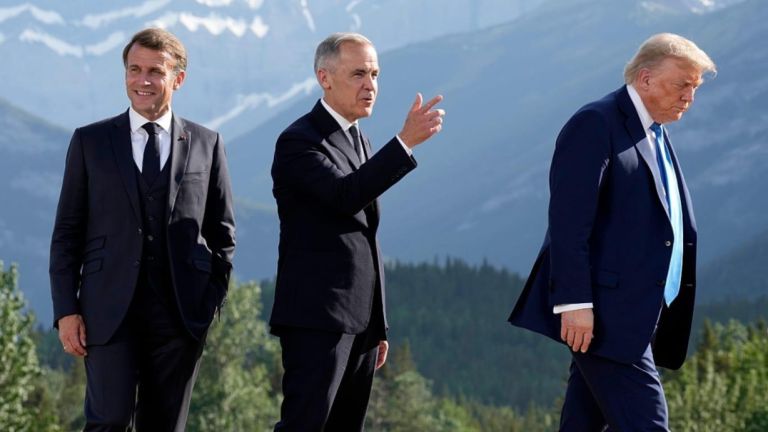
Πηγή Φωτογραφίας: AP Photo//Trump Arrives at the G7 with an Iran Peace Deal — But Allies Are Asking What Comes Next



The Group of Seven summit was supposed to focus on Ukraine, economic imbalances, and reducing dependence on China.
Instead, it opens under the shadow of a geopolitical shock: a preliminary agreement between the United States and Iran to end a war that had pushed the Middle East to the brink and threatened global energy markets.
For President Donald Trump, arriving in France on Monday, the timing could hardly be better.
After months of military escalation and growing concerns about the economic fallout of conflict in the Gulf, Trump is now presenting himself as the leader who forced Tehran to the negotiating table and prevented a broader regional war.“The Deal with the Islamic Republic of Iran is now complete. Congratulations to all!” Trump declared, framing the agreement as a major foreign-policy victory.
Yet behind the celebrations, many of America’s closest allies are looking for answers rather than applause.
THE G7’S FIRST QUESTION: WHAT EXACTLY IS IN THE DEAL?
While Washington, Tehran and Pakistani mediators have confirmed that an agreement has been reached, the details remain largely unknown.
The memorandum of understanding is expected to be signed in Switzerland on Friday, but key questions remain unanswered:
- What sanctions relief will Iran receive?
- What happens to Iran’s stockpile of highly enriched uranium?
- How permanent is the ceasefire?
- What security guarantees exist for the region?
European leaders are expected to press Trump privately for clarity.
Many fear that a short-term diplomatic breakthrough could simply postpone deeper disputes surrounding Iran’s nuclear ambitions and regional influence.
The concern is straightforward: ending a war is one thing; building a durable peace is another.
THE STRAIT OF HORMUZ IS OPENING — AND SO ARE THE MARKETS
One of the most immediate consequences of the agreement is expected to be the reopening of the Strait of Hormuz, the strategic waterway through which roughly one-fifth of global oil supplies normally pass.
The closure of the route during the conflict sent shockwaves through energy markets and reignited fears of a global inflation surge.
Trump announced that the passage would reopen following the official signing ceremony and that U.S. restrictions on Iranian maritime trade would be lifted.
For investors and policymakers alike, that may be the most consequential part of the agreement.
Lower energy prices would provide relief to economies already struggling with sluggish growth and persistent inflationary pressures.
UKRAINE RISKS BEING OVERSHADOWED
Until recently, Ukraine was expected to dominate discussions at the summit.
Now President Volodymyr Zelenskyy faces the challenge of keeping international attention focused on a war that has increasingly faded from global headlines.
Zelenskyy is scheduled to meet Trump on Tuesday at a time when Ukraine’s battlefield position has improved relative to earlier fears of a major Russian breakthrough.
But securing additional American support may prove difficult.
The White House is now heavily invested in portraying the Iran agreement as a defining foreign-policy achievement, and domestic political pressure is pushing Trump to demonstrate that he is ending conflicts rather than expanding U.S. commitments abroad.
For Kyiv, that could mean a more complicated diplomatic environment than at any point since the start of the war.
A GROWING TRUST GAP WITH WASHINGTON
Beyond the specific crises dominating the summit lies a broader concern shared by many G7 leaders.
The question is no longer simply how to respond to global instability.
It is whether the United States remains committed to the international order it helped create after World War II.
Trump’s approach — marked by tariffs, transactional diplomacy, and rapid policy shifts — has left allies increasingly uncertain about Washington’s long-term direction.
Privately, several governments acknowledge that they have begun preparing for a world in which U.S. leadership is less predictable than it once was.
The summit therefore serves as more than a diplomatic gathering.
It is becoming a test of Western cohesion itself.
CHINA REMAINS THE STRATEGIC CHALLENGE
Even as attention shifts to Iran, China continues to dominate the economic conversation.
French President Emmanuel Macron has used France’s G7 presidency to push discussions on global economic imbalances and the risks posed by excessive dependence on Chinese manufacturing and critical mineral supplies.
French officials increasingly frame the global economy through a simple formula:
- China overproduces
- The United States overconsumes
- Europe underinvests
That diagnosis is expected to shape discussions involving invited partners including India, Brazil, Kenya and South Korea.
The objective is clear: build more resilient supply chains and reduce strategic vulnerabilities before economic competition intensifies further.
MACRON’S FINAL GLOBAL STAGE
For Macron, this summit carries particular significance.
With his second and final presidential term approaching its conclusion next year, the French leader sees the gathering as an opportunity to cement his legacy as Europe’s leading diplomatic bridge-builder.
His decision to host Trump at a high-profile state dinner in the Palace of Versailles reflects that ambition.
Macron understands that symbolism matters.
At a moment when global alliances are under strain, projecting unity may be almost as important as achieving concrete policy outcomes.
THE REAL TEST BEGINS AFTER THE HANDSHAKES
The U.S.-Iran agreement may have prevented a wider regional conflict.
It has not resolved the deeper strategic tensions that produced the crisis in the first place.
The future of Iran’s nuclear program, the balance of power in the Middle East, the war in Ukraine, and the growing rivalry with China all remain unresolved.
As G7 leaders gather on the shores of Lake Geneva, one reality is becoming increasingly clear:
The Iran deal may have changed the headlines.
Whether it changes the trajectory of global politics is a question that remains unanswered.
Διαβάστε όλες τις τελευταίες Ειδήσεις από την Ελλάδα και τον Κόσμο