FT: Blow to Greek Shipowners – Nearly $4 Billion Earned from Transporting Russian Oil Over Three Years
 ΧΡΟΝΟΣ ΑΝΑΓΝΩΣΗΣ 7 '

Πηγή Φωτογραφίας: eurokinissi//FT: Blow to Greek Shipowners – Nearly $4 Billion Earned from Transporting Russian Oil Over Three Years



A major investigation by the Financial Times, titled “Greek shipping companies made almost $4bn carrying Russian oil in past three years,” has placed Greek shipping at the center of a renewed international debate over the effectiveness of Western sanctions against Russia and the pivotal role of maritime transport in the global energy market.
According to the FT investigation, based on data from Argus Media, Kpler, and the International Maritime Organization (IMO), Greek shipping companies earned at least $3.8 billion from transporting Russian crude oil between mid-2023 and mid-2026. The findings come despite the efforts of the G7 to reduce the Kremlin’s energy revenues through the oil price cap mechanism introduced after Russia’s invasion of Ukraine.
The report does not suggest that Greek companies violated sanctions. Instead, it highlights the structural weaknesses of the sanctions regime itself, which continued to allow Western-owned vessels to transport Russian crude provided the cargo complied with the G7 price cap requirements.
Greece: The World’s Second-Largest Carrier of Russian Oil
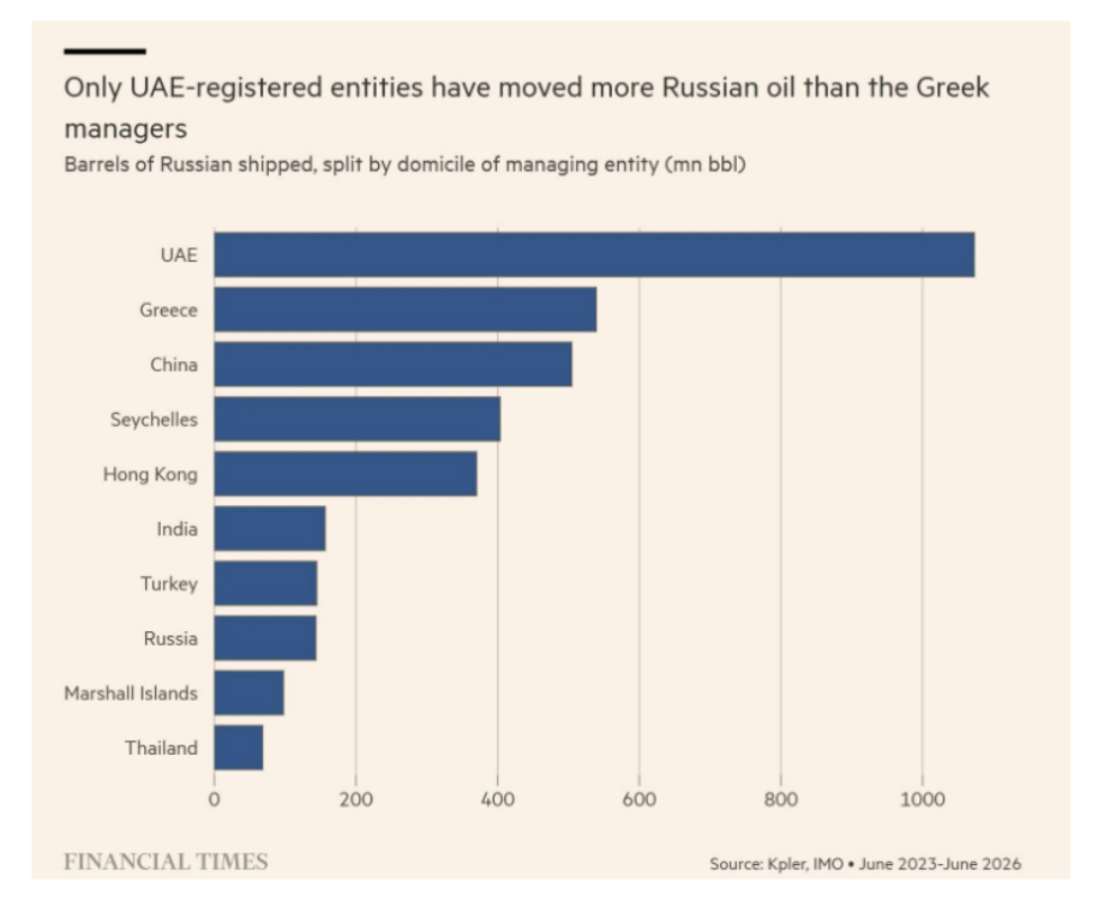
The Financial Times data reveal that only shipping entities registered in the United Arab Emirates transported more Russian crude than Greek-managed tanker fleets during the period under review.
According to Kpler, Greek shipping managers transported approximately 540 million barrels of Russian oil between June 2023 and June 2026, ranking second globally, ahead of China, Seychelles, and Hong Kong.
These figures underline the continued strategic importance of Greek shipping in maintaining global energy supply chains, even under an unprecedented sanctions regime.
The Five Biggest Greek Beneficiaries
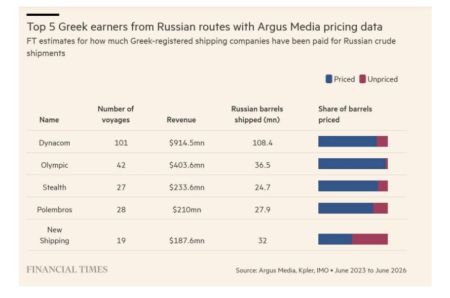
The FT investigation shows that revenues from Russian oil trades were concentrated among a handful of major Greek tanker operators.
- Dynacom Tankers (George Prokopiou): 101 voyages, transporting 108.4 million barrels, generating an estimated $914.5 million in revenue.
- Olympic Shipping & Management (Onassis Group): 42 voyages, approximately $403.6 million in revenue.
- Stealth Maritime (Harry Vafias): 27 voyages, approximately $233.6 million.
- Polembros Shipping (Polemis family): 28 voyages, approximately $210 million.
- New Shipping: 19 voyages, approximately $187.6 million.
An additional aspect highlighted by the FT is the distinction between priced and unpriced cargoes. While pricing information was available for most shipments, a significant number lacked publicly available freight data, suggesting that the actual revenues earned by Greek operators may have been even higher.
The Families Behind Greek Shipping
The companies featured in the FT investigation represent some of the most influential names in global shipping.
George Prokopiou’s Dynacom leads the list by a significant margin, followed by Olympic Shipping, which continues the maritime legacy of the Onassis family, Harry Vafias’ Stealth Maritime, and the Polemis family’s Polembros Shipping.
Together, they reflect the enduring strength of Greece’s family-controlled shipping industry, where ownership remains concentrated and strategic decisions are often driven by long-term commercial vision rather than corporate bureaucracy.
The G7 Price Cap and Its Loopholes
When the G7 introduced the Russian oil price cap in December 2022, it did not prohibit maritime transport of Russian crude.
Instead, it allowed Western shipping companies, insurers, and financial institutions to continue servicing Russian oil trades, provided the cargo was purchased below the established price ceiling.
However, according to the Financial Times, compliance relies primarily on documentation and declarations submitted by traders and charterers. Shipowners themselves have limited ability to independently verify the actual purchase price of cargoes or whether all parties involved fully comply with sanctions regulations.
Former sanctions officials and maritime lawyers interviewed by the FT describe the enforcement framework as fragmented and difficult to police.
Russian Oil Paid Premium Freight Rates
The report also explains why many shipowners continued participating in Russian trades.
According to shipbrokers quoted by the Financial Times, charterers paid 30% to 40% higher freight rates for Russian crude compared with cargoes originating from non-sanctioned producers.
Maritime intelligence analyst Michelle Wiese Bockmann summarized the commercial incentive succinctly:
“There is money to be made, and nobody else is going to make it.”
Companies Defend Their Compliance
The companies involved strongly reject any suggestion of sanctions violations.
Dynacom told the Financial Times that every voyage to Russian ports was conducted “in full compliance with all applicable sanctions and legal frameworks,” arguing that the G7 price cap actually helped reduce Russian revenues while stabilizing global energy markets.
Olympic Shipping stated that it complies fully with EU, UK, and US sanctions, while Stealth Maritime emphasized that every shipment had been reviewed by American and British legal advisers before being undertaken.
Pressure for Tougher Sanctions
The FT investigation comes as both the United States and the European Union consider tightening restrictions on Russian energy exports, encouraged by lower global oil prices that have reduced concerns about supply disruptions.
The report is likely to intensify political discussions in Brussels and Washington over whether the current sanctions architecture genuinely limits Russian revenues or merely reshapes the commercial landscape while allowing major maritime players to continue operating legally.
Criticism of Greek Shipowners Is Not Always Driven by Humanitarian Concerns
Greek shipping has frequently found itself at the center of international criticism whenever geopolitical crises intersect with global energy markets. Yet shipping is not merely another commercial industry; it is a strategic instrument of economic and geopolitical influence.
Greek shipowners operate the world’s largest tanker fleet and have traditionally assumed commercial and operational risks that many competitors avoid. Throughout decades of sanctions, embargoes, and regional conflicts, they have continued to ensure the uninterrupted flow of energy commodities essential to the global economy.
The timing of the Financial Times investigation is also noteworthy. It coincides with a period of heightened geopolitical negotiations involving NATO, US-Turkey relations, and broader discussions over Western strategy toward Russia.
In such an environment, major shipping groups inevitably become part of a much larger geopolitical equation. Their extensive international networks, financial influence, and access to decision-makers often place them at the intersection of commerce, diplomacy, and national strategic interests.
The Financial Times investigation therefore raises questions that extend well beyond the shipping industry itself. It exposes the limitations of the current sanctions framework while reminding policymakers that maritime transport remains one of the most powerful instruments of global energy security and geopolitical influence.
Whether viewed as a commercial success story or a reflection of sanctions loopholes, one conclusion is difficult to dispute: Greek shipping continues to occupy a central position in the world’s energy supply chain, even amid one of the most consequential geopolitical confrontations of the 21st century.
Source: pagenews.gr
Διαβάστε όλες τις τελευταίες Ειδήσεις από την Ελλάδα και τον Κόσμο