Is Greenland Just the Beginning? The New Geography of Power Is Rewriting Global Strategy
 ΧΡΟΝΟΣ ΑΝΑΓΝΩΣΗΣ 6 '
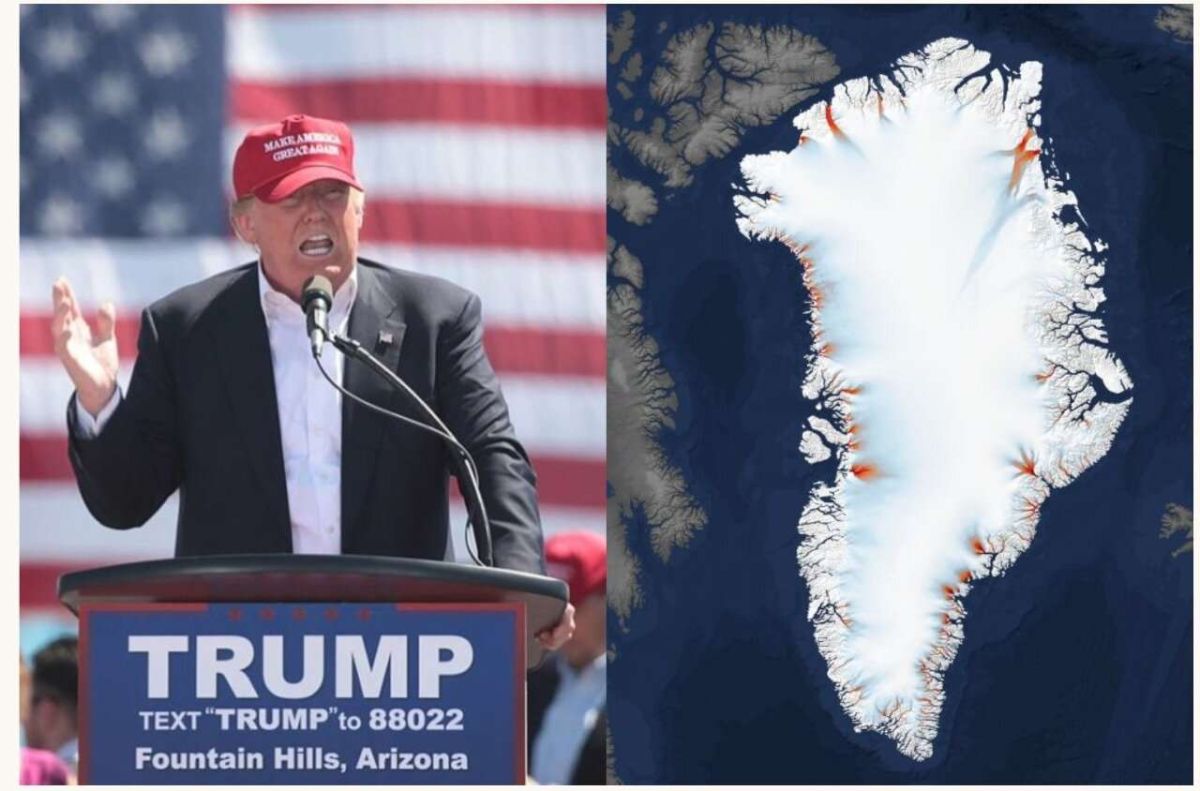
Πηγή Φωτογραφίας: AP Photo//Is Greenland Just the Beginning? The New Geography of Power Is Rewriting Global Strategy



Greenland Is Not the Real Story
For more than a year, every time Donald Trump has renewed his call for greater U.S. control over Greenland, the international response has been almost identical.
Denmark rejects the proposal outright.
Greenland’s government insists the island is not for sale.
European leaders reaffirm the inviolability of borders.
Yet Trump continues to return to the issue.
That persistence is the real geopolitical puzzle.
Why does a proposal that has been consistently rejected remain a recurring feature of Washington’s strategic discourse?
The answer may lie in the fact that most observers continue to interpret Greenland through the geopolitical logic of the twentieth century.
This Is Not About Imperialism
The most common explanation portrays Trump’s position as a revival of imperial ambition.
The evidence suggests otherwise.
Washington has shown little interest in governing Greenland’s population of roughly 57,000 people.
It has not advocated political integration.
Nor has it focused on administering the island itself.
Instead, American interest has centered on something far more specific:
- permanent military access,
- expanded basing rights,
- advanced radar installations,
- missile-warning systems,
- space surveillance,
- future missile-defense infrastructure.
The debate has quietly shifted from territorial sovereignty to functional access.
That distinction fundamentally changes how Greenland should be understood.
Technology Has Changed Geopolitics
Perhaps the greatest analytical mistake is assuming that geography functions today as it did during the eras of Mackinder, Mahan or Spykman.
Modern strategic competition is no longer measured simply by landmass.
It is measured by time.
Hypersonic weapons compress response windows from tens of minutes to only a few.
Satellite constellations require permanently positioned ground stations.
Artificial intelligence increasingly integrates radar, sensors and command systems into a single computational architecture.
Greenland’s geography has not changed.
Its strategic function has.
Its value today lies less in what it contains than in what it enables.
A New Form of Sovereignty
The most important shift emerging from the Greenland debate is conceptual.
The United States appears less interested in traditional territorial sovereignty than in functional control.
In twenty-first century geopolitics, controlling territory is no longer always necessary.
Controlling the functions performed on that territory may be sufficient.
Those functions include:
- military bases,
- radar coverage,
- satellite communications,
- missile-defense systems,
- data infrastructure,
- sensor networks.
Power increasingly derives from controlling strategic capabilities rather than governing populations.
This represents one of the most significant transformations in international politics since the end of the Cold War.
From Territory to Networks
Greenland is only one example of a much broader strategic transition.
The same logic now appears across multiple geopolitical theaters:
- Taiwan through semiconductor production,
- undersea data cables,
- Arctic shipping routes,
- satellite constellations,
- rare earth minerals,
- Red Sea maritime corridors,
- global data centers.
Major powers are no longer competing exclusively for territory.
They are competing for the critical nodes that sustain the global system.
Geopolitics is gradually becoming the geopolitics of networks.
Is the Westphalian Order Being Rewritten?
Since the Peace of Westphalia in 1648, international order has rested on a simple principle:
States exercise exclusive sovereignty within clearly defined borders.
The Greenland debate challenges that assumption.
When a superpower seeks permanent security rights without governing the local population, it introduces a fundamentally different understanding of sovereignty.
It is no longer sovereignty over people.
It is sovereignty over strategic functions.
The dispute therefore extends well beyond Greenland itself.
It raises broader questions about whether traditional concepts of territorial authority remain adequate in an age of AI-enabled warfare, hypersonic weapons and integrated security networks.
The Next Great Rivalry May Be Over Infrastructure, Not Territory
The real significance of Greenland lies far beyond the Arctic.
It points toward the future of global competition.
Tomorrow’s geopolitical conflicts may no longer revolve around conquering states.
Instead, they may center on controlling:
- satellite infrastructure,
- underwater communication cables,
- critical mineral supply chains,
- artificial intelligence infrastructure,
- missile-defense architecture,
- energy corridors,
- strategic logistics hubs.
Strategic power is migrating from physical territory toward interconnected infrastructure.
Whoever controls those networks increasingly controls decision time, deterrence and ultimately geopolitical influence.
From a Western Political Intelligence perspective, Donald Trump’s repeated focus on Greenland should not be understood primarily as a revival of imperialism or traditional sphere-of-influence politics.
Rather, it reflects a broader transformation in how major powers conceptualize strategic space.
The emerging competition is less about acquiring land than about securing permanent access to the infrastructure that enables military superiority: sensor networks, forward operating bases, computational systems and missile-defense architecture.
Greenland has become valuable not because its geography changed, but because technology changed the strategic function of that geography.
Whether Washington’s approach ultimately succeeds is a separate political and legal question.
What matters strategically is that Greenland illustrates a much larger shift.
The defining geopolitical competition of the twenty-first century may no longer be fought over territory itself—but over the networks, nodes and infrastructures that make modern power possible.
*This analysis is based on the conceptual framework presented in the source material regarding Greenland’s strategic role, the evolution of functional control, and the reorganization of strategic space.
Source: pagenews.gr
Διαβάστε όλες τις τελευταίες Ειδήσεις από την Ελλάδα και τον Κόσμο