APEC 2026: Why China Chose Shenzhen to Showcase Its Technology Power
 ΧΡΟΝΟΣ ΑΝΑΓΝΩΣΗΣ 9 '
Πηγή Φωτογραφίας: AP Photo//APEC 2026: Why China Chose Shenzhen to Showcase Its Technology Power



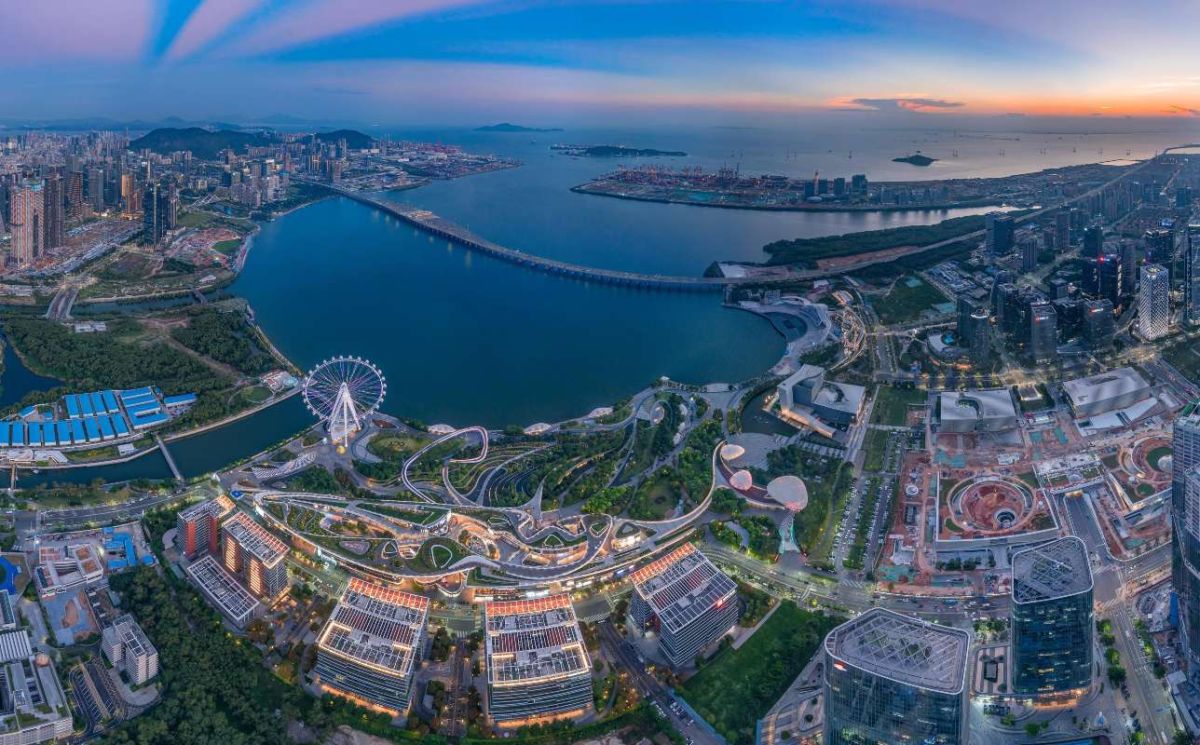
Shenzhen was not chosen by accident to host APEC Economic Leaders’ Week in November 2026. The city that evolved from China’s pioneering Special Economic Zone into a global center for hardware, telecommunications, electric vehicles, drones, artificial intelligence and robotics offers Beijing the perfect stage for a much bigger message: the next phase of China’s rise will not be built on trade alone, but on technological and industrial power.
China could have chosen Beijing.
It could have chosen Shanghai.
Instead, it chose Shenzhen — the city Beijing has used for more than four decades as a laboratory for economic transformation and, increasingly, technological ambition.
The choice to host APEC 2026 is therefore more than logistical.
It is strategic.
Under the theme “Building an Asia-Pacific Community to Prosper Together,” China has identified openness, innovation and cooperation as the three priorities of its APEC presidency.
Of those three words, Shenzhen most visibly embodies one:
Innovation.
From Special Economic Zone to technology laboratory
Shenzhen was one of the defining experiments of China’s reform era.
Designated as the country’s first Special Economic Zone in 1980, it became a testing ground for foreign investment, manufacturing, exports and market-oriented economic reforms.
Today, it serves another purpose.
It is a testing ground for China’s technology-driven economy.
According to APEC, Shenzhen’s GDP grew from just 270 million yuan in 1980 to around 3.68 trillion yuan in 2024, while its foreign trade reached approximately 4.5 trillion yuan.
That is the real Shenzhen story.
Not simply growth.
Transformation.

Where AI meets hardware
Shenzhen possesses something many of the world’s technology capitals do not.
It is not merely a software hub.
It is simultaneously a center for design, electronics, components, manufacturing, logistics and increasingly artificial intelligence.
That combination matters enormously.
Silicon Valley may create revolutionary software.
Shenzhen can develop software and rapidly turn it into a physical product.
This is the real meaning behind the often-used phrase “Shenzhen Speed.”
Ideas, engineers, component suppliers, prototype workshops, electronics markets and large-scale factories exist within an unusually concentrated industrial ecosystem.
Claims that practically any idea can become a finished prototype “within 30 minutes” should be treated as promotional exaggeration.
The underlying advantage, however, is very real:
few cities anywhere possess such a dense hardware and manufacturing ecosystem within such a limited geographic area.
Huawei, Tencent, DJI — and what comes next
Shenzhen is home to some of China’s most internationally recognizable technology companies.
Huawei.
Tencent.
DJI.
The wider region is also deeply embedded in China’s production of telecommunications equipment, electronics, batteries, drones and electric vehicles.
But Shenzhen is already moving toward the next technological frontier:
embodied intelligence.
This is artificial intelligence that moves beyond the chatbot and the screen and enters the physical world.
Humanoid robots.
Industrial robots.
Autonomous machines.
Intelligent vehicles.
Systems capable of perceiving, moving through and interacting with their physical environment.
And Beijing increasingly sees these technologies not as futuristic demonstrations, but as the foundations of a new industrial economy.
China’s humanoid robot bet
Shenzhen has adopted an ambitious program to expand its embodied-intelligence robotics industry.
Its 2025–2027 development plans target breakthroughs in critical components, AI chips, multimodal perception, precision motion control and dexterous manipulation.
The goal is to build an ecosystem of more than 1,200 companies by 2027, with the wider industry exceeding 100 billion yuan in scale.
That is an important distinction.
This is no longer simply a technology showcase.
It is industrial policy.
And APEC gives Beijing a global audience for it.
APEC leaders are being shown the future China wants to sell
The symbolism is already visible.
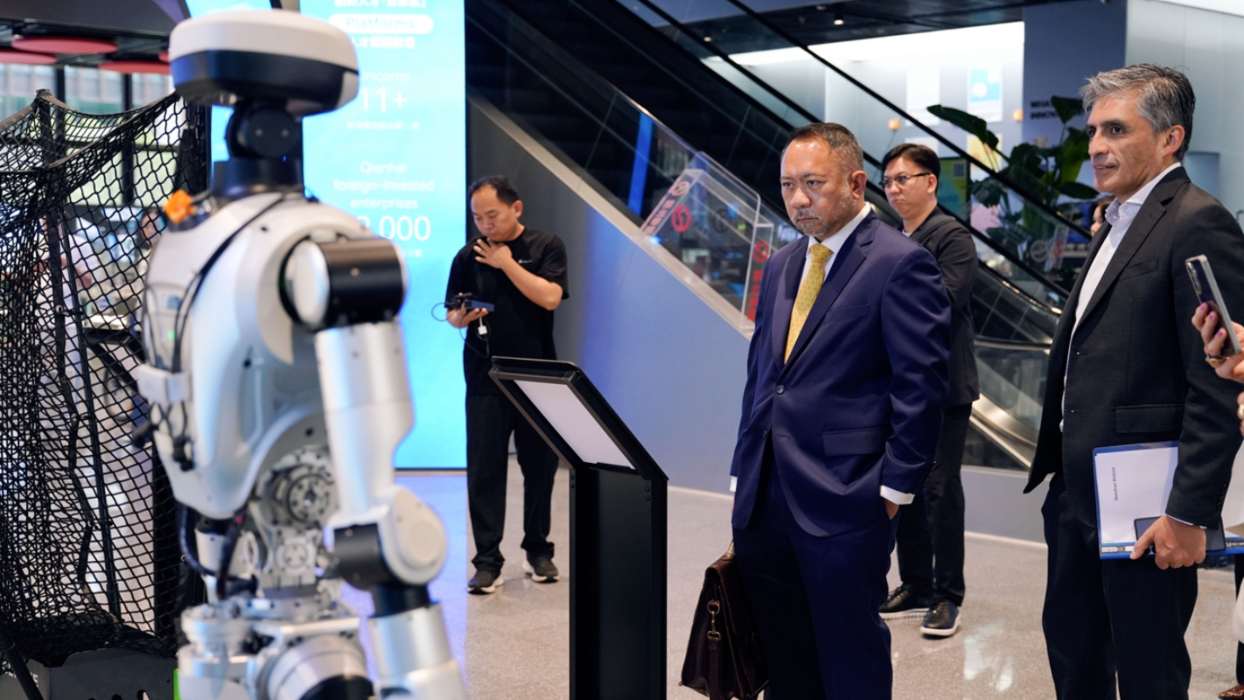
During APEC-related visits to Shenzhen, delegations have been shown humanoid robots and emerging AI products, including smart glasses, translation devices and advanced digital technologies.
That is likely a preview of what visiting leaders will encounter in November.
Not just presentations.
Products.
Not merely promises.
Factories, robots, EVs, drones and functioning industrial supply chains.
For China, that distinction is critical.
It wants its technology story to be physically visible.
APEC is becoming an AI summit too
Artificial intelligence has already become an important component of China’s APEC agenda.
Beijing has put digital transformation, AI-enabled economic development, connectivity and digital skills into the broader discussion over Asia-Pacific growth.
That means AI will not simply provide the backdrop to the summit.
It will form part of its political and economic substance.
And Shenzhen is an ideal showroom.
The city allows China to make a specific argument to Asia-Pacific economies:
AI is not only about large language models. It is about connecting algorithms to factories, machines, vehicles, logistics and physical infrastructure.
That is where Shenzhen’s model differs from much of the Western technology narrative.
The real battle is not only over AI — it is over supply chains
The U.S.–China technology rivalry is often reduced to advanced semiconductors or competition between frontier AI models.
The real contest is broader.
One of China’s greatest advantages remains its manufacturing ecosystem.
The ability to design a product.
Source its components.
Build prototypes.
Modify them.
Scale production.
And ship millions of units around the world.
Shenzhen — alongside Hong Kong and the wider Greater Bay Area — represents one of the clearest expressions of that system.
This is why APEC 2026 is about more than showcasing Chinese technology.
It is also about demonstrating that China remains deeply embedded in the industrial architecture of Asia.
Beijing’s message to Asia: China is still difficult to replace
This gives Shenzhen’s selection a distinctly geopolitical dimension.
China wants to tell Asia-Pacific economies:
the region’s technological and industrial future still runs through Chinese supply chains.
That message matters at a time when Washington, Brussels and several allied governments are pursuing various forms of “de-risking,” supply-chain diversification and tighter controls over sensitive technologies.
China’s response is not simply to argue against those policies.
It wants to demonstrate how difficult — and expensive — large-scale separation from its manufacturing ecosystem could become.
Shenzhen makes that argument without needing a speech.
Its factories make it.
Its supply chains make it.
Its technology companies make it.
From EVs and drones to robots
Shenzhen is also an ideal host because it represents China’s attempt to move beyond its old reputation as a low-cost manufacturing economy.
Its emerging industrial priorities stretch across AI devices, drones, the low-altitude economy, humanoid and quadruped robots, commercial space technologies and increasingly autonomous systems.
These sectors fit closely with Beijing’s concept of “new quality productive forces” — the effort to generate future growth through advanced manufacturing, automation and technological innovation.
Shenzhen is essentially the physical exhibition of that strategy.
Why not Beijing?
That is precisely the point.
Beijing would symbolize the Chinese state.
Shanghai would symbolize Chinese finance and global commerce.
Shenzhen symbolizes the technological future China wants to sell to the world.
For APEC 2026, that may be far more useful.
Asia-Pacific leaders will not simply gather in another Chinese metropolis.
They will meet inside an industrial ecosystem where telecommunications, AI, robotics, drones, electric mobility and manufacturing supply chains exist side by side.
The city itself becomes part of China’s presentation.
The geopolitical battle behind the technology
There is another reason Shenzhen matters.
China knows that its technological rise is now viewed with increasing suspicion across parts of the West.
Semiconductor export controls.
Restrictions on advanced computing technology.
Tariffs on Chinese electric vehicles.
Investment screening.
Security concerns surrounding Huawei and critical infrastructure.
Supply-chain diversification.
APEC gives Beijing a different audience.
China will not be speaking only to Washington or Brussels.
It will be speaking to the Asia-Pacific, where governments simultaneously want investment, technology, infrastructure, manufacturing capacity and access to the Chinese market.
Beijing’s pitch is therefore powerful:
China does not want to remain merely Asia’s factory.
It wants to become its laboratory as well.
Shenzhen 2026: Summit or technology showroom?
Officially, APEC 2026 will be about trade, economic cooperation, regional integration and diplomacy.
For China, however, Shenzhen will also function as something else:
a technology showroom for national power.
Humanoid robots.
Drones.
Electric vehicles.
AI applications.
Advanced telecommunications.
Automated factories.
Dense component networks.
Digital infrastructure.
These are no longer separate industries in Beijing’s strategic thinking.
They are components of a single industrial model in which artificial intelligence increasingly merges with physical manufacturing.
And Shenzhen may be the best city China has to demonstrate it.
Choosing Shenzhen was therefore not simply about choosing where APEC would meet.
It was about choosing what China wants APEC to see.
When Asia-Pacific leaders leave the city in November, Beijing wants them to have seen firsthand not only what China manufactures today —
but what China believes the world will manufacture tomorrow.
Διαβάστε όλες τις τελευταίες Ειδήσεις από την Ελλάδα και τον Κόσμο