Gerapetritis to Ankara: “We Are Ready for Every Scenario” — Greece Draws Red Lines in the Aegean
 ΧΡΟΝΟΣ ΑΝΑΓΝΩΣΗΣ 7 '

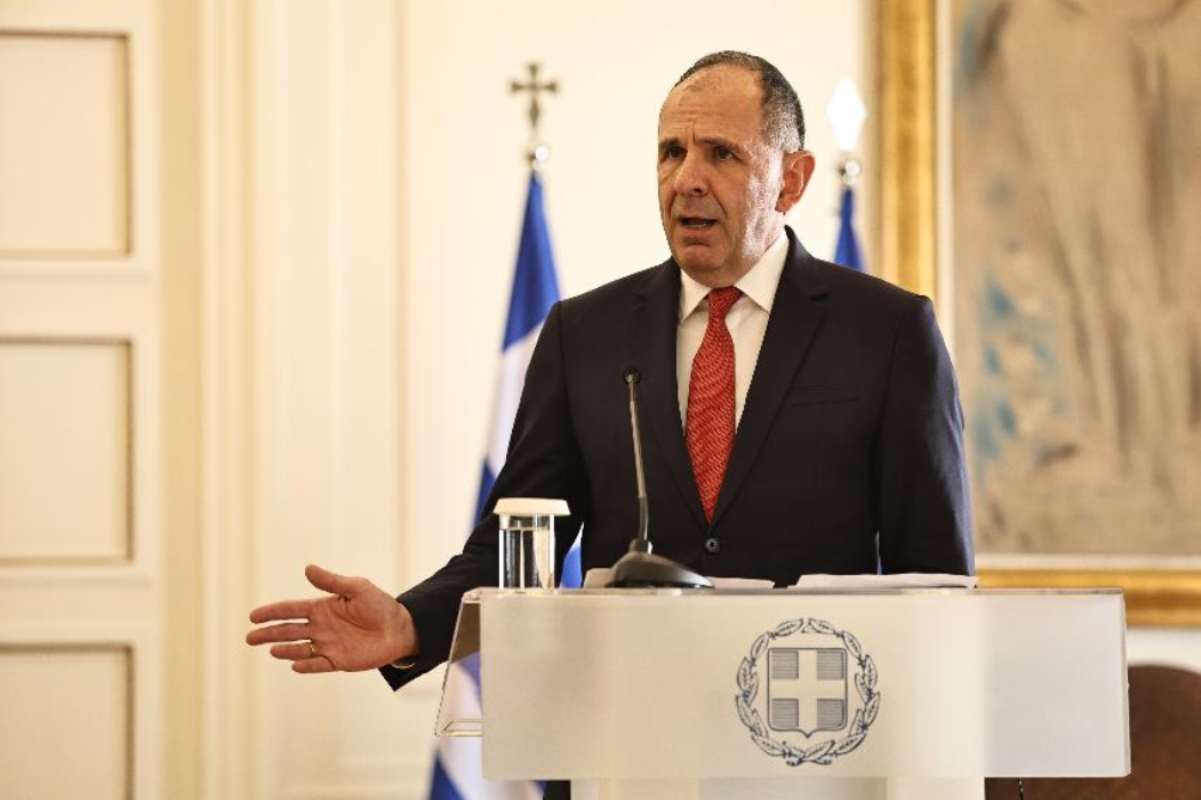
Πηγή Φωτογραφίας: eurokinissi//Gerapetritis to Ankara: “We Are Ready for Every Scenario” — Greece Draws Red Lines in the Aegean



Greek Foreign Minister Giorgos Gerapetritis has delivered one of Athens’ clearest messages to Ankara in recent months, insisting that Greece remains committed to dialogue with Turkey but will not allow de-escalation to turn into strategic paralysis.
In an interview with To Vima, Gerapetritis said Greece is “absolutely ready for every scenario” and stressed that any attempt to infringe on Greek sovereign rights would be confronted decisively.
“Any attempt to violate our sovereign rights will be addressed by every available means,” he said.
He followed with an equally strong political message:
“The Greece of passive diplomatic inertia is gone for good.”
The remarks come at a sensitive moment in Greek-Turkish relations, following renewed friction over maritime parks, renewable-energy spatial planning, the Great Sea Interconnector and Turkey’s continuing objections to Greek maritime claims.
Gerapetritis’ five key messages
- Greece is “absolutely ready” for every scenario
- Extension to 12 nautical miles remains Greece’s sovereign right
- The Great Sea Interconnector must proceed fully and unobstructed
- Turkish unilateral moves cannot create legal faits accomplis for Greece
- Dialogue with Ankara remains open, but it is not an end in itself
“Calm waters are not an end in themselves”
Gerapetritis was careful not to abandon the government’s de-escalation strategy with Turkey.
But he made clear that Athens does not view the period of “calm waters” as a substitute for pursuing national interests.
“Calm waters are not an end in themselves. They are a means of serving our national objectives,” he said.
This framing is important.
The Greek government argues that the relatively calmer period in bilateral relations created strategic space for Athens to strengthen both its diplomatic position and its military capabilities.
That includes Rafale fighter jets, upgraded F-16s, Belharra frigates and the future acquisition of F-35s, as well as deeper ties with the United States, France, Israel, Egypt, India and Gulf states.
In other words, Athens’ position is that de-escalation was never meant to mean inactivity. It was meant to provide room for Greece to reinforce its deterrence and regional standing.
Turkey brings the “gray zones” issue back
The interview comes after Turkey again challenged Greek planning decisions.
Ankara recently announced two national marine parks in the northeastern Aegean and the Eastern Mediterranean, prompting Athens to respond that any Turkish designation extending into international waters or areas of the Greek continental shelf cannot produce legal effects against Greece.
The Greek Foreign Ministry has emphasized that Greece’s own marine parks were established entirely within Greek territorial waters and in accordance with the Law of the Sea.
Turkey has also reacted to Greece’s new Special Spatial Framework for Renewable Energy, reviving its longstanding claims concerning islands, islets and maritime areas whose sovereignty Ankara disputes.
The Turkish Foreign Ministry has argued that unilateral steps in the Aegean should be avoided and has again invoked the Athens Declaration and the need for bilateral cooperation.
The result is a familiar but increasingly sharp contradiction:
both Athens and Ankara say they support dialogue and international law, but they fundamentally disagree over what those rules mean in the Aegean.
12 nautical miles: “An inalienable right”
Gerapetritis’ remarks on territorial waters were particularly significant.
“The extension of our territorial waters to 12 nautical miles is an inalienable right,” he said.
Athens’ position is that Greece retains the unilateral right to extend its territorial waters, under international law, at a time and in a manner of its choosing.
Gerapetritis added:
“International law cannot be applied à la carte.”
The issue remains one of the most sensitive in Greek-Turkish relations because Turkey’s 1995 parliamentary declaration still treats a Greek extension of territorial waters in the Aegean to 12 nautical miles as a casus belli.
For Athens, this is precisely why Gerapetritis’ formulation matters: the government is presenting the right as non-negotiable even while keeping channels with Ankara open.
The Aegean is getting busier again
Another concern is the return of military activity in the Aegean after a period of relative calm.
Greek defense data cited in recent international reporting show a sharp rise in Turkish air-space violations compared with the almost complete absence recorded in 2024.
The broader trend matters politically because the government had presented the 2023 Athens Declaration as a framework capable of reducing operational tension.
Now, as Turkish activity increases again, the question is whether the détente can survive while both sides continue pursuing incompatible maritime strategies.
GSI becomes the next real-world test
The Great Sea Interconnector, linking Greece and Cyprus, could become the most important practical test of the new phase in relations.
Gerapetritis described the project as strategically important and said Greece and Cyprus will do what is necessary for its “full and unobstructed implementation.”
The project is more than an electricity cable.
It is tied to energy security, Cyprus’ connection to the European grid and Greece’s ambition to become a major energy hub in the Eastern Mediterranean.
But it also passes through a politically sensitive maritime environment.
The memory of the 2024 tension near Kasos remains fresh, when Turkish warships appeared during survey work connected to the project.
The entry of French infrastructure investor Meridiam and the continued role of Nexans give the project a broader European dimension, but they do not eliminate the geopolitical risk.
“Any attempt will be answered”
Gerapetritis’ central message is therefore not that Greece wants confrontation.
It is that Athens wants to prevent Turkey from concluding that dialogue can be used to freeze Greek policy.
The Foreign Minister stressed that Greece will continue to shape its external policy independently.
“Greece will continue to build its foreign policy in our region. If that annoys some people, at home or abroad, they will simply have to get over it.”
That line captures the broader shift in Athens’ rhetoric.
The government wants dialogue.
It wants lower tension.
But it also wants to make clear that neither the GSI, nor maritime spatial planning, nor territorial-water rights will be indefinitely postponed simply to preserve a calm diplomatic atmosphere.
The real question: Are the “calm waters” over?
Not necessarily.
Gerapetritis still considers the Athens Declaration and structured dialogue with Turkey useful tools for preventing escalation.
But the bilateral environment has clearly become more demanding.
Turkey is again advancing its traditional positions on islands, maritime zones and sovereignty.
Greece, meanwhile, is moving ahead with energy projects, spatial planning and military modernization.
That creates a new equation in the Aegean:
dialogue without inertia, de-escalation without renouncing sovereign rights, and preparation for the possibility that the “calm waters” may once again become rough.
And in that context, Gerapetritis’ message to Ankara could hardly be clearer:
“We are ready for every scenario.”
Source: pagenews.gr
Διαβάστε όλες τις τελευταίες Ειδήσεις από την Ελλάδα και τον Κόσμο