Beijing Warns Washington: “Don’t Interfere” With China–Iran Trade as Sanctions War Goes Global
 ΧΡΟΝΟΣ ΑΝΑΓΝΩΣΗΣ 13 '
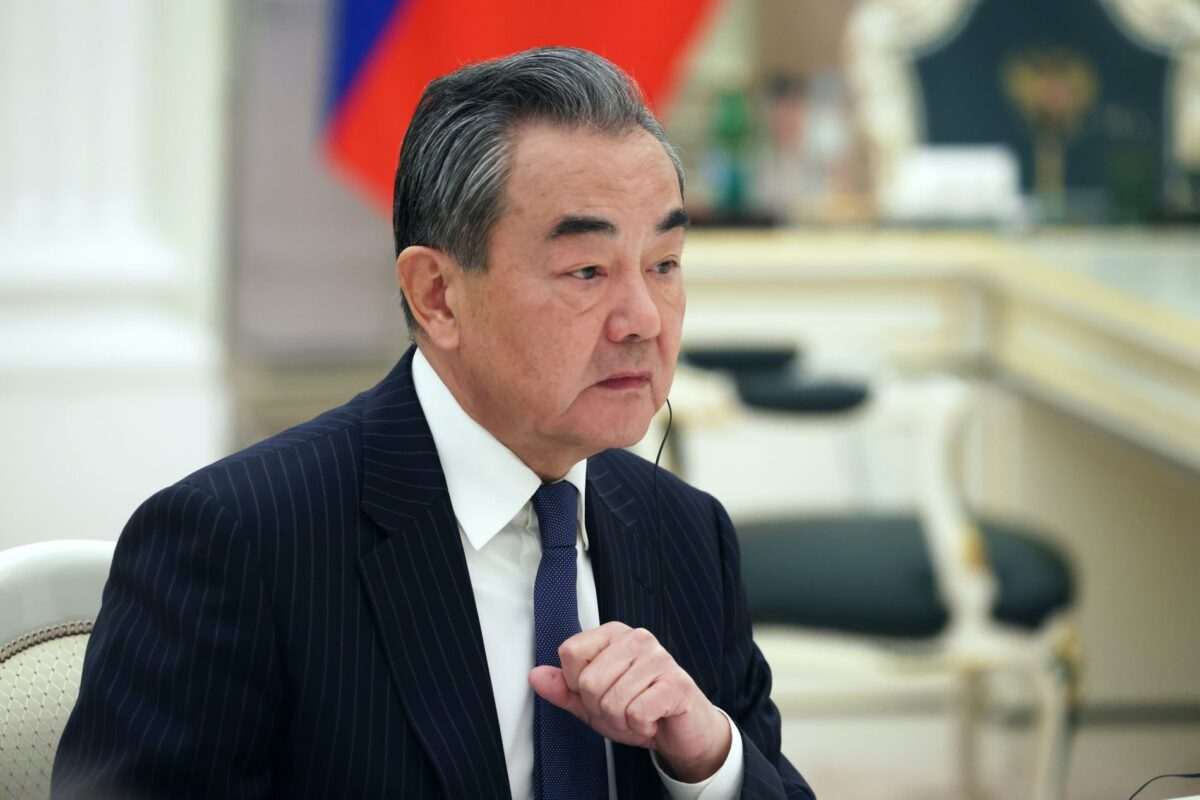
Πηγή Φωτογραφίας: AP Photo//Beijing Warns Washington: “Don’t Interfere” With China–Iran Trade as Sanctions War Goes Global



The confrontation between Washington and Tehran is rapidly expanding beyond Iran.
China has issued a direct warning to the United States not to interfere with its economic relationship with the Islamic Republic, rejecting Washington’s new sanctions campaign and signaling that Beijing is prepared to defend its commercial interests.
The Chinese response came after Treasury Secretary Scott Bessent unveiled Operation Economic Outcast, an unprecedented U.S. campaign designed not merely to sanction Iran itself, but to force companies, financial institutions and governments around the world to choose between doing business with Tehran and maintaining access to the American financial system.
That puts China directly in the firing line.
Beijing is by far the most important buyer of Iranian crude. The U.S. Treasury estimates that China purchases approximately 90% of Iran’s oil exports, much of it through independent “teapot” refineries and complex networks designed to evade sanctions.
The battle over Iran is therefore becoming something much bigger:
a test of whether Washington can use the power of the dollar to force Beijing to change its trade policy.
Beijing to Washington: Stay out of our trade
Chinese Foreign Ministry spokesperson Lin Jian delivered Beijing’s response in unusually clear terms.
“Cooperation between China and Iran has always been conducted within the framework of international law and should not be interfered with or disrupted,” Lin said.
He added:
“China has already stated many times that it firmly opposes illegal unilateral sanctions. China will take all necessary measures to firmly safeguard its own rights and interests.”
Beijing also warned that economic warfare would not resolve the Iranian conflict.
According to Lin, sanctions risk escalating tensions, creating international spillovers and disrupting the global economic and financial system.
That language matters.
China is not merely defending Iran.
It is challenging the broader principle that Washington can use access to the U.S. financial system to determine which countries third parties are permitted to trade with.
Trump launches an “economic D-Day”
Washington’s position is equally uncompromising.
On August 24, Bessent announced what the Treasury formally calls Operation Economic Outcast.
The stated objective is extraordinary in scope: to sever Iran’s economic connections around the world until Tehran is effectively isolated.
“Our objective is to sever every economic lifeline that sustains this tyrannical regime until Tehran stands alone,” Bessent said.
The new measures target five particularly important areas of the Iranian economy:
- digital assets,
- technology,
- gold,
- aviation,
- and shipping.
More importantly, Treasury has significantly expanded the threat of secondary sanctions against foreign companies and financial institutions continuing to deal with Iran.
The message is straightforward:
Trading with Iran could eventually mean losing access to the dollar system.
“The clock is ticking”
Bessent has made clear that Washington intends to give foreign governments and companies deadlines to unwind identified relationships with Iran.
If they fail to comply, Treasury says the United States is prepared to act unilaterally.
And the most consequential warning concerns banks.
“Any entity that facilitates money laundering on behalf of Iran will be removed from the U.S. dollar system,” Bessent said.
“The clock is ticking.”
For smaller countries and financial institutions, that threat is potentially devastating.
The dollar remains at the center of global trade and finance. Losing access to dollar clearing can effectively isolate a bank from large parts of the international financial system.
But applying that weapon against major Chinese banks is an entirely different proposition.
Bessent’s revealing answer: “Why would I want to blow up the global financial system?”
That is precisely why Washington has so far proceeded carefully.
The initial U.S. package targeted around 60 individuals, entities and vessels, but conspicuously avoided imposing the most severe measures on major Chinese financial institutions linked to Iran-related commerce.
Asked why Washington had not gone further, Bessent gave perhaps the most revealing answer of the entire sanctions campaign:
“Why would I want to blow up the global financial system?”
That sentence exposes Washington’s dilemma.
The dollar gives the United States enormous economic power.
But using that power aggressively against the world’s second-largest economy could create consequences far beyond Iran.
China is Iran’s oil lifeline
The reason Beijing cannot easily be excluded from the sanctions campaign is oil.
China remains Iran’s overwhelmingly dominant crude customer.
The U.S. Treasury estimated earlier this year that Chinese buyers accounted for approximately 90% of Iranian oil exports.
But the war and American blockade have already inflicted substantial damage on those flows.
Kpler data cited in recent reporting showed Iranian oil shipments to China falling to approximately 785,000 barrels per day in June, their lowest level since February 2023. Provisional figures subsequently pointed to further weakness.
The latest Kpler-based assessment shows Chinese imports of Iranian crude moving through Hormuz averaging roughly 530,000 barrels per day during July and August — about 48% below pre-war levels and 72% below the October 2024 peak.
That suggests Washington’s pressure is already having an impact.
But it has not eliminated the trade.
The secret oil network
Iranian oil does not necessarily arrive in China carrying an Iranian label.
The trade has evolved into an elaborate sanctions-evasion system.
Cargoes have historically been rebranded as originating from countries such as Malaysia and, more recently, Indonesia.
Transactions can be settled in Chinese currency rather than dollars.
Independent Chinese refiners — particularly the so-called teapot refineries concentrated in Shandong — have played a central role.
Meanwhile, shipping networks use front companies, intermediary brokers, ship-to-ship transfers, altered documentation and manipulation of vessel identities to obscure the origin of crude.
The U.S. Treasury says some Chinese refiners have nevertheless interacted with the American financial system, creating potential exposure to Washington’s sanctions machinery.
Washington has already started hitting Chinese refiners
The pressure did not begin this week.
Since March 2025, the U.S. Treasury has designated multiple China-based independent refineries accused of processing billions of dollars’ worth of Iranian crude.
In April, Washington escalated further by targeting Hengli Petrochemical (Dalian) along with roughly 40 shipping companies and vessels accused of facilitating Iranian petroleum exports.
Hengli denied purchasing Iranian crude.
The United States has also warned financial institutions about the risks of dealing with Chinese teapot refineries involved in the Iranian oil trade.
Treasury explicitly stated in April that it was prepared to deploy secondary sanctions against foreign financial institutions continuing to support Iranian activity.
Until now, however, Washington has largely avoided detonating the biggest weapon:
sanctions against major Chinese banks.
Why Chinese banks are the real red line
Independent refiners can be sanctioned without destabilizing the global financial system.
Major Chinese banks are different.
If Washington were to exclude a systemically important Chinese financial institution from the dollar network, Beijing could retaliate.
Potential pressure points extend far beyond Iran.
China possesses enormous economic leverage of its own — including its position in critical-mineral supply chains and its importance to global manufacturing.
And Washington has another reason to proceed carefully: Donald Trump is expected to meet Xi Jinping next month.
Trade tensions and access to critical minerals are already expected to feature prominently in those discussions.
Iran has now landed directly on that agenda.
Iran bets that China will not surrender
Tehran understands the importance of Beijing’s resistance.
Iranian Economy Minister Ali Madanizadeh has argued that neither China nor Russia has accepted the American secondary-sanctions regime and predicted broader resistance from other countries.
Tehran has simultaneously adopted a threatening posture toward Washington.
“The enemies should wait for an attack,” Madanizadeh told Iranian state television.
The calculation is clear.
Iran cannot economically match the United States.
But if Washington cannot persuade — or compel — China to abandon Iranian trade, complete economic isolation becomes far harder to achieve.
The rial shows how much pressure Tehran is already under
Iran’s ability to withstand the confrontation should not be overstated.
The combination of war, blockade and sanctions has inflicted enormous economic damage.
The Iranian rial fell to a record low of approximately 2.02 million to the U.S. dollar earlier this week, according to reporting cited by Al-Monitor.
Oil revenue has been squeezed.
Shipping has been disrupted.
Foreign currency access has become more difficult.
And Washington is now attempting to close remaining financial escape routes.
This explains why China matters so much.
Without Chinese demand, Iran’s capacity to monetize its oil reserves becomes dramatically weaker.
Hormuz links the sanctions war to global energy
The confrontation also runs directly through the Strait of Hormuz.
Iran has repeatedly used its ability to disrupt maritime traffic through the Gulf as strategic leverage.
Washington, meanwhile, is trying to keep increasing volumes of non-Iranian oil moving through the strait while simultaneously preventing Tehran from generating revenue from its own exports.
The situation remains highly unstable.
Commercial traffic through Hormuz has remained severely constrained, while Iran and Oman have been discussing arrangements that could facilitate passage through the waterway.
That creates a dangerous intersection between economic warfare and military escalation.
A sanctions confrontation can be calibrated.
A tanker attack can change the equation within hours.
Oil markets are already reading the shift
Interestingly, markets initially interpreted Washington’s new strategy as less dangerous than renewed large-scale military escalation.
Oil prices fell sharply following the sanctions announcement.
Brent dropped around 4% on Tuesday, although prices remained significantly above pre-war levels.
The market logic is understandable.
Sanctions can reduce Iranian supply gradually.
Airstrikes, retaliation and a major disruption of Hormuz can remove millions of barrels from global markets almost immediately.
But that calculation depends on the sanctions confrontation remaining economic.
If China retaliates, Iran escalates or maritime traffic deteriorates again, the risk premium could return rapidly.
The UAE moves — Turkey waits
Washington’s campaign is already forcing other Iranian trading partners to make decisions.
The United Arab Emirates has moved to suspend trade ties with Iran, according to recent reporting.
Turkey — another important commercial partner that has strongly criticized the U.S.-led campaign — has yet to make an equivalent move.
This is precisely what Washington wants.
Rather than fighting Iran alone, the Trump administration wants to create a cascading effect in which governments and businesses conclude that maintaining economic ties with Tehran is simply too expensive.
China is the ultimate test of that strategy.
If Beijing complies, Iran’s isolation becomes much deeper.
If Beijing openly refuses, Washington must decide whether it is genuinely prepared to punish China.
The dollar itself could become part of the battlefield
There is also a longer-term danger for Washington.
Secondary sanctions work because the dollar system is extraordinarily powerful.
But repeatedly forcing major economies to choose between their foreign policy and access to the dollar creates incentives to build alternatives.
China has already promoted greater use of the renminbi in international trade.
Iran has spent years developing alternative payment mechanisms.
Russia accelerated its own efforts after Western sanctions following the invasion of Ukraine.
None of those developments has displaced the dollar.
But an aggressive confrontation with China over Iran could reinforce Beijing’s argument that countries need financial systems less vulnerable to American political pressure.
This creates a paradox:
The more aggressively Washington weaponizes dollar access, the greater the incentive for its geopolitical rivals to reduce their dependence on it.
Iran is becoming a test of American financial power against Chinese economic power
The central question is no longer whether the United States can hurt Iran economically.
It clearly can.
The more difficult question is whether Washington can impose the same strategic choices on China.
The Trump administration is effectively testing three propositions simultaneously:
Can American sanctions choke Iran’s remaining oil revenues?
Can the threat of exclusion from the dollar system force third countries to comply?
And, most importantly, does that threat still work when the target is China?
Beijing faces its own dilemma.
Iranian crude offers strategic and economic value, while defending Tehran also allows China to challenge American extraterritorial sanctions.
But China has far larger economic interests in the United States and global financial system than it does in Iran.
Neither side therefore has an easy choice.
Washington risks turning an Iran sanctions campaign into a U.S.–China financial confrontation.
Beijing risks exposing Chinese companies and banks to American penalties if it openly defies Washington.
And Tehran is betting its economic survival on the assumption that China will refuse to bend.
That makes this far more than another chapter in the Iran war.
The battle is shifting from missiles and warships to oil cargoes, Chinese banks, critical minerals and the dollar — and the outcome could determine how much power U.S. sanctions still carry in an increasingly multipolar world.
Source: pagenews.gr
Διαβάστε όλες τις τελευταίες Ειδήσεις από την Ελλάδα και τον Κόσμο