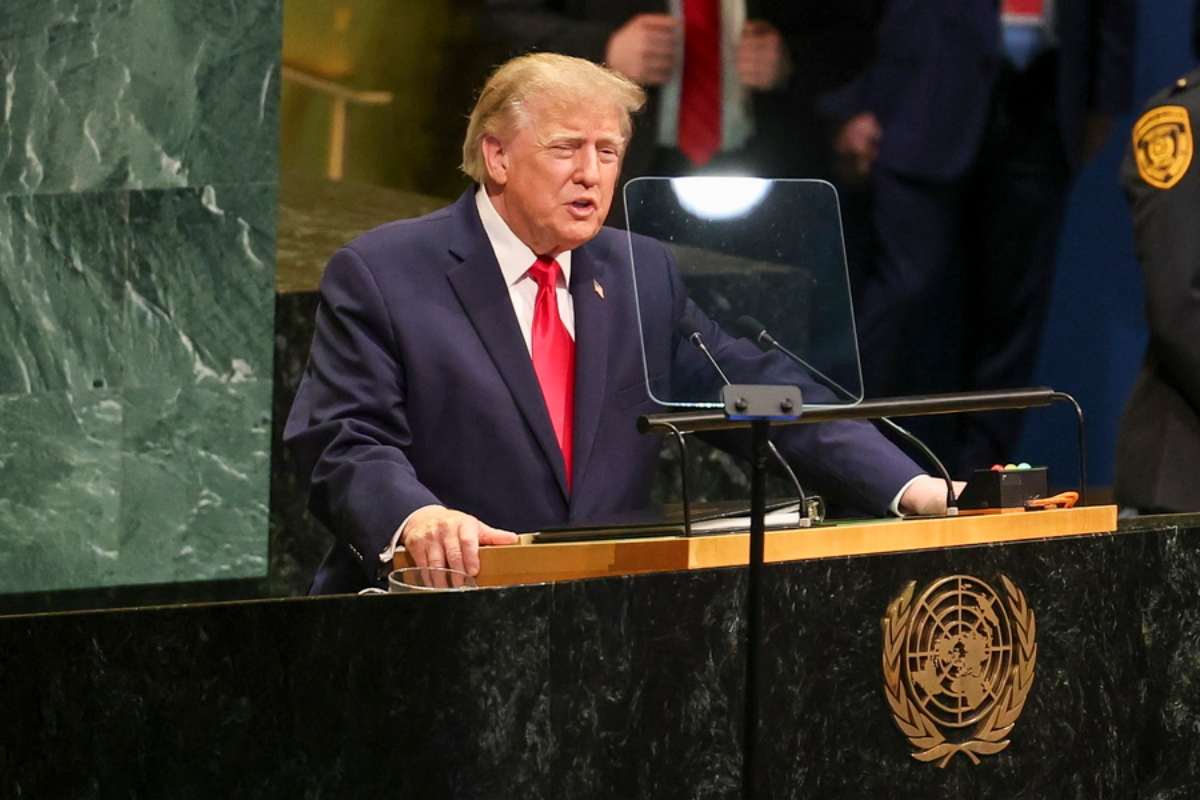
Donald Trump took the stage at the United Nations General Assembly in New York with a message that was difficult to misinterpret: US foreign policy will continue to rely on pressure, economic power and, where his administration considers it necessary, military force.
Iran dominated the US president’s speech. Trump defended Washington’s involvement in the war against Tehran, arguing that military action had been necessary to prevent Iran from obtaining a nuclear weapon.
Yet beneath the extraordinarily aggressive rhetoric was a second message: Washington is still leaving the door open to a deal.
“A deal with Iran — or I will annihilate the Islamic Republic”
Trump portrayed military action as the consequence of years of failed attempts to contain Iran’s nuclear ambitions.
“While others talked, I acted. While others talked about peace, I delivered peace. While others ignored threats, I confronted them,” he said, according to the speech as reported by LiFO.
His starkest warning came when he publicly framed Tehran’s options as a choice between reaching an agreement with Washington and facing further military escalation.
“Will there be a deal with Iran that allows them to rebuild and create a much better country than they have ever had? Or will I annihilate the Islamic Republic, and do it quickly?”
Trump went even further, asking whether Iran should instead be sent “to hell” with “no hope of survival.”
Despite that language, the president also expressed confidence that Tehran would ultimately return to negotiations.
The combination of an explicit military threat and an offer of negotiations is central to understanding the message Trump sought to send: Washington is presenting diplomacy not as an alternative to pressure, but as the outcome it expects pressure to produce.
The Strait of Hormuz becomes the key to what happens next
One of the most important geopolitical elements of the speech concerned the Strait of Hormuz.
Trump did not restrict the confrontation with Tehran to the nuclear issue. The security and operation of one of the world’s most important energy corridors has become part of the wider confrontation between the United States and Iran.
That dramatically raises the stakes.
The Strait is not simply a military chokepoint. It is a critical artery for global energy markets, connecting Gulf producers with international customers. Any sustained disruption can affect oil prices, shipping costs, insurance premiums and ultimately inflation far beyond the Middle East.
The next phase of US-Iran diplomacy could therefore revolve around more than Tehran’s nuclear programme. Oil, freedom of navigation and the security of global supply chains are increasingly part of the same negotiation.


Iran and Washington remain far apart
Tehran, however, presents a fundamentally different interpretation of the conflict.
Iran has argued at the United Nations that US military operations violate international law and that its own actions are carried out under the right of self-defence.
That leaves an enormous gap between the two governments.
Washington portrays its military campaign as necessary to prevent a nuclear threat and restore deterrence. Tehran portrays US action as aggression.
The existence of possible diplomatic contacts does not erase that fundamental disagreement.
Ukraine: “It is time for the killing to stop”
Trump then turned to Russia’s war in Ukraine, saying he would continue efforts to bring the conflict to an end.
“It is time for the killing to stop,” he said.
The US president again expressed confidence that an end to the war could come “faster than people think.”
Washington has also developed additional sanctions tools that could be directed at Russia’s energy sector if diplomacy fails.
That creates another version of the same strategy visible in the Iran file: negotiations accompanied by the threat of substantially greater economic pressure.
Attention is now focused on Trump’s contacts with Ukrainian President Volodymyr Zelensky in New York and on proposals surrounding a possible limited energy ceasefire.
Venezuela and Trump’s doctrine of power
Latin America was another major component of the address.
Trump portrayed the operation that resulted in Nicolás Maduro’s removal from power in Venezuela as evidence of the effectiveness of his administration’s strategy and referred to Washington’s subsequent relationship with the government of Delcy Rodríguez.
“To the victor belong the spoils,” Trump said, according to LiFO’s account, while discussing the Venezuelan oil arrangement.
The phrase captured a broader theme running through the speech: the Trump administration increasingly treats military, economic and energy power as interconnected instruments of foreign policy.
Venezuela matters in that equation not only politically but also because it possesses some of the world’s largest proven oil reserves.
“The cartels are the ISIS of the Western Hemisphere”
Trump used equally uncompromising language on drug cartels.
“The cartels are the ISIS of the Western Hemisphere,” he said.
The president argued that such organisations should be treated as hostile forces rather than simply criminal networks and signalled that Washington is prepared to use military power if it considers US national security to be threatened.
Mexico received a particularly pointed warning, with Trump arguing that its government must strengthen control over territory and curb cartel influence.
The significance of that position goes beyond the traditional war on drugs.
It increasingly places transnational organised crime within the framework of national security and military deterrence, potentially blurring the traditional distinction between law enforcement and military action.


Cuba: Washington seeks “fundamental change”
Trump also delivered a direct message to Havana, describing Cuba as a “failed state” and saying his administration seeks “fundamental change” there.
He argued that Cuba’s communist government is under greater pressure than ever and that conditions inside the country continue to deteriorate.
The rhetoric represents a continuation of Washington’s hard-line approach towards Havana, but the language of “fundamental change” carries additional diplomatic significance when delivered from the UN podium.
It also fits the broader picture presented by Trump: the Western Hemisphere is being treated as an increasingly important arena of US strategic and security policy.
From Artificial Intelligence to “Super Intelligence”
Trump opened another, very different front during his address: artificial intelligence.
He rejected attempts to create an international regulatory framework that, in his view, could restrict American technological leadership.
Trump even suggested moving away from the term Artificial Intelligence and replacing it with “Super Intelligence,” or “SI.”
The seemingly unusual proposal fits into a much broader contest over technology.
AI is increasingly intertwined with economic competitiveness, military capabilities, cyber power and the strategic rivalry between the United States and China. For Washington, control over the rules governing advanced technology is becoming an element of geopolitical power in its own right.
Trump brought his doctrine to the United Nations
The significance of the address goes beyond any single threat or policy announcement.
Trump effectively presented the international community with a model of foreign policy in which military superiority, economic pressure, energy leverage and negotiations operate simultaneously.
With Iran, the offer is negotiations under the threat of renewed military escalation.
With Russia, diplomacy is accompanied by the possibility of tougher energy sanctions.
In Latin America, cartels and governments Washington considers threatening are increasingly being viewed through the prism of US national security.
And in technology, the administration is resisting international structures it believes could constrain American leadership.
That message was delivered from the podium of the very institution created to encourage collective security and reduce the resort to force in international relations.
The central question after Trump’s UN appearance is therefore whether extreme pressure will ultimately bring Tehran back to the negotiating table — or whether the president’s ultimatum will become the prelude to another round of military escalation.
Source: pagenews.gr