Karamanlis Sends a Message as Rubio Visits Athens: “Greece Needs a Multidimensional Foreign Policy”
 ΧΡΟΝΟΣ ΑΝΑΓΝΩΣΗΣ 12 '
Πηγή Φωτογραφίας: eurokinissi//Karamanlis Sends a Message as Rubio Visits Athens: “Greece Needs a Multidimensional Foreign Policy”



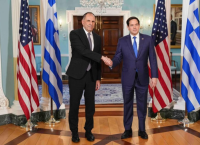
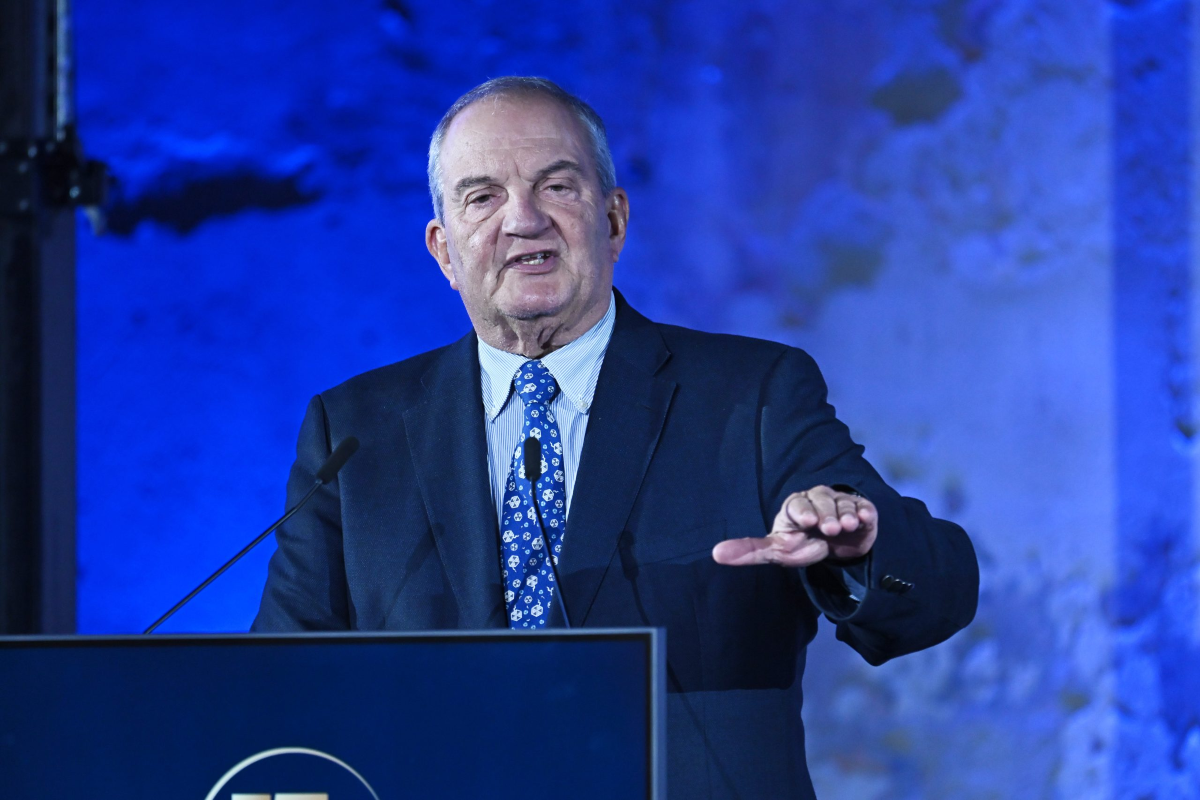
Former Greek Prime Minister Kostas Karamanlis has delivered a wide-ranging geopolitical intervention at a particularly sensitive moment, as the Greek government hosts US Secretary of State Marco Rubio in Athens for the 6th Greece-US Strategic Dialogue.
The timing is politically noteworthy.
While Athens and Washington are highlighting their deepening strategic partnership in defense, energy and regional security, Karamanlis has put forward a different principle for Greek foreign policy: Greece should remain firmly anchored in the West while simultaneously pursuing multidimensional relations and channels of cooperation beyond its traditional alliances.
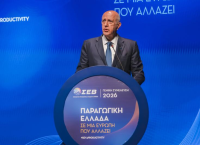
Speaking at an Executive Master in Business Administration program of Tsinghua University on “20 Years of Greece-China Strategic Partnership and the COSCO Experience,” Karamanlis did far more than review two decades of Sino-Greek relations.
He addressed the United States and China, Russia and Ukraine, Turkey and Cyprus, the Middle East, Europe’s geopolitical weakness and Greece’s place in an increasingly fragmented international order.
Karamanlis: Greece Needs a “More Complex and Multidimensional Foreign Policy”
The central message of his intervention was unequivocal:
“The emerging multipolar system requires the conduct of a more complex and multidimensional foreign policy, free from the rigid dividing lines of the past.”
Karamanlis immediately added an important qualification:
“Greece is undoubtedly aligned with the West; however, the West itself is undergoing a phase of transformation or even division.” Επικολλημένο markdown
His argument was therefore not that Greece should abandon its Western orientation.
Rather, he argued that belonging to the West should not prevent Athens from developing strategic relations with other major powers when Greek national and economic interests are served.
China was his primary example.
The Rubio Timing Adds Political Weight
Karamanlis’s intervention comes on the same day that Rubio is in Athens for talks centered on the further expansion of the Greece-US strategic partnership.
Energy, defense, the Eastern Mediterranean and regional security are all central to the American Secretary of State’s visit.
Against that backdrop, Karamanlis’s call for a multidimensional foreign policy inevitably carries additional political weight.
There is no evidence that the former prime minister deliberately framed his speech as a response either to Rubio or to the current Greek government.
But the timing and content place two foreign-policy concepts side by side: the rapidly deepening strategic partnership with Washington and Karamanlis’s argument that strong alliances should not become synonymous with one-dimensional diplomacy.
“Beyond Our Traditional Alliances”
Karamanlis explicitly returned to the foreign-policy philosophy pursued during his own premiership.
One of his government’s strategic priorities, he said, had been:
“A more multidimensional approach to foreign policy, beyond our traditional alliances.”
That strategy placed particular emphasis on economic diplomacy and sought to transform Greece into a strategic hub for the wider region. Επικολλημένο markdown
The statement has renewed relevance today as competition between the United States and China increasingly shapes global trade, investment, technology, shipping and critical infrastructure.
Karamanlis presented Greece’s relationship with Beijing as an example of how a country can remain committed to its alliances without closing the door to other major markets and centers of power.
COSCO: The Strategic Choice That Triggered Skepticism
A substantial part of Karamanlis’s speech was devoted to COSCO and the Port of Piraeus.
He openly acknowledged that the original agreement had generated reservations among some of Greece’s partners.
“It is no secret that the agreement caused skepticism among our partners within the geopolitical formations in which Greece participates,” he said.
But he also stressed that, at the time:
“No other credible international player had expressed interest in the Port of Piraeus.”
Karamanlis argued that the international interest now being shown in developing competing port facilities represents, in his view, “the best proof of the success of that strategic choice.” Επικολλημένο markdown
The issue is particularly relevant today.
Ports, logistics networks, shipping routes and strategic infrastructure have become major arenas of competition between Washington and Beijing.
What was once viewed primarily as a commercial investment is now increasingly assessed through a geopolitical lens.
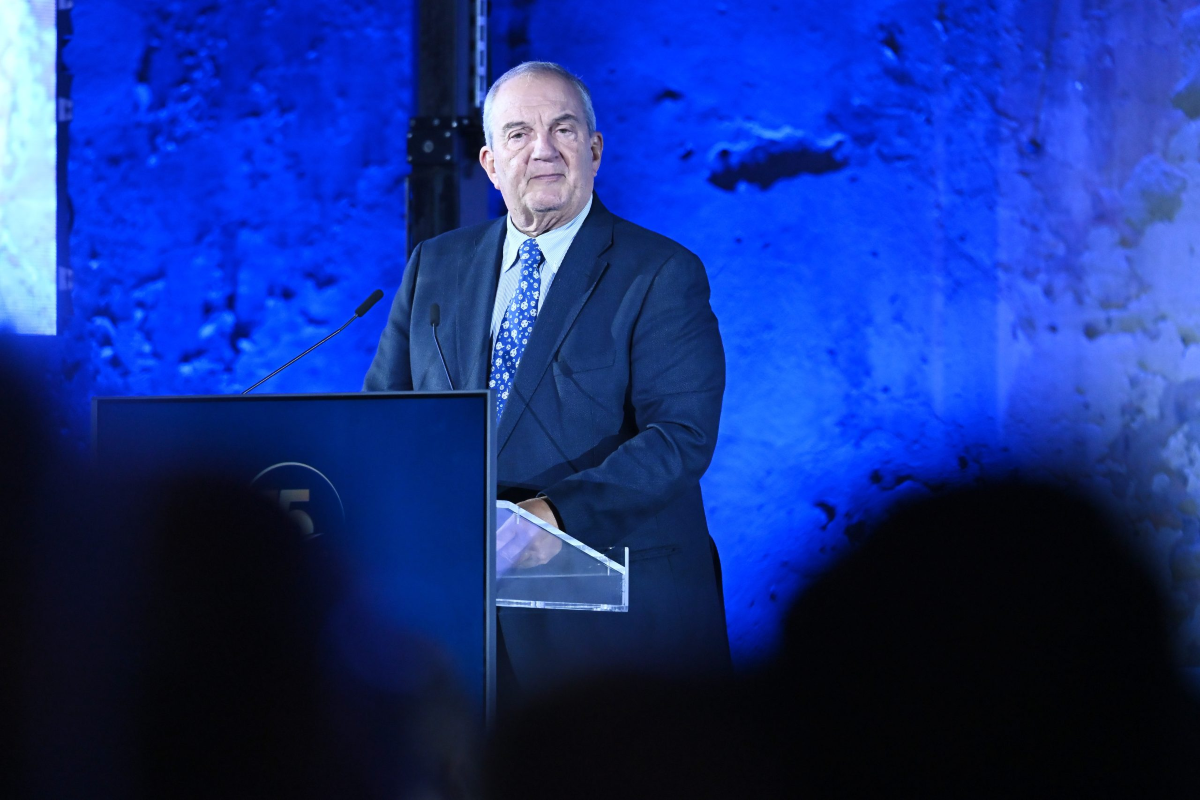
“The International Landscape Is More Unstable Than at Any Time Since World War II”
Karamanlis painted a stark picture of the international environment.
“The international landscape today is far more unstable than at any other period since the Second World War,” he said.
According to the former prime minister, the world is becoming increasingly multipolar, unpredictable and uncertain, while the international system is moving back toward realpolitik, spheres of influence and power politics.
One of his most striking remarks concerned the United States itself.
Karamanlis argued that Washington is attempting to maintain its global primacy by relying on its overwhelming military superiority, “although not with remarkable success.” Επικολλημένο markdown
That is a particularly notable assessment on the very day the head of American diplomacy is visiting Athens.
Karamanlis also warned that persistent geopolitical instability is feeding economic and social disruption across Western societies, pointing specifically to high inflation and elevated energy costs.
The Sharp Message on Turkey and Cyprus
One of the most politically charged sections of the speech concerned what Karamanlis described as the West’s double standards.
He contrasted the Western response to Russia’s invasion of Ukraine with its treatment of Turkey and the unresolved Cyprus issue.
Karamanlis argued that Turkey continues to advance revisionist claims against Greece, maintains threats of war and occupies part of Cyprus, yet Ankara is still regarded by many Western governments as a valuable partner and ally.
He said:
“While the Russian invasion of Ukraine is condemned, sanctions are imposed and the defending side receives every form of support, the parallel suffering of Cyprus remains unaddressed.”
He then delivered an even sharper conclusion:
“This inconsistency undermines the political, legal and moral superiority of the Western narrative.” Επικολλημένο markdown
It was one of the strongest passages of the entire speech.
Rather than questioning Greece’s Western orientation, Karamanlis was challenging what he views as inconsistencies in the way Western principles are applied to different geopolitical crises.
Ukraine: Russia Condemned, but the West Also Criticized
Karamanlis also offered a nuanced — and potentially controversial — assessment of the war in Ukraine.
He unequivocally described Russia’s invasion as “unjust and illegal.”
At the same time, however, he argued that the previous conduct of the collective West was “not without responsibility,” pointing to efforts to bring Ukraine into the Western geopolitical camp.
He further argued that the shift in US policy toward Moscow and pressure on Kyiv to accept what he described as a painful compromise had left European governments stunned and without a meaningful role in peace negotiations. Επικολλημένο markdown
The broader argument running through his speech was clear: international alignments are shifting too rapidly for Greece to rely on the rigid geopolitical assumptions of previous decades.
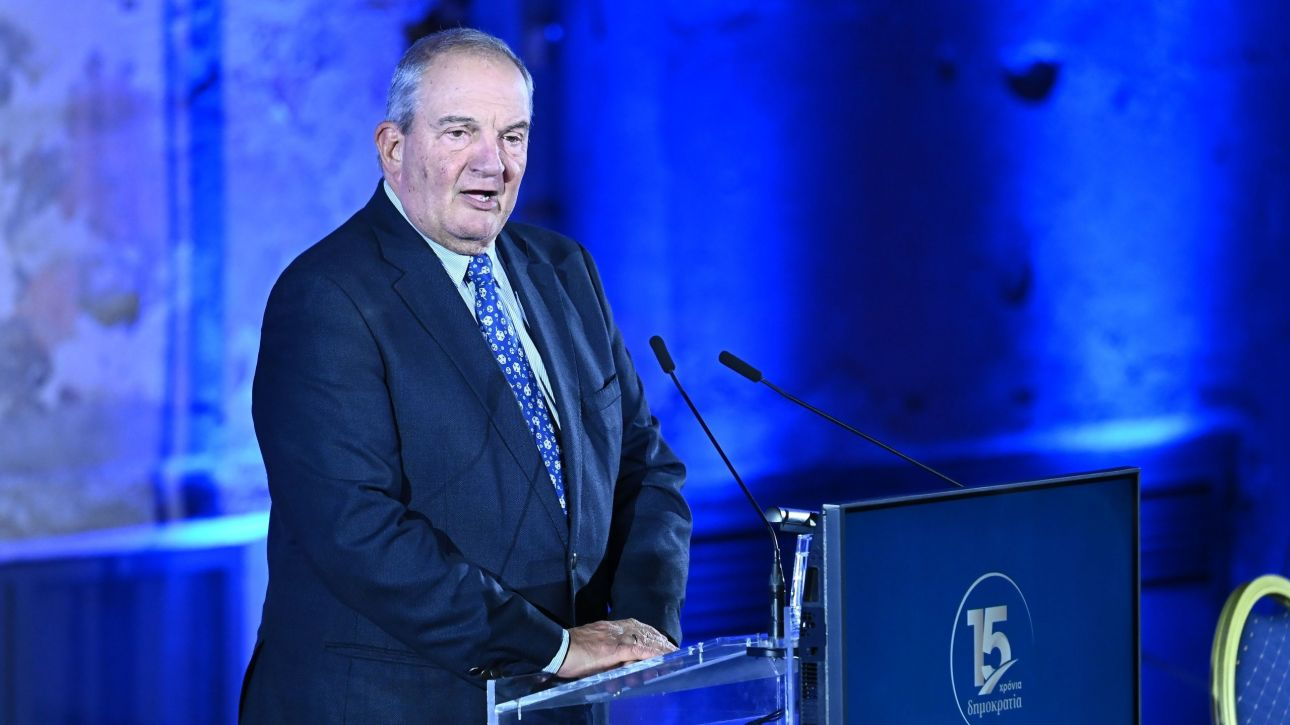
Middle East: The US Still Leads, but Cannot Always Impose Its Will
Karamanlis extended the same analysis to the Middle East.
He argued that while the United States retains the leading role, Washington increasingly faces difficulty imposing its will as Russia, China and smaller regional actors exercise their own influence.
He also pointed to what he described as a widening Euro-Atlantic gap.
At the same time, Karamanlis criticized the European Union for failing to emerge as a major geopolitical actor in a crisis that directly affects European security, energy and prosperity. Επικολλημένο markdown
For Greece, a country positioned at the intersection of Europe, the Balkans and the Eastern Mediterranean, that absence of a stronger European geopolitical role carries particular significance.
China and Greece: Karamanlis Defends a 20-Year Strategic Bet
The former prime minister devoted considerable attention to the strategic partnership between Greece and China launched during his administration.
He recalled that the Comprehensive Strategic Partnership was signed in 2006 during his official visit to China and argued that shipping became the cornerstone of the relationship.
Karamanlis highlighted the extensive interdependence between Greek shipping and the Chinese economy, pointing to Greek shipowners’ role in transporting Chinese trade and energy supplies and their extensive orders from Chinese shipyards. Επικολλημένο markdown
COSCO’s investment in Piraeus subsequently became the most visible symbol of that relationship.
Karamanlis described Greece as a bridge connecting China, the Mediterranean and Europe, with potential links extending across shipping, energy, communications, tourism and trade.
Piraeus as the Symbol of a Different Foreign-Policy Philosophy
For Karamanlis, Piraeus is not simply a commercial success story.
It represents the broader philosophy he sought to defend in his speech.
His argument is that Greece should use its geography, shipping power and position inside the European Union to build relationships with multiple economic and geopolitical centers.
The former prime minister noted that Piraeus has developed into one of the Mediterranean’s largest container ports and a major transshipment hub connecting Europe with Asia, Africa and the Black Sea. Επικολλημένο markdown
In that sense, the COSCO investment is presented by Karamanlis as evidence that a foreign-policy choice initially regarded with skepticism can, over time, acquire substantial economic and strategic importance.
Greece, China and Cyprus
Karamanlis also highlighted one area where, in his view, Athens and Beijing share strategically important positions.
“China strongly supports the sovereignty and territorial integrity of the Republic of Cyprus, while Greece consistently supports the ‘One China’ principle,” he said. Επικολλημένο markdown
He emphasized that Greece and China belong to different geopolitical formations but argued that mutual respect and shared interests provide room for continued cooperation.
His broader message was summed up in another key phrase:
“Today’s world needs fewer dividing lines and more understanding and cooperation.” Επικολλημένο markdown
The Message to Athens: West, but With Open Doors
This is ultimately where the political significance of Karamanlis’s intervention lies.
He did not challenge Greece’s Western identity.
He explicitly described it as unquestionable.
What he challenged was the idea that Western alignment necessarily requires rigid geopolitical dividing lines.
His prescription for the emerging multipolar world is more options, more channels of communication and a more multidimensional foreign policy.
China serves as his principal example, but the underlying argument goes considerably further.
For Karamanlis, Greece’s foreign policy should be built around a stable Western orientation while retaining the ability to develop economic and diplomatic relationships with other poles of power whenever Greek interests justify doing so.
Greece Between Washington and Beijing — Without an “Either/Or” Choice
The real debate opened by Karamanlis’s speech is therefore not whether Greece should choose Washington or Beijing.
Greece is a member of both NATO and the European Union, while its strategic relationship with the United States has expanded substantially across defense, energy and security.
At the same time, Piraeus and COSCO are tangible examples of the economic significance of Greece’s relationship with China.
Karamanlis is effectively putting forward a model in which Greece remains firmly embedded in the Western architecture but simultaneously maintains political and economic relationships with other major centers of global power.
And that is what gives his intervention particular resonance on October 7, 2026.
On the day Marco Rubio is in Athens and the Greek government is showcasing its strategic relationship with Washington, Kostas Karamanlis is reminding the political establishment of his own foreign-policy doctrine:
A firm Western orientation — but without closing Greece’s doors to the rest of the world.
And, above all, a foreign policy that assesses each relationship through the prism of Greece’s own strategic interests.
Source: pagenews.gr
Διαβάστε όλες τις τελευταίες Ειδήσεις από την Ελλάδα και τον Κόσμο