Athens and Cairo Challenge Ankara: Greece and Egypt Move to Expand EEZ Agreement Amid Turkey–Libya Dispute
 ΧΡΟΝΟΣ ΑΝΑΓΝΩΣΗΣ 12 '
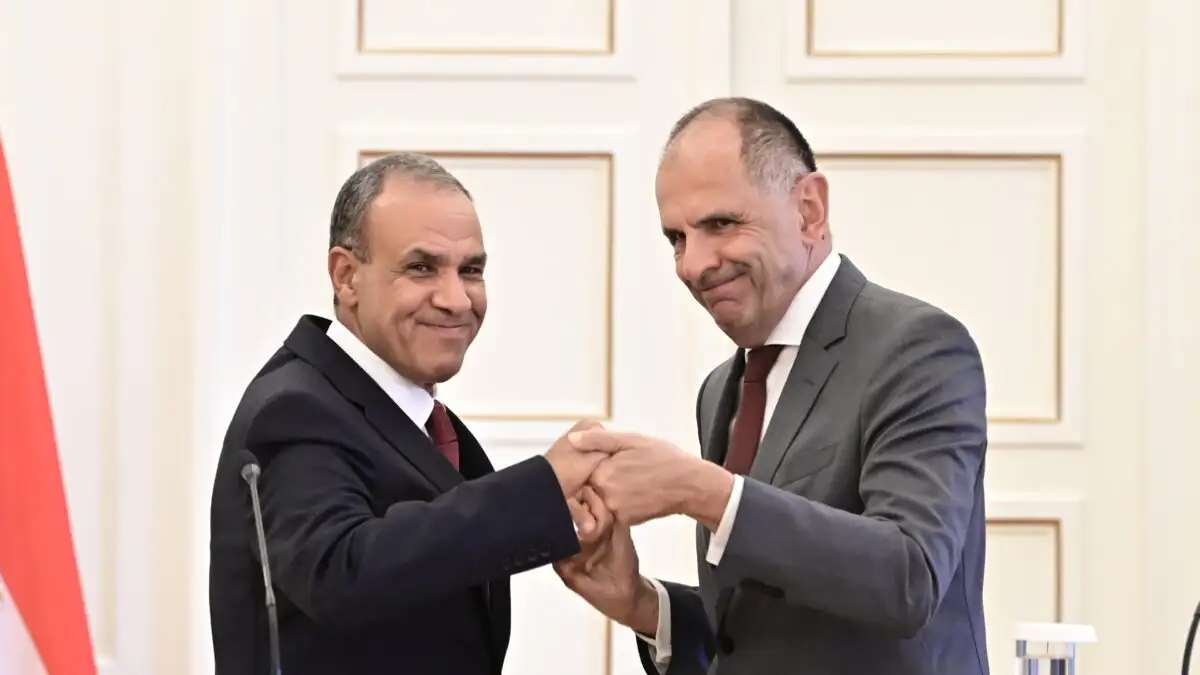
Πηγή Φωτογραφίας: eurokinissi//Athens and Cairo Challenge Ankara: Greece and Egypt Move to Expand EEZ Agreement Amid Turkey–Libya Dispute



Greece and Egypt are moving to strengthen their strategic partnership in the Eastern Mediterranean, opening a new chapter in their diplomatic response to the Turkey–Libya maritime memorandum.
Following a telephone conversation between Greek Foreign Minister Giorgos Gerapetritis and Egyptian Foreign Minister Badr Abdelatty, the two countries agreed to continue consultations aimed at expanding the geographical scope of their 2020 Exclusive Economic Zone (EEZ) delimitation agreement.
The development comes against the backdrop of renewed tensions after Libya’s House of Representatives approved the 2019 maritime memorandum between Turkey and Libya.
Athens considers the memorandum legally invalid, arguing that it disregards the maritime rights of Greek islands and conflicts with international maritime law.
Ankara rejects that interpretation and maintains that the agreement represents a legitimate bilateral maritime delimitation.
The renewed Greek–Egyptian initiative therefore carries significance beyond bilateral relations. It forms part of a wider diplomatic contest over maritime boundaries, energy resources and regional influence in the Eastern Mediterranean.
Gerapetritis and Abdelatty: A Coordinated Diplomatic Response
The telephone conversation between the two foreign ministers focused on their strategic partnership and developments in the Eastern Mediterranean.
According to the Greek Ministry of Foreign Affairs, Athens and Cairo agreed to continue consultations on extending the geographical scope of their existing EEZ agreement, in full compliance with international law and the United Nations Convention on the Law of the Sea (UNCLOS).
Both sides also rejected the Libyan House of Representatives’ approval of the 2019 Turkey–Libya maritime memorandum.
The announcement is important for two reasons.
First, it demonstrates that Greece and Egypt continue to coordinate their diplomatic positions on disputed maritime claims.
Second, it brings renewed attention to the sections of their maritime boundary that were deliberately left outside the partial delimitation agreement signed in August 2020.
The announcement does not mean that a new maritime boundary has already been agreed.
Rather, it signals the intention of both governments to continue negotiations that could eventually lead to a broader delimitation arrangement.

Libya’s Decision Changes the Diplomatic Landscape
The Libyan House of Representatives’ decision on October 20, 2026, introduced a new element into the Eastern Mediterranean dispute.
The legislature, based in eastern Libya, approved the maritime memorandum signed in November 2019 between Turkey and Libya’s then Government of National Accord in Tripoli.
The development is particularly significant because eastern Libya had historically maintained a more complicated relationship with Ankara than the authorities in Tripoli.
The approval reflects Turkey’s expanding diplomatic engagement across Libya’s divided political landscape.
For Greece, the principal concern is that the memorandum could be used to support maritime claims affecting areas in which Athens asserts sovereign rights.
The Greek government argues that the Turkey–Libya arrangement disregards the potential maritime entitlements of Greek islands, including Crete.
Turkey maintains a different interpretation of maritime delimitation and rejects Greece’s objections.
These competing legal and geographical positions lie at the centre of the dispute.
Athens: The Memorandum Cannot Override International Maritime Law
The Greek Ministry of Foreign Affairs responded to the Libyan decision by reiterating that the memorandum is inconsistent with international maritime law.
Athens argues that Turkey and Libya do not possess the relevant opposite or adjacent coastlines necessary to justify the maritime boundary described in their agreement.
It also maintains that the memorandum disregards the maritime rights generated by Greek islands.
Greece bases its position on UNCLOS and the broader principles of customary international law governing maritime delimitation.
The government has repeatedly stated that it will use diplomatic and legal means to protect the country’s sovereign rights.
The Libyan parliament’s approval does not, in Greece’s view, resolve the underlying legal objections.
The 2020 Greece–Egypt Agreement: Athens’ Strategic Foundation
The current diplomatic initiative builds upon one of Greece’s most important maritime agreements of recent decades.
On August 6, 2020, Greece and Egypt signed an agreement partially delimiting their Exclusive Economic Zones.
The agreement was signed by then Greek Foreign Minister Nikos Dendias and his Egyptian counterpart Sameh Shoukry.
It established an agreed maritime boundary between the two countries over a defined geographical area.
The agreement was widely regarded in Athens as a significant diplomatic response to the Turkey–Libya memorandum signed the previous year.
Crucially, however, it was a partial delimitation.
The two governments deliberately left certain sections of their potential maritime boundary unresolved, allowing for future negotiations.
Those outstanding sections are now returning to the diplomatic agenda.
A possible extension would strengthen the network of mutually agreed maritime boundaries in the Eastern Mediterranean, although the precise geographical scope and legal terms would still need to be negotiated.
Gerapetritis: “We Share a Strategic and Fraternal Relationship with Egypt”
The Greek Foreign Minister had already signalled the possibility of renewed discussions with Cairo during an interview with Mega News 104.6 on October 21.
Speaking about the bilateral relationship, Gerapetritis emphasised its strategic depth.
“We share a strategic and, if I may say so, fraternal relationship with Egypt.”
He explained that cooperation between the two countries extends beyond maritime delimitation.
“It is a relationship built not only on the agreement for the partial delimitation of the Exclusive Economic Zone; it is strategically structured.”
The minister also expressed confidence in the shared understanding between Athens and Cairo.
“I have absolute confidence in our common understanding.”
During the same interview, he indicated that extending the existing agreement was an issue that could be discussed in the future, depending on the circumstances.
The subsequent announcement of continued consultations gives that possibility renewed diplomatic importance.
“The Memorandum Will Not Be Implemented Under Any Circumstances”
Gerapetritis also delivered a categorical message concerning the Turkey–Libya memorandum.
“The memorandum will not be implemented under any circumstances, Mr Tsimas,” he said during the interview.
The statement reflected Athens’ determination to oppose any practical application of maritime claims that it considers inconsistent with international law.
The minister indicated that Greece would continue using the available diplomatic mechanisms to defend its position.
He also referred to planned energy and other activities in maritime areas south of Crete.
These developments underline why the maritime dispute has implications extending beyond diplomatic statements.
Maritime boundaries can affect exploration rights, infrastructure projects and the broader investment environment across the region.
European Union Rejects the Turkey–Libya Memorandum
Greece’s diplomatic position has also received support from the European Union.
On October 21, the EU issued a statement rejecting the Libyan House of Representatives’ approval of the memorandum.
The European position is that the Turkey–Libya arrangement infringes upon the sovereign rights of third states and does not comply with the Law of the Sea.
The EU reiterated that the memorandum cannot produce legal consequences for third countries.
This position follows earlier European Council conclusions adopted in December 2019 and subsequent reaffirmations.
For Athens, the EU’s stance is strategically important because it places the issue within a broader European legal and diplomatic framework.
The dispute is therefore not confined to bilateral disagreements between Greece and Turkey.
Nevertheless, European political support does not automatically translate into sanctions or enforcement measures against Turkey or Libya.
Egypt and Germany Reinforce Their Objections
Egypt has also rejected the Libyan parliamentary approval of the memorandum.
Cairo maintains that the agreement cannot create legal consequences affecting Egypt’s maritime rights.
The Egyptian position carries particular significance because of the country’s geographical location, energy interests and existing maritime arrangements in the Eastern Mediterranean.
Germany also reaffirmed its support for the European position on October 22.
German Foreign Ministry spokesperson Kathrin Deschauer emphasised that maritime boundaries must be established in accordance with applicable international law and with the participation of the coastal states concerned.
The alignment of these diplomatic positions strengthens Greece’s argument that maritime delimitation must respect the rights of all relevant states.
The 12-Nautical-Mile Question Returns to the Forefront
The renewed controversy surrounding the Turkey–Libya memorandum has also revived discussion about Greece’s potential extension of its territorial waters.
Under international maritime law, coastal states may establish territorial seas extending up to 12 nautical miles, subject to the applicable legal framework.
During his October 21 interview, Gerapetritis addressed questions about the possibility of extending Greek territorial waters south and west of Crete.
“Greece does not react impulsively. Greece acts according to a plan and, above all, in the service of its national interests.”
He also stated:
“Greece will extend its territorial waters.”
However, he clarified that the timing and manner of exercising that right would be determined by the Greek state.
The distinction between territorial waters and an Exclusive Economic Zone is essential.
Territorial waters involve sovereignty over a defined maritime area, whereas an EEZ concerns specific sovereign rights, primarily relating to the exploration, exploitation, conservation and management of natural resources.
The possible extension of Greek territorial waters is therefore legally separate from the ongoing Greece–Egypt EEZ consultations.
Crete, Energy Exploration and Strategic Infrastructure
The maritime dispute has direct implications for the Eastern Mediterranean’s energy and infrastructure landscape.
Hydrocarbon exploration south of Crete, electricity interconnections and subsea infrastructure projects all depend on a stable legal and operational environment.
Among the strategically significant projects is the Great Sea Interconnector, designed to connect the electricity systems of Greece and Cyprus.
Turkey has raised objections to activities in maritime areas over which it asserts jurisdiction.
For Athens, maintaining the ability to develop energy infrastructure while defending its maritime rights remains a central strategic priority.
A broader maritime delimitation agreement with Egypt could contribute to greater legal clarity in parts of the region.
However, it would not automatically settle all outstanding maritime disputes or eliminate the possibility of competing claims.
The Wider Geopolitical Contest: Ankara, Cairo and Athens
The latest developments also reveal the changing diplomatic dynamics of the Eastern Mediterranean.
Turkey has been expanding its engagement with different political actors in Libya, seeking to consolidate its influence in a country of considerable strategic importance.
Greece, meanwhile, continues to invest in bilateral partnerships, European coordination and international legal frameworks.
Egypt occupies a particularly important position in this geopolitical equation.
Its relationship with Greece is based on shared maritime interests, energy cooperation and broader regional security considerations.
At the same time, Cairo maintains its own diplomatic priorities and relations with other regional powers, including Turkey.
The future of the Greek–Egyptian delimitation process will therefore depend not only on legal and geographical considerations but also on the wider regional diplomatic environment.
What Happens Next?
The immediate priority for Athens and Cairo is to continue consultations on the possible geographical extension of their 2020 agreement.
Any future arrangement would require negotiations over the relevant maritime areas, agreement on the delimitation line and completion of the necessary legal procedures.
For Greece, such an agreement could reinforce its diplomatic and legal position in the Eastern Mediterranean.
For Egypt, it could provide greater clarity concerning maritime jurisdiction and support the development of regional energy projects.
For Turkey and Libya, it would represent another significant development in an already complex dispute over maritime boundaries.
The central question is whether the renewed consultations will produce a concrete agreement and how that outcome might affect the wider balance of interests in the region.
For now, Athens and Cairo have chosen to respond to the latest Turkey–Libya developments through closer diplomatic coordination and the prospect of expanding an existing maritime agreement grounded in international law.
The next phase of negotiations will determine whether that political commitment can be translated into a new and legally binding delimitation.
Source: pagenews.gr
Διαβάστε όλες τις τελευταίες Ειδήσεις από την Ελλάδα και τον Κόσμο