Pierrakakis: “Make Every Euro Deliver More” — Europe’s New Economic Test
 ΧΡΟΝΟΣ ΑΝΑΓΝΩΣΗΣ 10 '
Πηγή Φωτογραφίας: eurokinissi//Pierrakakis: “Make Every Euro Deliver More” — Europe’s New Economic Test



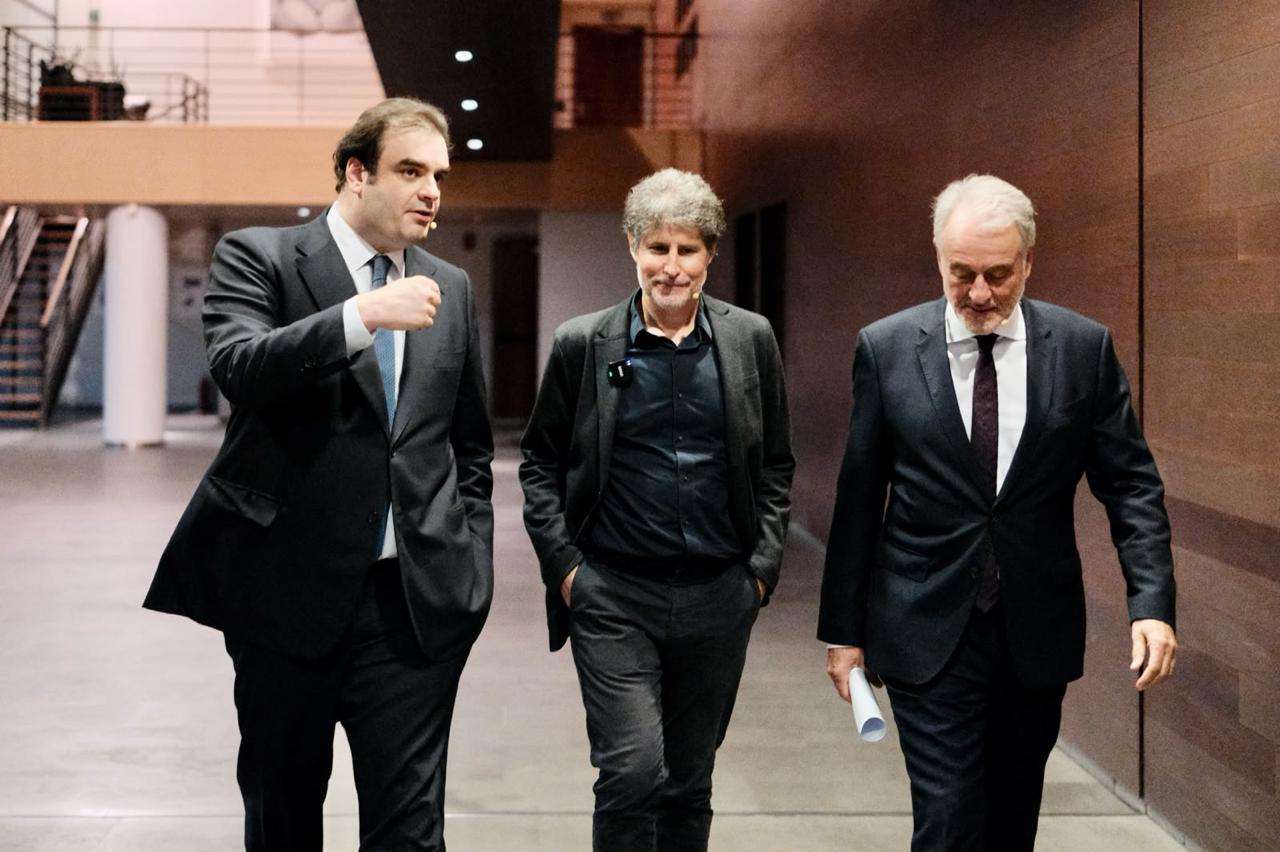
Europe must make better use of its financial resources as higher borrowing costs, mounting investment needs and the artificial intelligence revolution reshape its economic prospects, Kyriakos Pierrakakis said during a discussion with internationally acclaimed author Giuliano da Empoli.
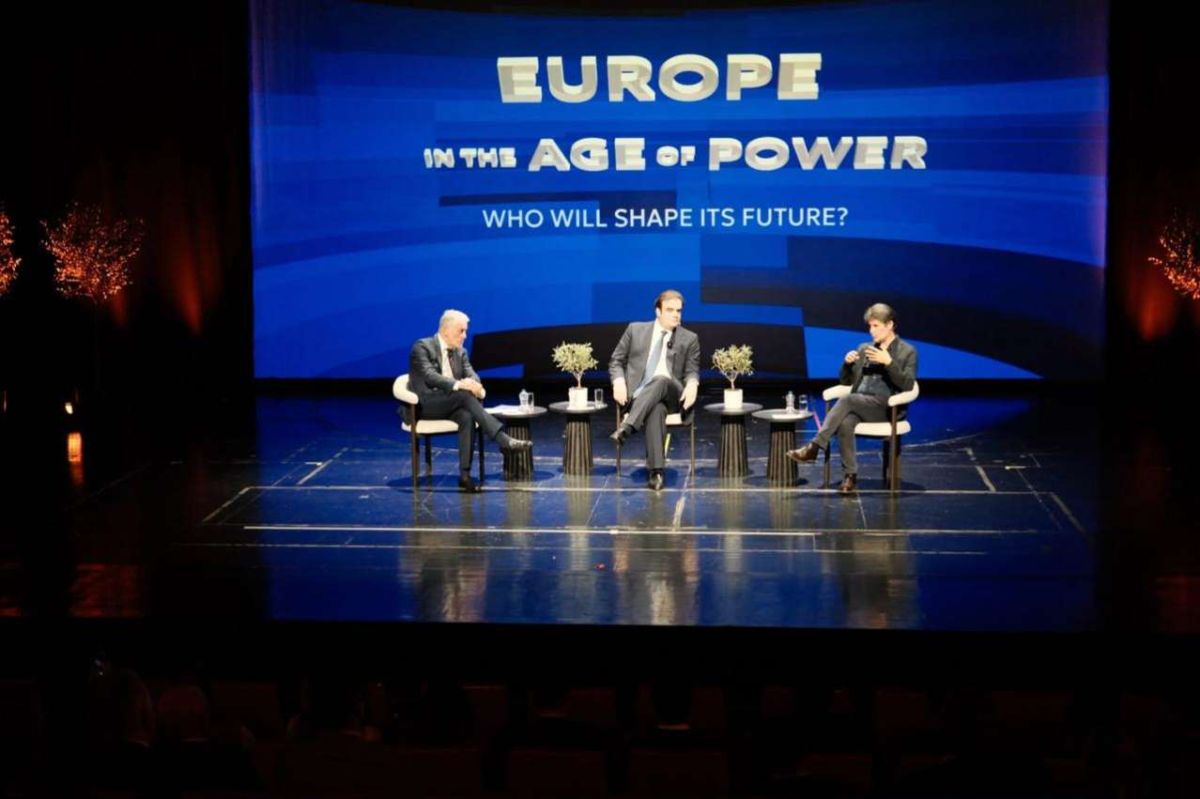
Speaking at an event organised by the Hellenic Foundation for European and Foreign Policy, ELIAMEP, Greece’s Minister of National Economy and Finance and Eurogroup President argued that Europe has become more resilient since the sovereign debt crisis, but now faces a more demanding combination of challenges.
The discussion, titled “Europe in the Age of Power: Who Will Shape Its Future?”, was moderated by Loukas Tsoukalis, President of ELIAMEP’s Board of Directors and a professor at Sciences Po in Paris.
Pierrakakis placed the emphasis on how Europe allocates its resources, supports innovation and turns shared priorities into practical decisions.
“We need to think innovatively, examine how to direct our financial resources in the best possible way, how to make every euro deliver more and how to coordinate better,” he said.
Stronger institutions, tougher financial conditions
Pierrakakis contrasted Europe’s current institutional capacity with the conditions Greece faced at the beginning of its debt crisis.
“If we compare today’s situation with the world and the European political reality in which Greece had to operate in 2010, we had no institutional framework to address the Greek crisis. Along the way, however, we evolved.”
He pointed to stronger bank balance sheets, the creation of the European Stability Mechanism and the development of Europe’s fiscal framework.
“Banks today are much better capitalised. We have new institutions, we have the European Stability Mechanism, we have a fiscal framework in Europe. That is the positive side. We therefore have resilience.”
That institutional progress, he argued, does not eliminate the pressures governments face when financing their spending and investment commitments.
“Right now, we are being tested in a more demanding environment.”
Referring to borrowing conditions, he cited average ten-year interest rates of approximately 4%, compared with 1.1% previously.
He also said Europe’s average deficit had doubled compared with a decade earlier, while governments face more competing priorities.
“We have more investment priorities, such as defence, ageing societies and higher social expenditure.”
Together with higher energy costs, he described these pressures as an exceptionally demanding combination that requires more effective allocation of public money.
The lasting political impact of the debt crisis
Pierrakakis also linked fiscal policy choices to the experience of countries that went through financial assistance programmes.
According to the figures he cited during the discussion, only five of the EU’s 27 member states were running surpluses.
“Which are those five? Denmark and the four countries that had IMF programmes in the previous decade.”
For the minister, the significance extends beyond budget balances.
“This is a collective trauma that turned into policy.”
His remarks connected the experience of crisis management with the importance those countries now attach to fiscal stability.
Artificial intelligence changes the competition for capital
A substantial part of the discussion focused on artificial intelligence and its implications for investment, borrowing and economic policy.
Pierrakakis argued that the speed of technological development is making it difficult to assess the full consequences.
“What is changing is the very quality of time, the way ChatGPT, Anthropic, algorithms and large language models are evolving in their degree of complexity.”
He said the public debate remains insufficiently systematic, often shifting between warnings about risks and expectations of major benefits.
“My problem with this discussion is that we are not yet conducting it in a very systematic way.”
One consequence, he argued, is already visible in the competition for financing.
“Microsoft, Amazon and Google are competing with states to raise capital.”
He contrasted this with an earlier period when large technology companies could finance expansion and investment from their substantial cash reserves.
In his assessment, that changing demand for capital adds another source of pressure to financial markets, alongside governments’ fiscal positions.
“This is only one of the changes we are seeing.”
“There are people we will need to protect”
Pierrakakis also addressed the social consequences of artificial intelligence, stressing that technological progress will require changes to public policy.
“We know, however, that from an economic perspective there will, to some extent, be a shift from labour towards capital because of this development.”
He said this creates a clear responsibility to support people affected by the transition.
“That means that, if we examine it in social terms, there are people we will need to protect. Our social insurance systems will have to adapt.”
He acknowledged that the precise form of that adaptation remains uncertain.
“I do not yet know how, because this is a situation that will evolve very dynamically, but that must be the objective.”
Education presents a similarly difficult challenge, he added, because governments must prepare children for economic and technological conditions that cannot yet be fully anticipated.
“We need to design education systems for a world that does not yet exist.”
He illustrated the point through the time a child spends in school:
“A four-year-old child starts school and will graduate at the age of 18. What will the world they graduate into look like? These are the difficult questions.”
“If you invest in everything, you achieve nothing”
Turning to European competitiveness and sovereignty, Pierrakakis called for clearer strategic priorities.
“If you are a politician, you have to make choices. Every person, every entrepreneur, every academic — everyone — has to make choices.”
He criticised the tendency to avoid those decisions in politics.
“But if you do not make choices, if you invest in everything, you achieve nothing. We need to pick winners.”
He linked the ability to concentrate resources and strengthen European capabilities with Europe’s position in negotiations with the United States and China.
“We will have greater strength at the negotiating table.”
The challenge, he said, is increasingly about implementation.
“The question, of course, is not what needs to be done, but whether it will be done and how it can be done.”
He expressed optimism that the shared diagnosis reflected in the Draghi and Letta reports could increasingly translate into common action.
A call for “big leaps”
Pierrakakis said Europe needs to move beyond an approach based predominantly on incremental progress.
“We have always operated through small, gradual steps. Personally, I am not a supporter of that approach.”
He argued that citizens expect more ambitious political action.
“I believe in big leaps, and that is what citizens want from us.”
Developing a common understanding of Europe’s challenges is already an important part of the process, he added.
“The development of a common vocabulary on certain issues and a shared understanding of what needs to be done represent half the journey.”
On France: “Violence is never acceptable. Full stop”
Asked about unrest in France, Pierrakakis unequivocally rejected violence.
“Violence is never acceptable. Full stop. And I think the discussion ends there.”
He then turned to the wider relationship between public frustration, government performance and confidence in democratic institutions.
Alongside anger and the influence of algorithms, he said, political debate must address whether governments deliver tangible results.
“That is what ultimately makes all the difference for every citizen, whether they vote for one party, another or a third.”
He identified healthcare, education and public finances as central tests.
“Are you delivering results in healthcare? Are you delivering results in education? Are public finances working?”
Those outcomes, he argued, influence whether people feel their taxes are serving their purpose and whether they feel part of a democratic political community.
Drawing on his experience in previous government roles, Pierrakakis pointed to digital public services as an example of how practical improvements can change citizens’ relationship with the state.
“The very fact that these digital platforms sent the message that the state now operates with less bureaucracy signalled that this mechanism for delivering results existed.”
He stressed that the same effort must extend across public policy.
“Of course, we need to do more in this direction in every area of public policy.”
Da Empoli: Greece offers a hopeful European example
Giuliano da Empoli also expressed optimism about Europe’s capacity to adapt, despite the scale of its political and economic challenges.
“If one looks at Europe, even just over the past few years, it has proved capable of delivering results.”
He said Europe had shown greater resilience than might have been expected, particularly during crises for which it initially lacked an adequate framework.
“In the case of the pandemic, of course, there was no European framework to address it. In the case of Ukraine, in some respects, even less so. And yet something happened, and the framework proved sufficiently resilient.”
Da Empoli argued that many European voters continue to support this direction and want political leaders to defend it more confidently.
“Many Europeans are waiting for certain European political leaders to stand up and defend this direction.”
He concluded with a positive assessment of Greece’s current leadership:
“That is why some of us see today’s Greek political leadership and government as one of the hopeful European examples and as a hopeful political stance.”
Source: pagenews.gr
Διαβάστε όλες τις τελευταίες Ειδήσεις από την Ελλάδα και τον Κόσμο