Gerapetritis: “No Turkish Permission” for Power Cable — Greece Sets Out Its Eastern Mediterranean Strategy
 ΧΡΟΝΟΣ ΑΝΑΓΝΩΣΗΣ 8 '
Πηγή Φωτογραφίας: eurokinissi//Gerapetritis: “No Turkish Permission” for Power Cable — Greece Sets Out Its Eastern Mediterranean Strategy



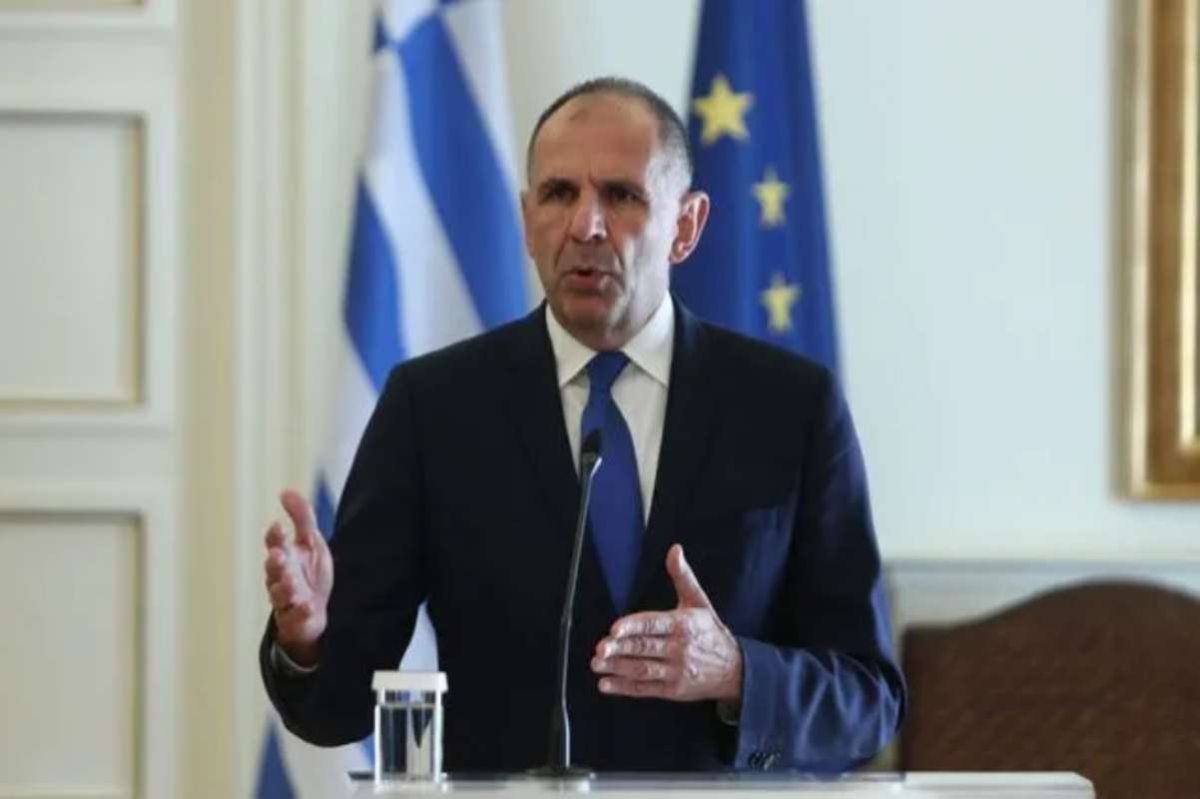
“We will neither seek permission nor notify Turkey.” With that unequivocal statement, Greek Foreign Minister George Gerapetritis outlined Athens’ position on the Greece–Cyprus electricity interconnector, alongside its next diplomatic steps in the Eastern Mediterranean.
Speaking on ANT1’s “Good Morning Greece,” Gerapetritis linked the project’s progress to its European significance, Greece’s strategic partnerships and contingency planning against any Turkish attempt to obstruct the works.
He also announced technical discussions on extending the Greece–Egypt maritime delimitation agreement and categorically rejected reports that Athens would support Turkish diplomat Feridun Sinirlioğlu for United Nations secretary-general.
“Greece is the only country authorising this project”
On the electricity cable, Gerapetritis rejected any suggestion that Turkey would acquire a role in authorising the relevant operations.
“Greece is the only country that authorises this particular project. There will be no relinquishment of that authority in any way whatsoever,” he stressed.
He distinguished, however, between state authorisation and possible informal communication by the company conducting the operations. A company notification concerning a research vessel’s movements, he explained, would constitute neither a request for permission nor recognition of Turkish jurisdiction.
“The company will not seek any permission. There is a clear understanding that the authorising country is exclusively Greece.”
Regarding possible informal notification, he added:
“It produces no legal consequences and obviously does not alter the position regarding authorisation.”
That distinction underpins his response to domestic criticism: Athens retains its authority, while Turkey gains no joint authorisation role.
The next steps before operations resume
The foreign minister described the administrative process under way to extend the works permit.
According to his account, the application has been forwarded to the competent interministerial committee for assessment. The subsequent steps include a Foreign Ministry decision, referral to the Defence Ministry and issuance of the relevant NAVTEX maritime notice.
“We expect the process to be completed in the coming days,” he said, without presenting the assessment as already concluded.
He also discussed questions surrounding the project’s economic and technical viability, as well as interest expressed by a major French energy company.
“If Turkey obstructs it, it will face Greece”
Asked about the possibility of Turkish warships appearing in the area, Gerapetritis said he did not consider such a development likely. He nevertheless made clear that Athens was preparing for contingencies.
“We have all scenarios ready for every eventuality,” he said.
He added:
“If Turkey attempts to obstruct it, then it will obviously find Greece opposing it. Plans exist to address any obstruction of the project.”
The minister also emphasised the interconnector’s European dimension, pointing to EU co-financing.
“A country that aspires to become part of the Union while simultaneously obstructing European projects is, as you understand, closing the door on itself,” he said.
Egypt talks: Athens’ response to the Turkey–Libya memorandum
Addressing criticism over Libya’s ratification of the Turkey–Libya maritime memorandum, Gerapetritis argued that ratification added nothing to the claims the two countries had advanced since 2019.
In his assessment, it creates no additional maritime jurisdiction and does not, by itself, change conditions on the ground.
He presented the planned extension of the Greece–Egypt agreement as a substantive Greek initiative in response.
“Greece and Egypt are agreeing to begin technical discussions on extending the Greek–Egyptian agreement,” he announced.
He expressed confidence that results could follow within a relatively short period. The discussions are beginning; their outcome remains to be negotiated.
“Countries operate according to rules, because otherwise we would have a maritime jungle. Serious countries understand that,” he stressed.
Chevron and Greece’s diplomatic presence
Gerapetritis cited energy activity and Chevron’s involvement as factors strengthening Greece’s position in the region.
Under his analysis, the boundaries of exploration blocks and their assessment by major companies carry practical weight because investors must consider geopolitical risk.
He maintained that the activity he described followed the median line as understood by Greece. Corporate involvement was therefore presented as supporting Greek positions, while remaining distinct from the legal process of interstate maritime delimitation.
He also explained why Athens continues to challenge the Turkey–Libya memorandum internationally:
“The Turkey–Libya memorandum represents a clear disregard for the international law of the sea.”
Pointing to Turkey’s military presence and influence in Libya, he argued that Greece must correspondingly expand its own diplomatic presence.
Sanctions and territorial waters remain available options
On European sanctions, the minister said Greece had communicated its intention to request an EU response in the event of escalation.
His remarks concerned Athens’ readiness to submit such a request; any sanctions decision would proceed through the applicable European mechanisms.
On extending territorial waters, he said the option remained available, without announcing a timetable or a specific geographical scope.
“The extension of territorial waters will take place when the Greek state chooses,” he said.
He connected that planning with maritime spatial planning, marine parks, energy partnerships and stronger defence capabilities.
“These things are not done on the fly or in the heat of the moment. Greek diplomacy has a very specific plan,” he underlined.
“Delivering results, rather than communication”
Responding more broadly to criticism of his foreign policy approach, Gerapetritis described how he sees his responsibilities:
“I understand my job primarily as delivering results rather than producing communication. Sometimes that does not work to my advantage. But it is a personal choice I have made.”
He argued that Greece was strengthening its alliances and diplomatic arguments during an exceptionally difficult international period.
“Not only is it not retreating, not only is it not losing footholds, but it is gaining allies, gaining positions and gaining arguments,” he said.
United States: “Relations transcend electoral cycles”
Discussing the American elections, Gerapetritis identified the economy and the domestic impact of the Iran war as factors influencing voters.
He anticipated a difficult relationship between the president and a Democratic-controlled Congress, highlighting the legislature’s oversight and funding powers.
For Greece, however, he emphasised continuity in the strategic partnership:
“Greek–American relations transcend electoral cycles. Support for Greece is bipartisan.”
He referred to elected Americans of Greek descent and expected changes in influential congressional positions, which also affect discussions concerning US–Turkish defence relations.
“Greece has developed a form of diplomacy with the United States that is not affected by electoral changes,” he stressed.
A categorical rejection of Sinirlioğlu’s candidacy
Closing the interview, Gerapetritis rejected reports that Greece would support the Turkish diplomat’s bid to lead the United Nations.
“Greece will not support Mr Sinirlioğlu’s candidacy for the UN,” he declared.
He said Athens had communicated its position, linking the selection of a secretary-general to international standing and respect for international law. Referring specifically to Cyprus, he concluded:
“To the extent that Turkey does not accept UN resolutions—and I am referring above all to Cyprus—support for such a candidacy would never be acceptable to any Greek government.”
Source: pagenews.gr
Διαβάστε όλες τις τελευταίες Ειδήσεις από την Ελλάδα και τον Κόσμο