Greece Challenges Turkey–Libya Maritime Deal at UN: “Geography Cannot Be Rewritten”
 ΧΡΟΝΟΣ ΑΝΑΓΝΩΣΗΣ 12 '
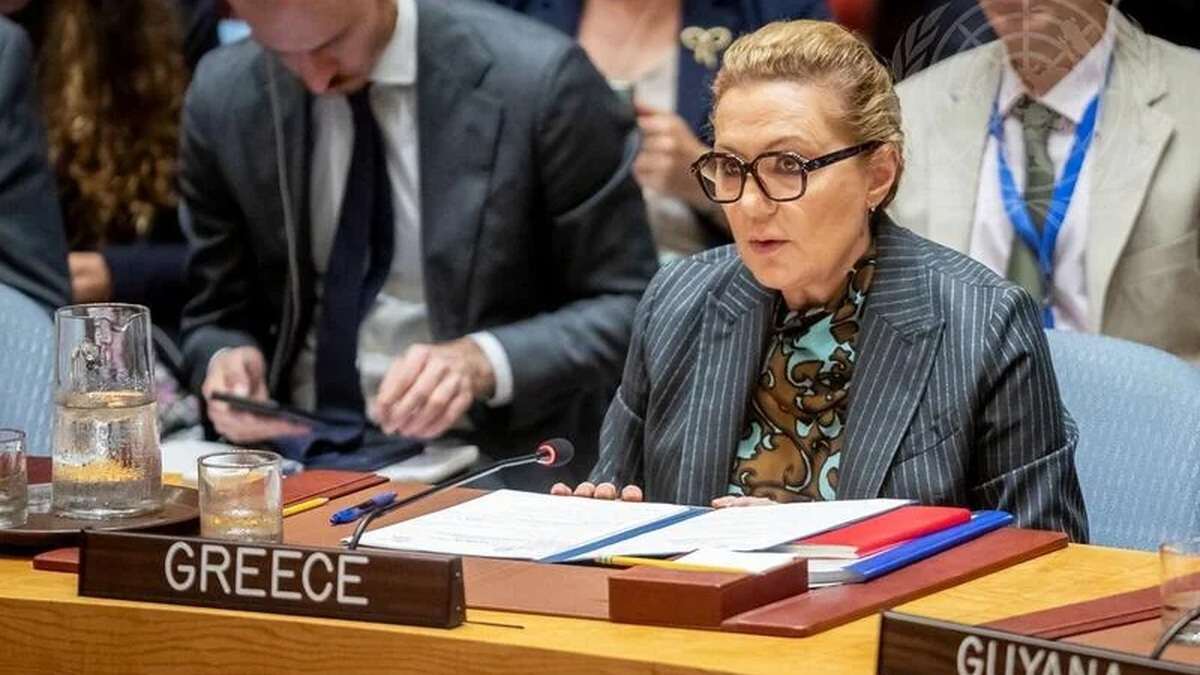
Πηγή Φωτογραφίας: AP Photo//Greece Challenges Turkey–Libya Maritime Deal at UN: “Geography Cannot Be Rewritten”



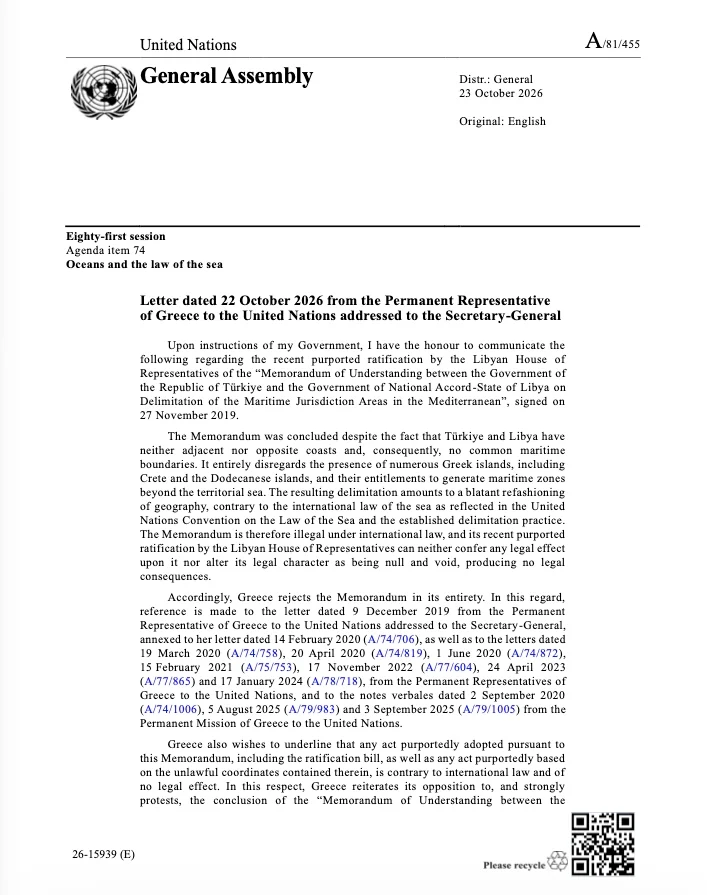
Greece has escalated its diplomatic response to the Turkey–Libya maritime agreement, submitting a comprehensive letter to United Nations Secretary-General António Guterres that challenges the legality of the disputed maritime delimitation and warns against any attempt to establish new facts on the ground in the Eastern Mediterranean.
The letter, dated October 22, 2026, was sent just two days after the reported ratification of the 2019 maritime memorandum by Libya’s House of Representatives. It was signed by Greece’s Permanent Representative to the United Nations, Ambassador Aglaia Balta.
The full text, made public by the Greek newspaper Kathimerini, sets out Athens’ legal objections to the agreement and its implications for maritime sovereignty, offshore energy exploration, and regional security.
At the heart of the dispute lies a fundamental disagreement over maritime geography: Greece maintains that Turkey and Libya cannot establish maritime boundaries while disregarding the presence and legal entitlements of Greek islands, particularly Crete and the Dodecanese.
Athens argues that the memorandum violates international law and cannot produce legal consequences affecting Greece, regardless of its ratification by the Libyan parliament.
Athens to the UN: Turkey and Libya Have No Common Maritime Boundary
The Greek letter directly challenges the geographical and legal foundations of the maritime memorandum signed between Turkey and Libya on November 27, 2019.
According to the document, the agreement was concluded despite the absence of adjacent or opposite coastlines between the two countries, once the relevant Greek islands are taken into account.
The Greek government argues that the maritime boundary established by Ankara and Tripoli effectively bypasses Greek territory and the maritime entitlements associated with it.
The letter describes the resulting delimitation as an attempt to reshape maritime geography in violation of the international law of the sea.
This argument forms the cornerstone of Greece’s diplomatic position.
Athens maintains that a bilateral agreement cannot lawfully determine maritime boundaries at the expense of a third state whose sovereign rights are potentially affected.
Turkey, however, advances a different interpretation of maritime delimitation principles, particularly regarding the effect of islands on exclusive economic zones and continental shelves.
The dispute therefore extends beyond the validity of a single agreement and concerns competing interpretations of maritime jurisdiction across the Eastern Mediterranean.
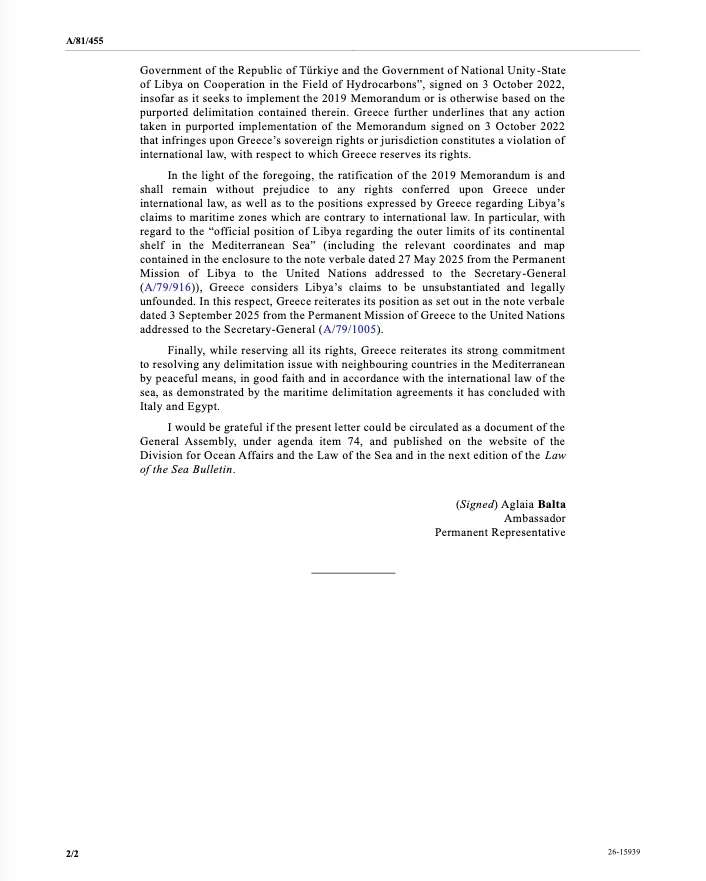
Crete and the Dodecanese: The Strategic Geography at the Center of the Dispute
One of the strongest elements of the Greek diplomatic intervention is its explicit reference to Crete and the Dodecanese.
The letter argues that the Turkey–Libya memorandum disregards numerous Greek islands and their entitlement to maritime zones beyond their territorial waters.
Under the United Nations Convention on the Law of the Sea (UNCLOS), islands meeting the relevant legal requirements may generate territorial seas, continental shelves, and exclusive economic zones.
However, the existence of maritime entitlements and the precise effect given to islands in a final delimitation are distinct legal questions.
International courts and tribunals have, in certain circumstances, adjusted the effect of islands when determining equitable maritime boundaries.
For Greece, the central objection is that the Turkey–Libya agreement does not merely dispute the extent of Greek island entitlements but effectively excludes them from the delimitation.
Athens considers that approach incompatible with international law.
The importance of Crete is particularly pronounced because of its size, geographical position, and proximity to the disputed maritime areas south of the island.
“An Attempt to Redraw Geography”: Greece Rejects the Memorandum’s Legal Validity
The Greek letter adopts an uncompromising legal position on the memorandum.
Athens argues that the maritime delimitation constitutes an attempt to redraw geography contrary to the international law of the sea, as reflected in UNCLOS and established delimitation practice.
The document further states that the reported ratification by Libya’s House of Representatives cannot confer legal validity on an agreement that Greece considers unlawful.
In the Greek government’s assessment, the memorandum remains invalid and incapable of producing legal consequences affecting Greek rights.
This distinction is central to Athens’ diplomatic strategy.
The ratification of an international agreement through domestic parliamentary procedures does not automatically settle questions concerning its compatibility with international law or its effects on third states.
Greece therefore rejects the proposition that the Libyan parliamentary decision changes the legal status of the contested maritime boundary.
The letter makes Athens’ position unequivocal: Greece rejects the memorandum in its entirety.
The Energy Dimension: Turkey–Libya Hydrocarbon Cooperation Under Scrutiny
Beyond maritime boundaries, the Greek intervention addresses the memorandum on hydrocarbon cooperation signed between Turkey and Libya on October 3, 2022.
Athens objects to the agreement insofar as it seeks to implement the disputed maritime delimitation established in 2019 or relies on its coordinates.
This introduces a significant geoeconomic dimension to the diplomatic dispute.
The Eastern Mediterranean remains an area of strategic interest for offshore energy exploration, infrastructure development, and potential hydrocarbon production.
Maritime jurisdiction is particularly important because states exercise sovereign rights over the exploration and exploitation of natural resources in their continental shelves and exclusive economic zones.
The Greek letter warns that activities conducted under the 2022 memorandum would violate international law if they infringed Greece’s sovereign rights or jurisdiction.
Athens expressly reserves its rights in relation to such activities.
The warning is legally significant, although it does not announce specific operational or military measures.
Instead, it establishes Greece’s formal objection to any exploration or exploitation activities based on maritime coordinates that Athens considers unlawful.
A Direct Warning Against Violations of Greek Sovereign Rights
The diplomatic message becomes particularly explicit when the letter addresses possible future actions by Turkey and Libya.
Greece states that any measure adopted in implementation of the disputed agreements that violates its sovereign rights or jurisdiction would constitute a breach of international law.
The formulation is intended to preserve Athens’ legal position should future exploration activities, licensing decisions, or other maritime operations take place in contested areas.
Such activities could generate further diplomatic disputes, particularly if offshore concessions overlap areas claimed by Greece.
At the same time, the letter does not suggest that all Turkish or Libyan energy cooperation is inherently unlawful.
Its objection concerns activities relying on the contested delimitation or otherwise infringing rights that Greece maintains under international law.
This distinction is important because the dispute concerns specific maritime claims rather than the general right of Turkey and Libya to cooperate economically.
Libya’s 2025 Continental Shelf Claims Add Another Layer to the Dispute
The Greek intervention also addresses Libya’s separately declared position regarding the outer limits of its continental shelf in the Mediterranean.
Athens refers specifically to the Libyan diplomatic note of May 27, 2025, submitted to the United Nations with relevant geographical coordinates and a map.
Greece rejects those claims as insufficiently substantiated and lacking a valid legal basis.
The letter recalls the Greek diplomatic note of September 3, 2025, which set out Athens’ objections.
This element broadens the scope of the dispute.
Rather than addressing only the bilateral Turkey–Libya memorandum, Greece is challenging maritime claims that it considers inconsistent with its own entitlements, including claims advanced directly by Libya.
The issue also illustrates the complexity of maritime delimitation in a region where the potential claims of several coastal states overlap.
Greece Builds a Diplomatic Record at the United Nations
A notable feature of the October 22 letter is its extensive reference to previous Greek diplomatic communications.
Athens cites a series of letters and notes submitted to the United Nations since December 2019, documenting its sustained opposition to the Turkey–Libya maritime arrangement.
These include diplomatic interventions in 2020, 2021, 2022, 2024, and 2025.
The purpose is to establish continuity in Greece’s legal and diplomatic position.
By maintaining a formal record of objections, Athens seeks to prevent its silence or inaction from being interpreted as acceptance of contested maritime claims.
The letter also requests circulation as an official document of the UN General Assembly and publication through the UN Division for Ocean Affairs and the Law of the Sea, including its Law of the Sea Bulletin.
Such publication does not constitute UN endorsement of Greece’s legal arguments.
It does, however, ensure that the Greek position is formally documented and accessible within the United Nations system.
The Egypt and Italy Agreements: Athens’ Alternative Model for Maritime Delimitation
Greece also invokes its existing maritime delimitation agreements with Italy and Egypt as evidence of its commitment to negotiated solutions under international law.
The agreement with Italy concerns maritime delimitation in the Ionian Sea, while the agreement with Egypt establishes a partial exclusive economic zone boundary in the Eastern Mediterranean.
The Greek–Egyptian agreement is particularly relevant because it reflects a different approach to maritime delimitation from the one adopted in the Turkey–Libya memorandum.
For Athens, these agreements demonstrate that maritime boundaries can be negotiated through bilateral diplomacy while taking account of applicable international legal principles.
They also form part of Greece’s broader diplomatic engagement with Mediterranean partners.
However, the partial nature of the agreement with Egypt means that not all maritime boundaries in the wider region have been settled.
The Broader Geopolitical Stakes: Maritime Rights, Energy and Regional Stability
The Turkey–Libya maritime dispute intersects with several strategic questions affecting the Eastern Mediterranean.
First, it concerns the legal framework governing maritime boundaries and the rights of coastal states.
Second, it has implications for energy exploration, offshore investment, and the legal certainty required for major infrastructure projects.
Third, it affects relations among Greece, Turkey, Libya, Egypt, and other regional actors with interests in Mediterranean security.
The European Union has also previously expressed objections to the Turkey–Libya maritime memorandum, particularly regarding its implications for the sovereign rights of third states.
The dispute therefore has a wider European dimension, although the specific maritime claims remain a matter of international law and relations among the states concerned.
For Greece, the challenge is to maintain its legal objections while preserving diplomatic channels for the peaceful settlement of maritime disagreements.
For Turkey and Libya, the contested agreement remains part of their respective maritime and strategic calculations.
Athens Reaffirms Its Commitment to Peaceful Settlement
Despite the firm language of its objections, the Greek letter concludes by reaffirming Athens’ commitment to peaceful dispute resolution.
Greece emphasizes that maritime disagreements with neighboring Mediterranean states should be addressed in good faith and in accordance with the international law of the sea.
The document also makes clear that this commitment does not entail relinquishing any sovereign rights or legal positions.
The final diplomatic message is therefore twofold: Greece remains open to negotiated maritime settlements, but it rejects any arrangement that it considers incompatible with international law or detrimental to its sovereign rights.
The October 22 letter consolidates that position in the United Nations record, linking the 2019 maritime memorandum, the 2022 hydrocarbon agreement, and Libya’s subsequent continental shelf claims into a single diplomatic challenge.
At its core, Athens’ position remains unchanged: the Turkey–Libya memorandum cannot override the maritime entitlements of Greek islands or establish binding boundaries at Greece’s expense.
Source: pagenews.gr
Διαβάστε όλες τις τελευταίες Ειδήσεις από την Ελλάδα και τον Κόσμο