GERMANY: AfD Tops Poll Amid Energy Crisis and Political Discontent
 ΧΡΟΝΟΣ ΑΝΑΓΝΩΣΗΣ 3 '
Πηγή Φωτογραφίας: AP Photo//GERMANY: AfD Tops Poll Amid Energy Crisis and Political Discontent



Political shock in Germany
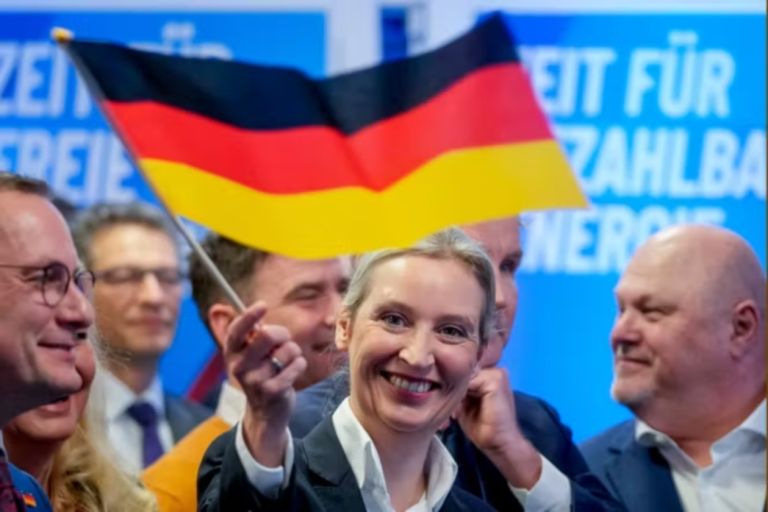
A new poll conducted for Germany’s public broadcaster ZDF (“Politbarometer”) shows that if elections were held this Sunday, the Alternative for Germany (AfD) would emerge as the leading party with 26%, unchanged from the previous survey.
The rest of the political landscape follows closely:
- CDU/CSU: 25% (-1)
- Greens: 14% (-1)
- SPD: 12% (-1)
- The Left (Die Linke): 11% (+1)
The results underline a fragmented political system in Germany, with traditional governing parties losing ground while the far-right AfD consolidates support amid public frustration.
Energy crisis fuels public anger
The survey highlights strong dissatisfaction with government performance, particularly on energy policy:
- 81% say the government is doing “too little” to address high energy prices
- Only 11% say it is doing “the right amount”
- Just 3% believe it is doing “too much”
In addition:
- 91% do not believe a 17-cent-per-litre fuel discount will reach consumers
- 73% say government reforms do not significantly solve national problems
- Around two-thirds rate coalition cooperation as “rather poor”
Crisis of trust in government
The findings reflect not only economic pressure but also a broader institutional trust deficit.
According to the Politbarometer summary:
“A majority of citizens are not convinced that government measures are effectively addressing the energy crisis or broader reform agenda.”
This sentiment is translating into political realignment, with voters shifting toward protest or anti-establishment parties, most notably the AfD.
Foreign policy skepticism: war and EU stability
The survey also reveals strong public resistance to military engagement:
- Over 93% oppose German military support for the United States in a hypothetical war against Iran
- 74% believe that a potential defeat of Viktor Orbán in Hungary would improve EU cooperation
These results suggest a population increasingly wary of military escalation and more focused on internal stability within the European Union.
Geopolitical analysis
The data reflects broader European political trends:
- Energy inflation → political punishment High energy costs continue to weaken incumbent governments across Europe, fueling voter volatility.
- Rise of anti-establishment parties The AfD’s growth is driven primarily by economic dissatisfaction rather than ideological consensus, reflecting protest voting dynamics.
- Coalition fatigue in Germany Public confidence in Germany’s three-party coalition is declining, with governance perceived as inefficient and fragmented.
- Strategic restraint in foreign policy The overwhelming rejection of military involvement signals strong societal resistance to external military commitments.
The poll does not merely show a potential electoral shift but signals a deeper structural change in German politics: rising polarization, declining trust in governing institutions, and increasing support for protest-oriented political forces.
Source: pagenews.gr
Διαβάστε όλες τις τελευταίες Ειδήσεις από την Ελλάδα και τον Κόσμο