TRUMP HITS “PAUSE” IN MIDDLE EAST WAR: 3-Week Ceasefire, No Rush on Iran Deal
 ΧΡΟΝΟΣ ΑΝΑΓΝΩΣΗΣ 3 '
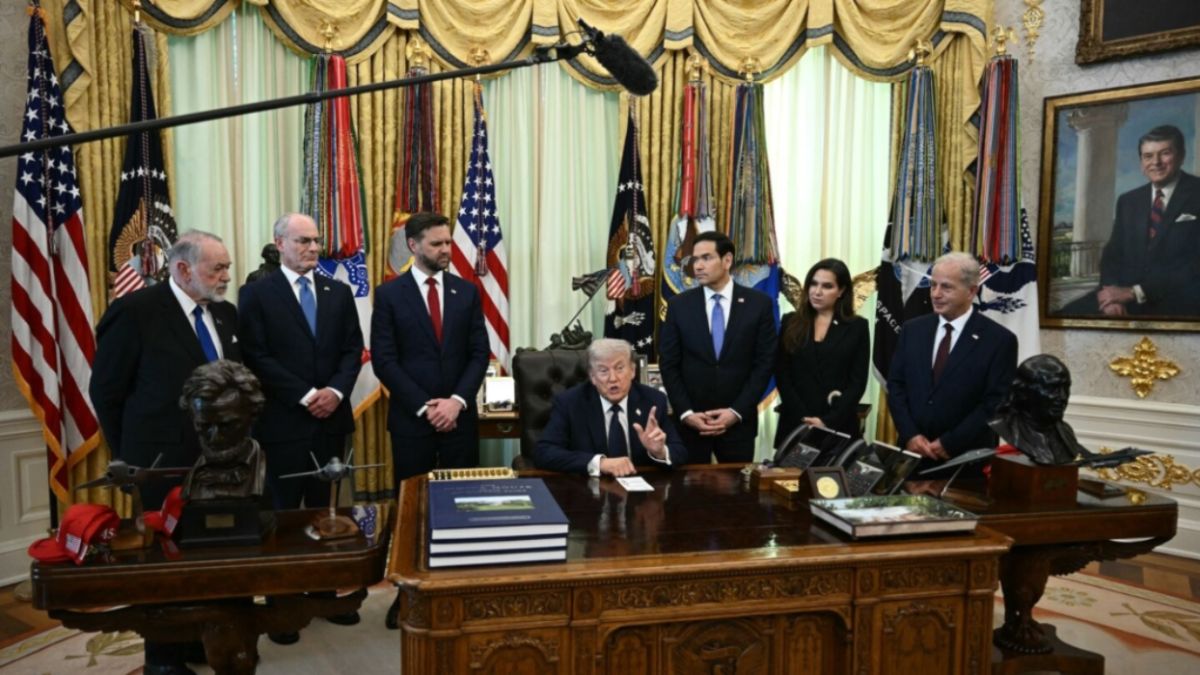
Πηγή Φωτογραφίας: Πηγή Φωτογραφίας: US Ambassador to Israel Mike Huckabee, Israel Ambassador to US Yechiel Leiter, US Vice President JD Vance, US Secretary of State Marco Rubio, Lebanon Ambassador to the US Nada Hamadeh and US Ambassador to Lebanon Michel Issa listen as President Donald Trump speaks during a meeting at the White House in Washington on April 23, 2026. — Brendan SMIALOWSKI / AFP



Key Takeaways
- Donald Trump extends Israel–Lebanon ceasefire by 3 weeks, buying diplomatic time
- US aims for possible peace agreement by 2026
- Trump: “no rush” on Iran deal → long-game strategy
- Planned high-stakes meeting between Benjamin Netanyahu and Joseph Aoun
- Ceasefire remains fragile, with ongoing clashes involving Hezbollah
- US deploys 3 aircraft carriers (incl. USS George H. W. Bush) → strong deterrence signal
- Strait of Hormuz remains a critical flashpoint
- Marco Rubio: Trump’s involvement was decisive
- Nuclear option ruled out → focus on conventional power
- Overall: US pursuing a strategy of “controlled tension” to maximize leverage
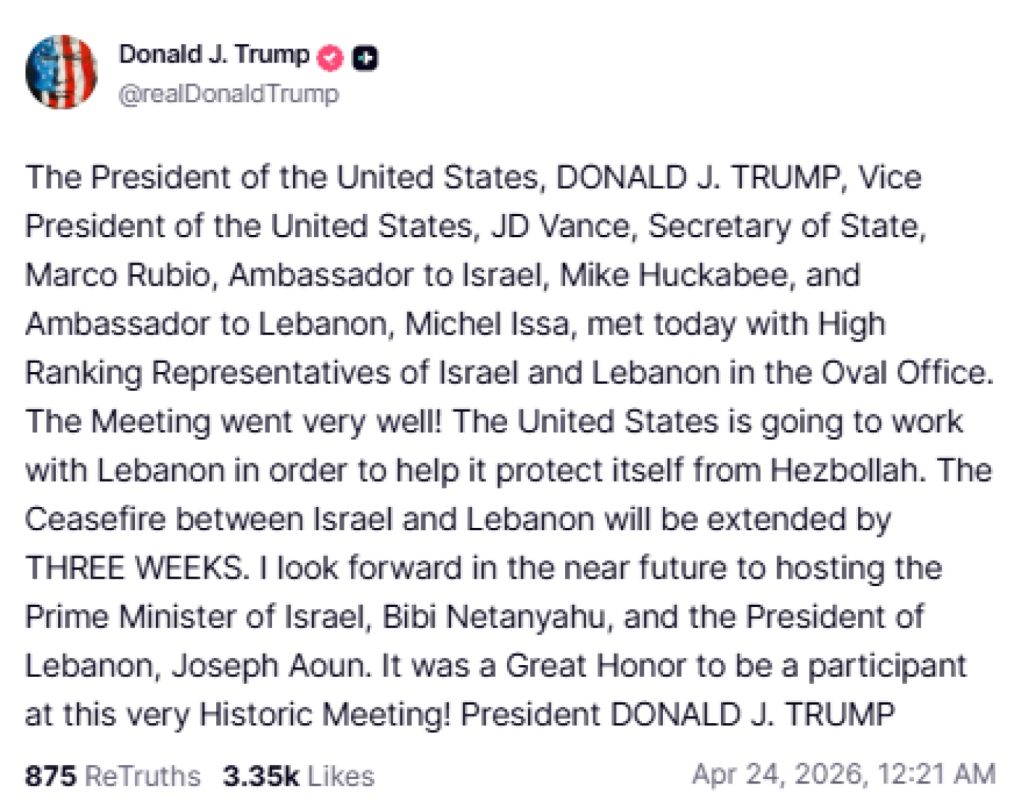
In a move that could reshape Middle Eastern dynamics, Donald Trump announced a three-week extension of the ceasefire between Israel and Lebanon, buying critical time for diplomacy.
The decision followed high-level talks at the White House, highlighting Trump’s direct personal involvement in mediation efforts.
“I’m in no rush” on Iran
At the same time, Trump signaled a deliberate approach toward Iran:
“I have all the time in the world… There will be no deal unless it is the right one.”
This reflects a broader strategy: not a quick diplomatic win, but maximum leverage over time.
He also ruled out nuclear escalation:
“There is no reason to use nuclear weapons.”
High-level diplomacy in motion
Behind the scenes, momentum is building:
- Benjamin Netanyahu expected in Washington
- Joseph Aoun to join upcoming talks
- هدف: potential peace framework by 2026
US Secretary of State Marco Rubio emphasized:
“The president’s personal involvement made this extension possible.”
A fragile ceasefire
Despite the extension, the situation remains volatile:
- Hezbollah continues rocket attacks
- Israel maintains military pressure in southern Lebanon
- Thousands killed, over a million displaced
Both sides accuse each other of violations, underscoring that this is more a pause in conflict than true peace.
US military posture: deterrence mode
Washington is reinforcing its presence:
- USS George H. W. Bush deploying to the region
- Alongside USS Gerald R. Ford and USS Abraham Lincoln
Three carrier strike groups signal strong deterrence, especially around the strategic Strait of Hormuz.
The bigger strategy
Trump’s approach appears built on three pillars:
- Diplomatic control via temporary ceasefires
- Military deterrence through overwhelming presence
- Pressure on Iran without rushing negotiations
This creates a model of controlled escalation, where Washington retains strategic flexibility.
The ceasefire extension is not just a pause—it is a stress test for regional stability.
Peace may be within reach—but it runs through a narrow and risky geopolitical corridor.
Source: pagenews.gr
Διαβάστε όλες τις τελευταίες Ειδήσεις από την Ελλάδα και τον Κόσμο