U.S. Explores a Ukraine-Russia “Winter De-Escalation”: Trump’s New Diplomatic Gamble
 ΧΡΟΝΟΣ ΑΝΑΓΝΩΣΗΣ 9 '

Πηγή Φωτογραφίας: AP Photo//U.S. Explores a Ukraine-Russia “Winter De-Escalation”: Trump’s New Diplomatic Gamble



The Trump administration appears to be testing a different approach to ending the war in Ukraine: if a comprehensive peace agreement remains out of reach, try first to prevent the coming winter from becoming another battlefield of strategic escalation.
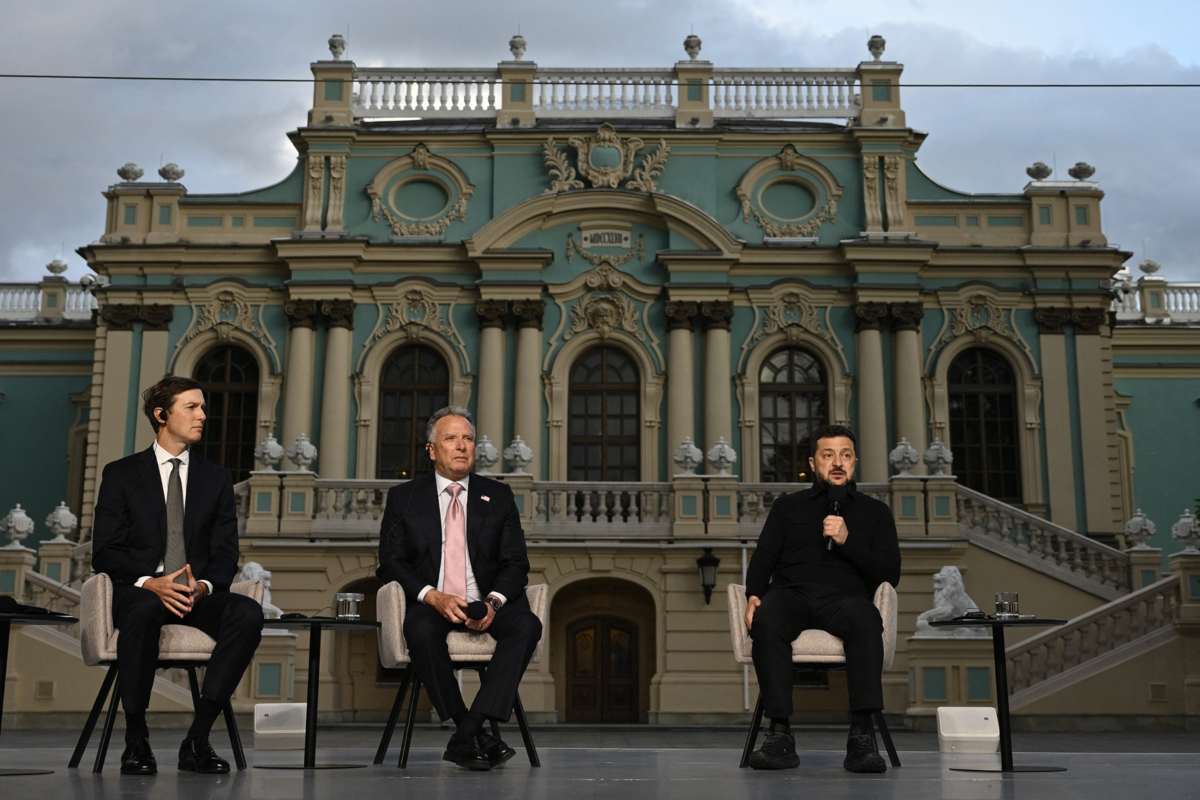
That is the key message emerging from Ukrainian President Volodymyr Zelensky’s interview with Axios following talks in Kyiv with U.S. envoys Steve Witkoff and Jared Kushner.
According to Zelensky, Washington is exploring whether Ukraine and Russia could agree to reciprocal de-escalation measures over the winter while simultaneously restarting negotiations toward a broader peace settlement.
No agreement has been reached.
But something potentially important is taking shape: a U.S.-driven diplomatic channel moving directly between Moscow and Kyiv.
Moscow to Kyiv: The Shuttle Diplomacy That Matters
The sequence of events is significant.
Witkoff and Kushner held roughly three hours of talks with Vladimir Putin in Moscow before traveling to Kyiv, where they met Zelensky and senior Ukrainian officials. European national security officials were also involved in consultations.
According to Zelensky, the American envoys brought back one central message from Moscow:
“The Russians are ready to negotiate.”
Kyiv remains deeply skeptical.
Zelensky believes Putin still sees another punishing winter as an opportunity to weaken Ukraine militarily, economically and psychologically.
That makes the next several weeks crucial.
Not Peace Yet — First, Take Winter Off the Battlefield
The most interesting element of the emerging American approach is that Washington does not appear to be treating a comprehensive ceasefire as the only possible first step.
Instead, it is examining limited, reciprocal arrangements around strategic infrastructure and economic lifelines.
Zelensky said discussions include ideas concerning energy facilities, electricity infrastructure, grain and oil and gas exports.
In other words, this would not necessarily amount to a conventional ceasefire across the entire front.
It could look more like a functional de-escalation pact: both sides restrain attacks on selected targets while broader negotiations continue.
That distinction matters.
A smaller agreement may be easier to negotiate than an immediate settlement of the war’s hardest questions — territory, security guarantees, sanctions and Ukraine’s long-term geopolitical alignment.
Putin’s Winter Weapon
The urgency is easy to understand.
Ukraine fears that Russia will once again try to turn cold weather into a strategic weapon by targeting power generation and transmission infrastructure.
Zelensky’s assessment is stark: Moscow believes winter can increase pressure on both Ukraine’s government and population.
For Kyiv, therefore, an agreement limiting attacks against energy infrastructure could have enormous strategic value.
But Ukraine also has leverage.
Its ability to strike Russian energy infrastructure means Moscow has something of its own to protect.
This creates an unusual point of overlapping interest: Kyiv wants to protect its electricity system; Moscow wants to protect infrastructure connected to the energy revenues underpinning its economy.
That could provide Washington with the basis for a limited bargain.
Energy Is Becoming the Currency of Diplomacy
The potential negotiations underline how profoundly energy has become intertwined with the military conflict.
For Ukraine, electricity and heating are questions of national resilience.
For Russia, oil and gas remain central to state revenue and its capacity to sustain a prolonged war.
Zelensky described the logic directly:
“When they attacked our electricity, we reduced their ability to sell oil and gas.”
That creates the outline of a possible exchange.
Russia reduces attacks on Ukrainian energy infrastructure.
Ukraine restrains some attacks on Russian energy assets.
The United States attempts to turn that limited understanding into a foundation for wider negotiations.
It would be fragile, reversible and extremely difficult to verify.
But it would also represent something that has repeatedly proved elusive throughout the war: a mutually valuable reason not to escalate.
Washington’s Second Track: Help Ukraine Survive the Winter
The diplomatic initiative is only one side of the American strategy.
According to Zelensky, Washington is also supporting a separate winter package for Ukraine involving air-defense capabilities and energy assistance.
“It’s not only about missiles. It’s also about LNG and de-escalation steps,” Zelensky told Axios.
That combination is strategically important.
Washington appears to be pursuing diplomacy while simultaneously trying to strengthen Ukraine’s ability to withstand another Russian winter campaign.
The message is effectively twofold:
negotiate — but do not negotiate from collapse.
If Ukraine’s energy system is better protected and alternative energy supplies are available, Moscow’s ability to use winter hardship as negotiating leverage diminishes.
Zelensky’s Intriguing Calculation: Putin Needs Trump
There is another factor behind Kyiv’s belief that a diplomatic opening may exist.
Trump himself.
Zelensky argues that Putin currently has an incentive to preserve his relationship with the U.S. president rather than provoke a complete rupture with Washington.
“My feeling is that Putin needs Trump. He doesn’t want to upset him,” Zelensky said.
That assessment is impossible to prove from the outside, but it explains part of Kyiv’s strategic calculation.
If Trump believes he can deliver progress toward ending the war, Moscow must decide whether rejecting his diplomatic initiative carries political or economic costs.
That gives Washington potential leverage — particularly when combined with sanctions.
Trump’s Two Levers: Sanctions and Economics
The negotiations are therefore about much more than battlefield positions.
Economic pressure remains a central part of the equation.
Zelensky is pushing Washington to maintain or increase pressure on Moscow, arguing that restricting Russia’s access to revenue directly affects its capacity to finance the war.
“Putin needs money. Putin wants money to continue the war,” he said.
That points toward a possible Trump negotiating architecture:
pressure first, incentives later.
Sanctions and Ukrainian military pressure raise the cost of continuing the war.
Limited de-escalation provides the first potential off-ramp.
And broader economic normalization could eventually become part of the bargaining process — but only if meaningful progress toward ending the conflict occurs.
September and October: The Window Before Winter
Zelensky believes the diplomatic clock is already ticking.
His argument is that September and October provide a narrow opportunity to establish dialogue before winter conditions deepen the military and humanitarian confrontation.
“We have this September and October to find any way to talk. Without dialogue, we will not have a result,” he told Axios.
That makes the coming weeks potentially decisive.
If Washington can convert shuttle diplomacy into even a narrow agreement over energy and infrastructure, it could establish a precedent for negotiating other parts of the conflict.
If it fails, both sides could enter winter preparing instead for another cycle of attacks and retaliation.
The Bigger Trump Gamble
There is a broader strategic logic behind the American effort.
Peace negotiations often fail when governments try to solve every disputed issue simultaneously.
The territorial question remains extraordinarily difficult.
Ukraine wants credible security guarantees.
Russia has its own maximalist demands.
Sanctions remain deeply contentious.
And neither side trusts the other.
A limited winter arrangement offers a different sequence:
de-escalation first, confidence-building second, comprehensive bargaining later.
It is not a peace plan in itself.
It is an attempt to construct the conditions under which a peace negotiation might become possible.
The Risk: Previous Energy Understandings Have Failed
There is every reason for caution.
Previous efforts to restrain attacks against energy infrastructure have struggled to hold, with both sides accusing the other of violations.
There is also no public indication that Putin has accepted the specific arrangement currently being explored.
And a limited agreement would leave the central battlefield confrontation intact.
So describing what Washington is discussing as an agreed “winter ceasefire” would go too far.
It is, for now, an exploratory framework for winter de-escalation.
That distinction is essential.
Not Peace — But Potentially the First Rung of the Ladder
The significance of the initiative lies precisely in its limited ambition.
Washington may be concluding that it cannot begin by solving the entire Russia-Ukraine war.
Instead, it can try to identify areas where Moscow and Kyiv have something tangible to gain from restraint.
Ukraine wants its lights and heating to remain on.
Russia wants its energy infrastructure and export revenues protected.
Trump wants movement toward a negotiated settlement.
Those interests are not identical. But for perhaps the first time in this phase of the war, they may overlap enough to create a negotiable space.
If that space can be turned into an agreement, it will not mean peace has arrived.
But it could mark the beginning of something strategically important: a transition from unrestricted escalation toward negotiated limits on the war.
And that is why September and October may ultimately matter more than the winter itself.
Source: pagenews.gr
Διαβάστε όλες τις τελευταίες Ειδήσεις από την Ελλάδα και τον Κόσμο