Trump’s Diesel Crisis Fuels Ukraine Peace Push as Witkoff and Kushner Enter High-Stakes Talks
 ΧΡΟΝΟΣ ΑΝΑΓΝΩΣΗΣ 16 '
Πηγή Φωτογραφίας: AP Photo//Trump’s Diesel Crisis Fuels Ukraine Peace Push as Witkoff and Kushner Enter High-Stakes Talks



A new diplomatic initiative over the war in Ukraine is unfolding against an increasingly urgent political and economic backdrop in Washington, where rising fuel prices are putting pressure on President Donald Trump just two weeks before the November 3 midterm elections.
According to reporting by the Financial Times, the White House is seeking to revive negotiations involving Ukraine and Russia while simultaneously addressing an energy crisis that has pushed American diesel prices sharply higher.
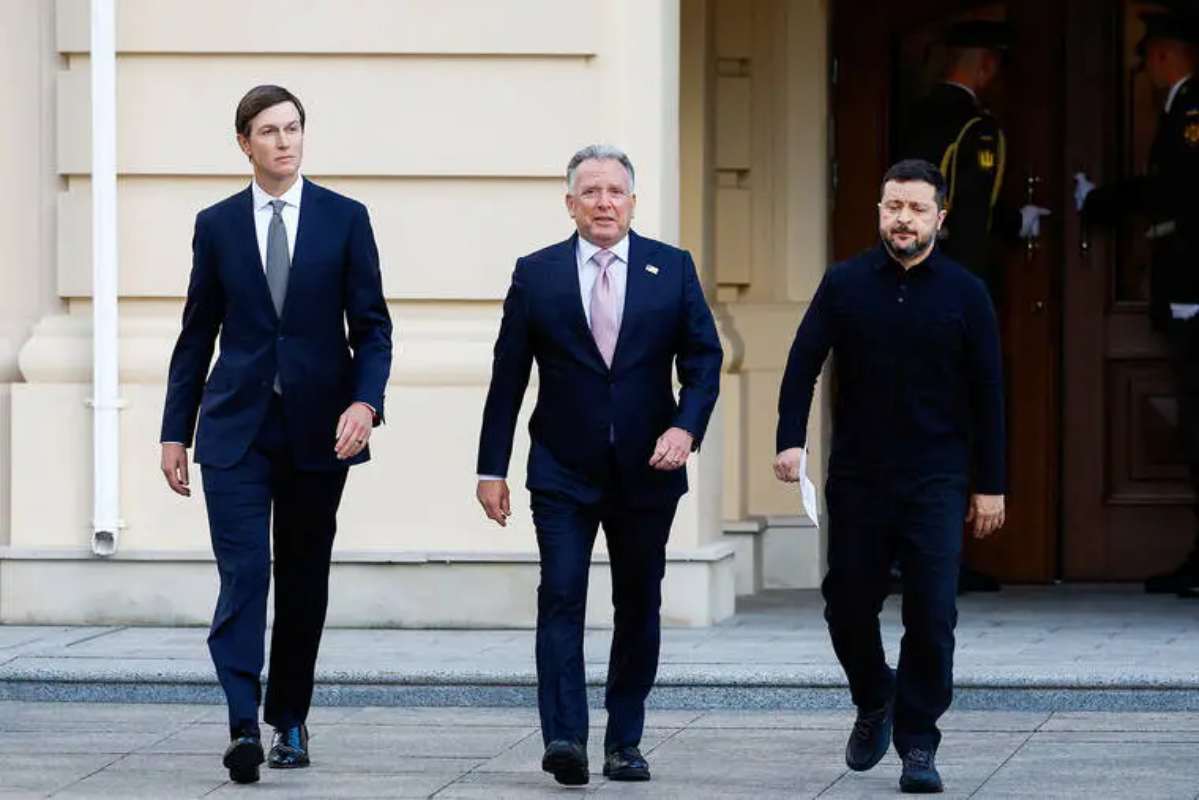
Trump’s envoys, Steve Witkoff and Jared Kushner, are participating in a renewed round of diplomatic engagement involving Ukrainian President Volodymyr Zelenskyy and European leaders.
The immediate focus is the possibility of restarting meaningful peace negotiations.
But the underlying stakes extend well beyond the battlefield.
Russian oil exports, Ukrainian strikes on refineries, US sanctions, European energy security and American electoral politics have become increasingly interconnected.
For Washington, bringing down fuel prices has become an urgent domestic priority.
For Kyiv, maintaining pressure on Russia remains essential to its military strategy.
And for European governments, any relaxation of sanctions against Moscow raises difficult questions about the future of Western unity.
Oslo Becomes the New Diplomatic Center
Norway has emerged as a key venue for the latest diplomatic initiative.
The Norwegian government confirmed that US special envoy Steve Witkoff would participate in discussions with Zelenskyy, Finnish President Alexander Stubb and Norwegian Prime Minister Jonas Gahr Støre.
Jared Kushner, Trump’s son-in-law and another influential figure in the administration’s diplomatic efforts, is expected to participate remotely.
The composition of the meeting highlights the attempt to rebuild coordination between Washington, Kyiv and European governments.
Norway has indicated that the participation of American representatives was requested by Ukraine.
The objective is to restore momentum to negotiations at a time when disagreements between the United States and Ukraine have become increasingly public.
For Zelenskyy, the central challenge is to ensure that any diplomatic initiative preserves Ukraine’s sovereignty and provides credible security guarantees.
For the Trump administration, the priority is to establish a framework capable of bringing Moscow back into substantive negotiations.
Whether these objectives can be reconciled remains uncertain.
A Possible Moscow Visit and the Putin Factor
The diplomatic initiative may extend beyond Oslo.
Witkoff is reportedly considering a visit to Russia, where he hopes to engage directly with President Vladimir Putin.
The proposed sequence would involve discussions with Ukraine and European partners before presenting potential arrangements to Moscow.
Such an approach could help establish common negotiating principles among Ukraine’s supporters.
However, the obstacles remain substantial.
Kyiv insists that its territorial sovereignty and future security must be protected.
Moscow continues to advance demands involving occupied Ukrainian territory and the broader European security architecture.
These disagreements have repeatedly prevented previous diplomatic initiatives from producing a comprehensive settlement.
The latest round of talks therefore represents an attempt to reopen negotiations rather than evidence that an agreement is imminent.
Diesel at $6.32: The Energy Crisis Facing Trump
The energy market has become one of the most important factors shaping Washington’s diplomatic calculations.
According to AAA figures cited by the Financial Times, average US gasoline prices reached approximately $4.29 per gallon on Monday, representing an increase of more than 50% since the beginning of the year.
Diesel prices have risen even more dramatically.
At approximately $6.32 per gallon, diesel has increased by nearly 80%.
The consequences extend across the American economy.
Higher diesel prices raise operating costs for trucking companies, agricultural producers, construction businesses and industrial supply chains.
Transportation costs can eventually feed into consumer prices, increasing pressure on household budgets.
Farmers face higher expenses for machinery, harvesting and transporting agricultural products.
Businesses dependent on road freight confront higher distribution costs.
For an administration preparing for congressional elections, these developments create an immediate political challenge.
The White House is seeking ways to stabilize energy markets before the economic consequences become more deeply entrenched.
The November Midterms Change Washington’s Calculations
The November 3 elections are taking place amid growing concerns about living costs and the direction of the US economy.
Energy prices have become a prominent issue in the political debate.
For Trump, a sustained rise in gasoline and diesel prices risks undermining his administration’s economic messaging.
The president has therefore placed increasing emphasis on measures intended to expand fuel availability and reduce market pressure.
This helps explain why Ukrainian attacks on Russian oil infrastructure have become a source of disagreement between Washington and Kyiv.
The administration believes that disruptions to Russian refining capacity can contribute to volatility in international fuel markets.
Ukraine, however, views attacks on energy infrastructure supporting Russia’s war economy as a legitimate element of its military campaign, subject to the laws of armed conflict.
The two governments are approaching the issue from different strategic perspectives.
Washington is increasingly focused on energy prices and diplomatic negotiations.
Kyiv remains focused on weakening Russia’s capacity to sustain its invasion.
Russian Diesel Returns to the Negotiating Table
One of the most controversial elements of Trump’s approach involves easing restrictions on Russian diesel.
The administration hopes that allowing additional Russian fuel supplies into international markets could help reduce prices.
Trump has also declined to activate additional sanctions targeting Russia’s war economy, despite congressional pressure for tougher measures.
The president has argued that imposing new economic penalties could discourage Moscow from participating in peace negotiations.
This approach combines two objectives: stabilizing energy markets and maintaining a diplomatic channel with Putin.
Yet the strategy has generated criticism.
Opponents argue that relaxing economic pressure without obtaining meaningful concessions could provide Moscow with additional financial resources while the war continues.
European governments have also expressed concern about policies that could weaken the effectiveness of sanctions.
The central question is whether limited sanctions relief can produce measurable diplomatic progress without undermining existing pressure on Russia.
Why More Russian Diesel May Not Solve the Problem
The economic effectiveness of easing sanctions is also uncertain.
Energy analysts have warned that Russia’s ability to increase refined fuel exports may be constrained by damage to its refining infrastructure.
Ukrainian strikes have targeted facilities involved in producing and distributing petroleum products.
Even if trade restrictions are relaxed, damaged facilities cannot immediately return to full production.
Refining capacity, transportation availability and domestic Russian fuel requirements all influence the volume that can reach international markets.
Consequently, allowing additional Russian diesel exports does not necessarily guarantee a substantial increase in global supply.
There is an important distinction between removing legal restrictions on trade and ensuring that additional physical supplies are available.
For the Trump administration, this uncertainty complicates the attempt to achieve a rapid reduction in American fuel prices.
Zelenskyy Says Ukraine Observed a Three-Day Pause
Zelenskyy has presented a different account of the recent energy negotiations.
In remarks reported by the Financial Times, the Ukrainian president said Kyiv had suspended attacks on Russian energy infrastructure for three days in response to an American request for an energy ceasefire.
According to Zelenskyy, Russia continued striking Ukrainian energy facilities during that period.
The Ukrainian government subsequently resumed its operations.
Kyiv argues that a unilateral halt to attacks cannot constitute a sustainable arrangement if Russia continues targeting Ukrainian infrastructure.
The dispute illustrates one of the fundamental difficulties surrounding a possible energy ceasefire.
Both sides would need to agree on the scope of prohibited attacks, mechanisms for monitoring compliance and consequences for violations.
Without credible verification and reciprocal commitments, any limited pause could prove difficult to maintain.
Trump Escalates His Criticism of Zelenskyy
The disagreement has also become increasingly personal at the political level.
Speaking before departing the White House for campaign activities in Kansas, Trump criticized Zelenskyy’s approach to negotiations.
The president suggested that the Ukrainian leader was obstructing efforts to end the war.
He went further by questioning whether Zelenskyy should continue representing Ukraine in peace negotiations.
Trump’s remarks marked a significant escalation in the public disagreement between the two governments.
The United States has no authority to determine who represents Ukraine in negotiations.
Nevertheless, the statement demonstrated the extent of Washington’s frustration with Kyiv’s resistance to elements of the American diplomatic approach.
For Ukraine, such rhetoric creates additional uncertainty about the reliability of its most important military partner.
Patriot Missiles and the Growing Military Dispute
Energy policy is not the only source of tension.
Zelenskyy has also raised concerns about delays involving American-made Patriot interceptor missiles.
European governments have financed purchases of critical US air-defense equipment intended for Ukraine.
However, the transfer of certain systems and munitions still requires American authorization.
The Ukrainian president has accused Washington of deliberately delaying deliveries.
That allegation remains Ukraine’s position; the political motives behind the reported delays have not been independently established.
The issue is particularly sensitive because Patriot systems provide essential protection against ballistic missile attacks.
Russia continues targeting Ukrainian cities and energy infrastructure, increasing the importance of maintaining adequate interceptor stocks.
Delays can place additional pressure on Ukraine’s air-defense network, especially when multiple waves of missiles and drones are launched against critical facilities.
The dispute also exposes Europe’s dependence on American weapons manufacturing and export approvals.
Even when European countries provide the financing, they cannot necessarily guarantee the timing of deliveries.
Starlink, Starshield and Ukraine’s Technological Vulnerability
Another area of disagreement involves satellite communications.
Ukraine has expressed concerns about restrictions affecting services associated with SpaceX’s Starlink and Starshield systems.
These technologies support communications and other military functions.
Reports of disruptions have raised questions about the vulnerability of military operations that depend on externally controlled digital infrastructure.
Zelenskyy has discussed these concerns with US Secretary of State Marco Rubio, alongside issues involving missile deliveries and early warnings of Russian attacks.
The controversy reflects a broader transformation in modern warfare.
Military capability now depends not only on conventional weapons but also on satellite networks, software systems, intelligence-sharing arrangements and secure communications.
When these capabilities are provided by foreign governments or private companies, questions arise over operational independence and control.
For Ukraine, securing reliable access to these systems has become an important part of its broader defense strategy.
Republican Lawmakers Challenge the White House
Trump’s approach to Russia has also generated criticism within his own party.
Republican Senator Thom Tillis condemned the administration’s willingness to ease pressure on Moscow.
He argued that reducing sanctions against Russia while its invasion continues risks rewarding aggression.
Republican Representative Brian Fitzpatrick separately raised concerns about reported interference with Ukraine’s access to Starshield capabilities.
He called for accountability and emphasized the importance of continued American support for Ukraine.
These interventions demonstrate that the administration’s Russia policy remains contested within Republican ranks.
Although Trump continues to shape the party’s overall political direction, disagreements persist over sanctions, military assistance and the appropriate conditions for negotiations with Moscow.
The debate could become increasingly significant as Congress considers future measures affecting Russia and Ukraine.
Europe Faces a Strategic Energy Dilemma
European governments are closely watching the American diplomatic initiative.
Since Russia’s full-scale invasion of Ukraine, the European Union and its partners have sought to reduce dependence on Russian energy and restrict Moscow’s access to international financial resources.
The strategy has involved sanctions, diversification of energy supplies and investment in alternative infrastructure.
Trump’s willingness to ease restrictions on Russian diesel creates a potential divergence between American and European priorities.
Washington is emphasizing the immediate need to reduce fuel prices.
Many European governments continue to prioritize maintaining economic pressure on Russia until meaningful progress is achieved toward ending the war.
The disagreement has broader implications for transatlantic coordination.
Energy policy is no longer simply a question of supply and demand.
It has become a central instrument of economic diplomacy and strategic competition.
The Geoeconomic Reality: Energy Markets Shape Diplomacy
The latest developments demonstrate how deeply energy markets have become intertwined with international security.
Oil and diesel prices influence inflation, transportation costs, industrial production and household spending.
They also shape political debates and government priorities.
In the United States, the approaching midterm elections have increased the political importance of fuel prices.
In Ukraine, energy infrastructure has become both a critical civilian necessity and a major component of the broader wartime economy.
In Russia, petroleum exports remain an important source of state revenue.
For Europe, energy diversification and sanctions policy remain central to the effort to reduce strategic vulnerability.
These competing interests make any proposed energy ceasefire especially complicated.
An agreement would need to account for military realities, economic incentives and the humanitarian consequences of continued attacks.
What the Oslo Talks Must Address
The diplomatic discussions in Norway will test whether Washington and Kyiv can narrow their differences.
Three issues are particularly important.
First, whether the parties can develop a reciprocal arrangement limiting attacks on energy infrastructure.
Second, whether the United States can provide greater clarity regarding the delivery of critical military equipment and continued technological support for Ukraine.
Third, whether American, Ukrainian and European representatives can establish common negotiating principles before any renewed engagement with Moscow.
Progress on these questions would not automatically produce a comprehensive peace agreement.
But it could help reduce uncertainty and establish a more coherent diplomatic process.
Conversely, continued disagreements over military support and sanctions could complicate efforts to present a unified negotiating position.
The Political Stakes Before November 3
Trump is attempting to demonstrate progress on two politically important fronts.
The first is the economy, particularly the cost of fuel.
The second is foreign policy, where the administration is seeking a diplomatic breakthrough over Ukraine.
Yet the effort to pursue both objectives simultaneously has created difficult trade-offs.
Easing restrictions on Russian diesel could conflict with the goal of maintaining economic pressure on Moscow.
Pressuring Ukraine to halt attacks on Russian refineries could deepen disagreements with Kyiv.
And the continued disruption of global energy markets may limit how quickly American fuel prices can decline.
The administration must also navigate criticism from lawmakers who oppose reducing pressure on Russia.
The outcome of the diplomatic initiative will therefore depend on more than the willingness of leaders to attend another round of talks.
It will depend on whether the parties can reconcile fundamentally different security and economic priorities.
Ukraine, Russia and the US Election: An Increasingly Complex Equation
The renewed diplomatic push highlights a central reality of the war: decisions taken in Washington are increasingly shaped by both international security concerns and domestic economic pressures.
For Ukraine, the immediate priority remains defending its territory and protecting civilians against continued Russian attacks.
For Russia, negotiations take place alongside ongoing military operations and economic pressure.
For European governments, the challenge is to preserve support for Ukraine while managing energy security and maintaining coordination with the United States.
For Trump, the approaching elections have added urgency to efforts to stabilize fuel markets and demonstrate diplomatic progress.
The central question is whether Washington can pursue lower energy prices and a negotiated settlement without weakening Ukraine’s defensive position or reducing the pressure needed to secure meaningful Russian commitments. As the November 3 elections approach, the intersection of energy markets, military strategy and diplomacy is becoming one of the defining challenges of US foreign policy.
Source: pagenews.gr
Διαβάστε όλες τις τελευταίες Ειδήσεις από την Ελλάδα και τον Κόσμο